

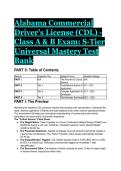
Alabama Commercial
Driver’s License (CDL) -
Class A & B Exam: S-Tier
Universal Mastery Test
Bank
PART 0: Table of Contents
Section Cognitive Tier Subject Focus Question Range
PART I N/A The Preview & Critical N/A
Axioms
PART II Tier 1 Foundational Syntax & Q1 – Q10
Application
PART II Tier 2 Complex Application & Q11 – Q20
Simulation
PART II Tier 3 Grandmaster Synthesis Q21 – Q30
PART I: The Preview
Mastering the Alabama CDL protocols requires transcending rote memorization; it demands the
rapid, flawless application of federal and state statutory limits under extreme operational stress.
This assessment will forge your conceptual understanding of commercial motor vehicle
parameters into razor-sharp, real-world competence.
The "Critical Axioms" Cheat Sheet:
● The Weight Matrix: Class A applies to a Gross Combination Weight Rating (GCWR) over
26,000 lbs towing a unit over 10,000 lbs. Interstate maximum Gross Vehicle Weight
(GVW) is 80,000 lbs.
● The Pneumatic Baselines: Applied air leakage must not exceed 3 psi/minute (single) or
4 psi/minute (combination). The Tractor Protection Valve closes automatically between
20–45 psi.
● The Disqualification Triggers: CDL holders operate under a 0.04% BAC limit in a CMV
(0.02% in a school bus). Refusing a chemical test triggers an immediate 1-year
disqualification.
● The Securement Ratio: One tiedown is strictly required for every 10 feet of cargo length,
or fraction thereof, beyond the initial 5 feet.
,PART II: THE ELITE TEST BANK
Tier 1: Foundational Syntax & Application
The foundational syntax of commercial driving relies heavily on understanding the absolute
mechanical and legal thresholds established by the Federal Motor Carrier Safety Administration
(FMCSA) and enforced by the Alabama Law Enforcement Agency (ALEA). The foundational
rules cover vehicle weight classifications, foundational pneumatic systems, and the strict codes
that restrict a commercial driver's license based on their testing environment. A commercial
driver must rapidly identify which class of vehicle they are legally permitted to operate, and what
mechanical limitations are placed upon them via restriction codes. The table below outlines the
primary restrictions that limit a CDL holder's operational capacity.
CDL Restriction Code Operational Limitation Application / Trigger
Restriction E No Manual Transmission CMV Applicant tested in an
automatic transmission vehicle.
Restriction L No Air Brake Equipped CMV Applicant failed air brake test or
tested in a hydraulic rig.
Restriction O No Tractor-Trailer CMV Applicant tested in a rig with a
pintle hook / non-fifth wheel.
Restriction Z No Full Air Brake Equipped Applicant tested in an
CMV air-over-hydraulic system.
Restriction M/N Passenger Class Downgrade Applicant tested in a
lower-class passenger vehicle.
Understanding these basic parameters ensures that a driver does not inadvertently violate
federal law by operating outside their tested competency.
Q1: A driver is operating a single-unit box truck with a Gross Vehicle Weight Rating (GVWR) of
29,500 lbs and is not towing any additional vehicles. Based on the principles of Alabama
commercial vehicle classifications, which licensing action is the MOST ACCURATE? A) The
driver must hold a Class A CDL due to the vehicle exceeding the 26,000 lb threshold. B) The
driver must hold a Class C CDL because no trailing unit is attached. C) The driver must hold a
Class B CDL, as the single vehicle exceeds 26,000 lbs GVWR. D) The driver operates under a
standard Class D license if the vehicle is strictly intrastate.
● The Answer: C (The driver must hold a Class B CDL, as the single vehicle exceeds
26,000 lbs GVWR.)
● Distractor Analysis:
○ A is incorrect: A Class A CDL is only triggered when towing a vehicle with a GVWR
over 10,000 lbs, which is absent here.
○ B is incorrect: Class C is reserved for vehicles under 26,001 lbs that are placarded
for hazmat or designed for 16+ passengers.
○ D is incorrect: Intrastate operation does not negate the requirement for a CDL when
the GVWR statutory weight threshold is breached; it only restricts interstate
commerce.
The Mentor's Analysis: Understanding licensing syntax is non-negotiable. When facing vehicle
classification parameters, the immediate priority is evaluating the power unit's weight, followed
by the towed unit's weight. By utilizing the GVWR threshold, you bypass the common trap of
confusing trailing weights with single-unit capacities. Professional/Academic Intuition: The
, 26,001 lb mark is the absolute regulatory floor for Class B; the 10,001 lb trailing unit marks the
pivot to Class A.
Q2: During the Air Warning Device(s) Test of a pre-trip inspection, the driver begins fanning off
the air pressure by applying and releasing the foot brake. According to the Alabama CDL
guidelines, at what pressure MUST the low air warning devices activate? A) Immediately upon
dropping below 80 psi. B) Exactly when the governor cut-out pressure is reached. C) Before the
air pressure drops below 55 psi or the manufacturer's specified level. D) When the system drops
below 20 psi.
● The Answer: C (Before the air pressure drops below 55 psi or the manufacturer's
specified level.)
● Distractor Analysis:
○ A is incorrect: 80 psi is an arbitrary number well above the regulatory threshold for
the low air warning.
○ B is incorrect: The governor cut-out (120-140 psi) stops the compressor from
building more air; it is fundamentally unrelated to low air warnings.
○ D is incorrect: 20-45 psi is the critical range for the Tractor Protection Valve and
spring brakes to physically engage, not the initial auditory/visual warning.
The Mentor's Analysis: Precision in pneumatic thresholds saves lives. When facing a loss of
system air, the immediate priority is driver notification before mechanical lockdown occurs. By
utilizing the 55 psi threshold, you bypass the common trap of conflating the warning alarm with
the automatic spring brake engagement. Professional/Academic Intuition: Warning
mechanisms must always precede automatic physical interventions; 55 psi is your warning,
20-45 psi is your lockdown.
Q3: A state trooper conducts a Level 1 inspection on a commercial combination vehicle. The
trooper measures the tread depth of the steer tires. What is the absolute minimum legal tread
depth allowed for this specific axle? A) 2/32 of an inch in every major groove. B) 4/32 of an inch
in every major groove. C) 4/32 of an inch, provided the tires are retreads. D) 6/32 of an inch
across the center tread.
● The Answer: B (4/32 of an inch in every major groove.)
● Distractor Analysis:
○ A is incorrect: 2/32 of an inch is the legal minimum for drive tires and trailer tires,
but fatally insufficient for steer tires.
○ C is incorrect: Recapped or retreaded tires are universally prohibited on the steer
axle of standard commercial vehicles.
○ D is incorrect: While some fleets proactively pull tires at 6/32 for casing
preservation, it is not the statutory minimum limit enforced by DOT.
The Mentor's Analysis: Steer tires control the directional velocity of 80,000 pounds of mass.
When facing tire inspections, the immediate priority is confirming front-axle integrity. By utilizing
the 4/32 statutory minimum, you bypass the common trap of applying trailer-axle tolerances to
the steer axle. Professional/Academic Intuition: Never compromise the steering matrix; 4/32
front, 2/32 rear, and zero recaps on the steer.
Q4: A driver completes the CDL road skills test successfully but performs the examination in a
commercial motor vehicle equipped with an automatic transmission. Which restriction will be
IMMEDIATELY placed on their CDL? A) Restriction L B) Restriction O C) Restriction E D)
Restriction M
● The Answer: C (Restriction E)
● Distractor Analysis:
○ A is incorrect: Restriction L prohibits the operation of a CMV equipped with full air
Driver’s License (CDL) -
Class A & B Exam: S-Tier
Universal Mastery Test
Bank
PART 0: Table of Contents
Section Cognitive Tier Subject Focus Question Range
PART I N/A The Preview & Critical N/A
Axioms
PART II Tier 1 Foundational Syntax & Q1 – Q10
Application
PART II Tier 2 Complex Application & Q11 – Q20
Simulation
PART II Tier 3 Grandmaster Synthesis Q21 – Q30
PART I: The Preview
Mastering the Alabama CDL protocols requires transcending rote memorization; it demands the
rapid, flawless application of federal and state statutory limits under extreme operational stress.
This assessment will forge your conceptual understanding of commercial motor vehicle
parameters into razor-sharp, real-world competence.
The "Critical Axioms" Cheat Sheet:
● The Weight Matrix: Class A applies to a Gross Combination Weight Rating (GCWR) over
26,000 lbs towing a unit over 10,000 lbs. Interstate maximum Gross Vehicle Weight
(GVW) is 80,000 lbs.
● The Pneumatic Baselines: Applied air leakage must not exceed 3 psi/minute (single) or
4 psi/minute (combination). The Tractor Protection Valve closes automatically between
20–45 psi.
● The Disqualification Triggers: CDL holders operate under a 0.04% BAC limit in a CMV
(0.02% in a school bus). Refusing a chemical test triggers an immediate 1-year
disqualification.
● The Securement Ratio: One tiedown is strictly required for every 10 feet of cargo length,
or fraction thereof, beyond the initial 5 feet.
,PART II: THE ELITE TEST BANK
Tier 1: Foundational Syntax & Application
The foundational syntax of commercial driving relies heavily on understanding the absolute
mechanical and legal thresholds established by the Federal Motor Carrier Safety Administration
(FMCSA) and enforced by the Alabama Law Enforcement Agency (ALEA). The foundational
rules cover vehicle weight classifications, foundational pneumatic systems, and the strict codes
that restrict a commercial driver's license based on their testing environment. A commercial
driver must rapidly identify which class of vehicle they are legally permitted to operate, and what
mechanical limitations are placed upon them via restriction codes. The table below outlines the
primary restrictions that limit a CDL holder's operational capacity.
CDL Restriction Code Operational Limitation Application / Trigger
Restriction E No Manual Transmission CMV Applicant tested in an
automatic transmission vehicle.
Restriction L No Air Brake Equipped CMV Applicant failed air brake test or
tested in a hydraulic rig.
Restriction O No Tractor-Trailer CMV Applicant tested in a rig with a
pintle hook / non-fifth wheel.
Restriction Z No Full Air Brake Equipped Applicant tested in an
CMV air-over-hydraulic system.
Restriction M/N Passenger Class Downgrade Applicant tested in a
lower-class passenger vehicle.
Understanding these basic parameters ensures that a driver does not inadvertently violate
federal law by operating outside their tested competency.
Q1: A driver is operating a single-unit box truck with a Gross Vehicle Weight Rating (GVWR) of
29,500 lbs and is not towing any additional vehicles. Based on the principles of Alabama
commercial vehicle classifications, which licensing action is the MOST ACCURATE? A) The
driver must hold a Class A CDL due to the vehicle exceeding the 26,000 lb threshold. B) The
driver must hold a Class C CDL because no trailing unit is attached. C) The driver must hold a
Class B CDL, as the single vehicle exceeds 26,000 lbs GVWR. D) The driver operates under a
standard Class D license if the vehicle is strictly intrastate.
● The Answer: C (The driver must hold a Class B CDL, as the single vehicle exceeds
26,000 lbs GVWR.)
● Distractor Analysis:
○ A is incorrect: A Class A CDL is only triggered when towing a vehicle with a GVWR
over 10,000 lbs, which is absent here.
○ B is incorrect: Class C is reserved for vehicles under 26,001 lbs that are placarded
for hazmat or designed for 16+ passengers.
○ D is incorrect: Intrastate operation does not negate the requirement for a CDL when
the GVWR statutory weight threshold is breached; it only restricts interstate
commerce.
The Mentor's Analysis: Understanding licensing syntax is non-negotiable. When facing vehicle
classification parameters, the immediate priority is evaluating the power unit's weight, followed
by the towed unit's weight. By utilizing the GVWR threshold, you bypass the common trap of
confusing trailing weights with single-unit capacities. Professional/Academic Intuition: The
, 26,001 lb mark is the absolute regulatory floor for Class B; the 10,001 lb trailing unit marks the
pivot to Class A.
Q2: During the Air Warning Device(s) Test of a pre-trip inspection, the driver begins fanning off
the air pressure by applying and releasing the foot brake. According to the Alabama CDL
guidelines, at what pressure MUST the low air warning devices activate? A) Immediately upon
dropping below 80 psi. B) Exactly when the governor cut-out pressure is reached. C) Before the
air pressure drops below 55 psi or the manufacturer's specified level. D) When the system drops
below 20 psi.
● The Answer: C (Before the air pressure drops below 55 psi or the manufacturer's
specified level.)
● Distractor Analysis:
○ A is incorrect: 80 psi is an arbitrary number well above the regulatory threshold for
the low air warning.
○ B is incorrect: The governor cut-out (120-140 psi) stops the compressor from
building more air; it is fundamentally unrelated to low air warnings.
○ D is incorrect: 20-45 psi is the critical range for the Tractor Protection Valve and
spring brakes to physically engage, not the initial auditory/visual warning.
The Mentor's Analysis: Precision in pneumatic thresholds saves lives. When facing a loss of
system air, the immediate priority is driver notification before mechanical lockdown occurs. By
utilizing the 55 psi threshold, you bypass the common trap of conflating the warning alarm with
the automatic spring brake engagement. Professional/Academic Intuition: Warning
mechanisms must always precede automatic physical interventions; 55 psi is your warning,
20-45 psi is your lockdown.
Q3: A state trooper conducts a Level 1 inspection on a commercial combination vehicle. The
trooper measures the tread depth of the steer tires. What is the absolute minimum legal tread
depth allowed for this specific axle? A) 2/32 of an inch in every major groove. B) 4/32 of an inch
in every major groove. C) 4/32 of an inch, provided the tires are retreads. D) 6/32 of an inch
across the center tread.
● The Answer: B (4/32 of an inch in every major groove.)
● Distractor Analysis:
○ A is incorrect: 2/32 of an inch is the legal minimum for drive tires and trailer tires,
but fatally insufficient for steer tires.
○ C is incorrect: Recapped or retreaded tires are universally prohibited on the steer
axle of standard commercial vehicles.
○ D is incorrect: While some fleets proactively pull tires at 6/32 for casing
preservation, it is not the statutory minimum limit enforced by DOT.
The Mentor's Analysis: Steer tires control the directional velocity of 80,000 pounds of mass.
When facing tire inspections, the immediate priority is confirming front-axle integrity. By utilizing
the 4/32 statutory minimum, you bypass the common trap of applying trailer-axle tolerances to
the steer axle. Professional/Academic Intuition: Never compromise the steering matrix; 4/32
front, 2/32 rear, and zero recaps on the steer.
Q4: A driver completes the CDL road skills test successfully but performs the examination in a
commercial motor vehicle equipped with an automatic transmission. Which restriction will be
IMMEDIATELY placed on their CDL? A) Restriction L B) Restriction O C) Restriction E D)
Restriction M
● The Answer: C (Restriction E)
● Distractor Analysis:
○ A is incorrect: Restriction L prohibits the operation of a CMV equipped with full air


