

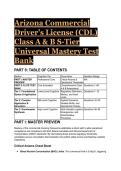
Arizona Commercial
Driver’s License (CDL)
Class A & B S-Tier
Universal Mastery Test
Bank
PART 0: TABLE OF CONTENTS
Section Cognitive Tier Focus Area Question Range
PART I: MASTER Professional Core Critical Axioms & N/A
PREVIEW Operational Thresholds
PART II: ELITE TEST Core Evaluation Comprehensive Class Questions 1–60
BANK A & B Assessment
Tier 1: Foundational Lower-Level Cognitive Regulatory Definitions, Questions 1–15
Syntax & Application Metrics, and Hard
Limits
Tier 2: Complex Mid-Level Cognitive Applied Scenarios, Questions 16–35
Application & Variable Shifts, and
Simulation Operational Choices
Tier 3: Grandmaster High-Level Cognitive Multi-Variable Logistics, Questions 36–60
Synthesis Emergencies, and
Administrative
Processes
PART I: MASTER PREVIEW
Mastery of this commercial licensing framework establishes a direct path to elite operational
competence and compliance with both federal mandates and Arizona Department of
Transportation (ADOT) standards. By internalizing these precise regulatory thresholds,
candidates secure a foundation that translates into perfect safety scores and flawless roadside
inspections.
Critical Axioms Cheat Sheet
● Blood Alcohol Concentration (BAC) Limits: The commercial limit is 0.04g\%, triggering
, a mandatory 1-year Commercial Driver's License (CDL) disqualification (3 years if hauling
placarded hazardous materials). Standard adult personal vehicle limit is 0.08g\%, but any
DUI conviction in any vehicle triggers a 1-year CDL disqualification.
● Air Brake Leakage Rate Thresholds:
○ Static Test (brakes released): Single vehicles must not lose more than 2\text{ psi}
per minute; combination vehicles must not lose more than 3\text{ psi} per minute.
○ Applied Test (service brake held): Single vehicles must not lose more than 3\text{
psi} per minute; combination vehicles must not lose more than 4\text{ psi} per
minute; triple combinations must not lose more than 6\text{ psi} per minute.
● The Federal Bridge Formula: Weight limits are determined by W = 500 \left[
\frac{LN}{N-1} + 12N + 36 \right] where W is maximum weight, L is distance between
outer axles, and N is number of axles. Maximum single axle is 20,000\text{ lbs}, tandem
axle is 34,000\text{ lbs}, and Gross Vehicle Weight (GVW) is 80,000\text{ lbs}.
● Serious Traffic Violations: Excessive speeding (15\text{ mph} or more over), reckless
driving, aggressive driving, racing, improper lane changes, and following too closely. A
second conviction within 3 years triggers a 60-day disqualification; a third triggers a
120-day disqualification.
PART II: ELITE TEST BANK
Tier 1: Foundational Syntax & Application (Questions 1–15)
Q1: An operator is driving a combination vehicle consisting of a truck-tractor and a semi-trailer.
The truck-tractor has a Gross Vehicle Weight Rating (GVWR) of 15,000 pounds, and the towed
semi-trailer has a GVWR of 12,000 pounds, resulting in a Gross Combination Weight Rating
(GCWR) of 27,000 pounds. Under Arizona Motor Vehicle Division (MVD) rules, which license
class is REQUIRED to operate this configuration? A) Class B CDL B) Class C CDL C) Class A
CDL D) Class D Driver's License
● The Answer: C (Class A CDL)
● Distractor Analysis:
○ A is incorrect: Class B is for single vehicles over 26,000 pounds or combinations
where the towed unit does not exceed 10,000 pounds.
○ B is incorrect: Class C is for vehicles under 26,000 pounds carrying placarded
hazardous materials or 16+ passengers.
○ D is incorrect: A standard Class D license is limited to non-commercial operations
under 26,001 pounds GCWR.
The Mentor's Analysis: A Class A CDL is triggered when the Gross Combination Weight
Rating (GCWR) is 26,001 or more pounds, provided the Gross Vehicle Weight Rating (GVWR)
of the towed vehicle is in excess of 10,000 pounds. When evaluating vehicle classification, the
primary focus is the GVWR of the towed unit. By utilizing the combination weight threshold rule,
the candidate bypasses the common trap of confusing Class A and Class B combinations.
Professional/Academic Intuition: Any combination with a GCWR of 26,001 or more
pounds where the towed trailer exceeds 10,000 pounds automatically mandates a Class
A CDL.
Q2: An operator drives a single-unit dump truck with a Gross Vehicle Weight Rating (GVWR) of
28,000 pounds towing a utility trailer with a GVWR of 8,500 pounds. Under Arizona CDL
guidelines, which license class is REQUIRED? A) Class A CDL B) Class B CDL C) Class C
,CDL D) Class D Driver's License
● The Answer: B (Class B CDL)
● Distractor Analysis:
○ A is incorrect: Although the GCWR exceeds 26,000 pounds (28,000 + 8,500 =
36,500\text{ lbs}), Class A is not required because the towed trailer is under the
10,001-pound threshold.
○ C is incorrect: Class C is reserved for small vehicles under 26,000 pounds GVWR
that transport passengers or hazardous materials.
○ D is incorrect: A regular Class D license cannot be used because the power unit's
GVWR is over 26,000 pounds.
The Mentor's Analysis: Class B CDL authority covers any single vehicle with a GVWR of
26,001 pounds or more, as well as any such vehicle towing another vehicle that does not
exceed a GVWR of 10,000 pounds. When facing combination weights, the weight of the trailer
must be isolated. By utilizing the trailer threshold rule, the operator bypasses the novice error of
upgrading to a Class A based solely on the total combination weight. Professional/Academic
Intuition: If the towed trailer is 10,000 pounds or less, a power unit over 26,000 pounds
requires a Class B CDL, regardless of the overall gross combination weight.
Q3: A vehicle has a Gross Vehicle Weight Rating (GVWR) of 22,000 pounds. It is configured to
carry 18 passengers, including the driver, but does not carry hazardous materials. Under
Arizona CDL rules, what is the minimum class of commercial driver license REQUIRED? A)
Class A CDL B) Class B CDL C) Class C CDL D) Class D Driver's License
● The Answer: C (Class C CDL)
● Distractor Analysis:
○ A is incorrect: Class A is for combination vehicles exceeding 26,000 pounds towing
over 10,000 pounds.
○ B is incorrect: Class B is for single vehicles exceeding 26,000 pounds, which this
vehicle does not meet.
○ D is incorrect: A standard Class D license is invalid because the passenger
capacity of 16 or more triggers commercial licensing mandates.
The Mentor's Analysis: A Class C CDL is designed for vehicles that do not meet Class A or
Class B weight criteria but are either designed to transport 16 or more passengers (including the
driver) or are hauling placarded amounts of hazardous materials. When assessing
passenger-carrying configurations, passenger design capacity is the direct legal trigger. By
utilizing the passenger threshold criteria, you bypass the common error of neglecting
commercial license requirements for lighter passenger vans. Professional/Academic Intuition:
Any vehicle designed to transport 16 or more passengers (including the driver) that does
not meet Class A or B weight thresholds requires a Class C CDL.
Q4: Under Arizona commercial driver licensing regulations, what is the minimum age required to
apply for an intrastate commercial driver license? A) 16 years of age B) 18 years of age C) 21
years of age D) 25 years of age
● The Answer: B (18 years of age)
● Distractor Analysis:
○ A is incorrect: 16 is the minimum age for a standard Class D graduated license,
which is strictly non-commercial.
○ C is incorrect: 21 is the federal and state minimum age required to operate in
interstate commerce or haul placarded hazardous materials.
○ D is incorrect: There are no commercial licensing categories in Arizona that require
a minimum age of 25.
, The Mentor's Analysis: Arizona establishes a clear division between intrastate and interstate
commercial driving. Operators who are at least 18 years of age may secure a commercial
credential restricted to intrastate operations only. By utilizing the intrastate age threshold, you
bypass the misconception that all commercial driving is restricted to those aged 21 and older.
Professional/Academic Intuition: Arizona permits the issuance of an intrastate-only CDL
to applicants who are at least 18 years of age.
Q5: After establishing a true, fixed, and permanent principal residence in Arizona, a commercial
driver license holder from another state must change their state of domicile and transfer their
CDL within how many days? A) 10 days B) 30 days C) 60 days D) 90 days
● The Answer: B (30 days)
● Distractor Analysis:
○ A is incorrect: 10 days is the standard timeline for notifying the MVD of a address
change, not a full state CDL transfer.
○ C is incorrect: 60 days is a legacy grace period in some states but is legally
non-compliant under Arizona and federal statutes.
○ D is incorrect: 90 days is the standard transfer period for non-commercial
passenger vehicle credentials but does not apply to commercial status.
The Mentor's Analysis: Federal commercial driver licensing standards dictate that a
commercial operator may hold only one active credential at any time, which must be issued by
their state of domicile. Upon establishing a permanent home in Arizona, the driver must quickly
surrender their previous credential and complete the transfer process. By utilizing the 30-day
residency transfer rule, you bypass the common trap of using a non-domiciliary credential.
Professional/Academic Intuition: CDL operators are legally required to change their
licensing domicile to Arizona within 30 days of establishing local residency.
Q6: Under Arizona Department of Transportation standards, what is the legal limit for Blood
Alcohol Concentration (BAC) that triggers a per se commercial driver license major offense
conviction when operating a commercial motor vehicle? A) 0.00g\% B) 0.02g\% C) 0.04g\% D)
0.08g\%
● The Answer: C (0.04g\%)
● Distractor Analysis:
○ A is incorrect: While zero tolerance rules exist for specific young drivers, it is not the
per se criminal commercial DUI standard.
○ B is incorrect: 0.02g\% is the zero tolerance threshold for operators under the age
of 21, not the standard commercial per se limit.
○ D is incorrect: 0.08g\% is the standard legal limit for non-commercial operators,
which is twice the commercial threshold.
The Mentor's Analysis: Operating a commercial motor vehicle carrying up to 80,000 pounds
demands strict behavioral limits. The commercial per se BAC limit is set at half the standard
level to emphasize public safety. By utilizing the 0.04% commercial limit, you bypass the novice
error of assuming non-commercial thresholds apply to commercial operations.
Professional/Academic Intuition: Operating a commercial vehicle with a BAC of 0.04g%
or higher constitutes a per se commercial DUI under Arizona law.
Q7: During a pre-trip vehicle inspection, an air brake-equipped commercial vehicle's low air
warning system (consisting of both a visual light and an audible buzzer) must activate at or
before what minimum air pressure threshold? A) 45\text{ psi} B) 55\text{ psi} C) 85\text{ psi} D)
100\text{ psi}
● The Answer: B (55\text{ psi})
● Distractor Analysis:
Driver’s License (CDL)
Class A & B S-Tier
Universal Mastery Test
Bank
PART 0: TABLE OF CONTENTS
Section Cognitive Tier Focus Area Question Range
PART I: MASTER Professional Core Critical Axioms & N/A
PREVIEW Operational Thresholds
PART II: ELITE TEST Core Evaluation Comprehensive Class Questions 1–60
BANK A & B Assessment
Tier 1: Foundational Lower-Level Cognitive Regulatory Definitions, Questions 1–15
Syntax & Application Metrics, and Hard
Limits
Tier 2: Complex Mid-Level Cognitive Applied Scenarios, Questions 16–35
Application & Variable Shifts, and
Simulation Operational Choices
Tier 3: Grandmaster High-Level Cognitive Multi-Variable Logistics, Questions 36–60
Synthesis Emergencies, and
Administrative
Processes
PART I: MASTER PREVIEW
Mastery of this commercial licensing framework establishes a direct path to elite operational
competence and compliance with both federal mandates and Arizona Department of
Transportation (ADOT) standards. By internalizing these precise regulatory thresholds,
candidates secure a foundation that translates into perfect safety scores and flawless roadside
inspections.
Critical Axioms Cheat Sheet
● Blood Alcohol Concentration (BAC) Limits: The commercial limit is 0.04g\%, triggering
, a mandatory 1-year Commercial Driver's License (CDL) disqualification (3 years if hauling
placarded hazardous materials). Standard adult personal vehicle limit is 0.08g\%, but any
DUI conviction in any vehicle triggers a 1-year CDL disqualification.
● Air Brake Leakage Rate Thresholds:
○ Static Test (brakes released): Single vehicles must not lose more than 2\text{ psi}
per minute; combination vehicles must not lose more than 3\text{ psi} per minute.
○ Applied Test (service brake held): Single vehicles must not lose more than 3\text{
psi} per minute; combination vehicles must not lose more than 4\text{ psi} per
minute; triple combinations must not lose more than 6\text{ psi} per minute.
● The Federal Bridge Formula: Weight limits are determined by W = 500 \left[
\frac{LN}{N-1} + 12N + 36 \right] where W is maximum weight, L is distance between
outer axles, and N is number of axles. Maximum single axle is 20,000\text{ lbs}, tandem
axle is 34,000\text{ lbs}, and Gross Vehicle Weight (GVW) is 80,000\text{ lbs}.
● Serious Traffic Violations: Excessive speeding (15\text{ mph} or more over), reckless
driving, aggressive driving, racing, improper lane changes, and following too closely. A
second conviction within 3 years triggers a 60-day disqualification; a third triggers a
120-day disqualification.
PART II: ELITE TEST BANK
Tier 1: Foundational Syntax & Application (Questions 1–15)
Q1: An operator is driving a combination vehicle consisting of a truck-tractor and a semi-trailer.
The truck-tractor has a Gross Vehicle Weight Rating (GVWR) of 15,000 pounds, and the towed
semi-trailer has a GVWR of 12,000 pounds, resulting in a Gross Combination Weight Rating
(GCWR) of 27,000 pounds. Under Arizona Motor Vehicle Division (MVD) rules, which license
class is REQUIRED to operate this configuration? A) Class B CDL B) Class C CDL C) Class A
CDL D) Class D Driver's License
● The Answer: C (Class A CDL)
● Distractor Analysis:
○ A is incorrect: Class B is for single vehicles over 26,000 pounds or combinations
where the towed unit does not exceed 10,000 pounds.
○ B is incorrect: Class C is for vehicles under 26,000 pounds carrying placarded
hazardous materials or 16+ passengers.
○ D is incorrect: A standard Class D license is limited to non-commercial operations
under 26,001 pounds GCWR.
The Mentor's Analysis: A Class A CDL is triggered when the Gross Combination Weight
Rating (GCWR) is 26,001 or more pounds, provided the Gross Vehicle Weight Rating (GVWR)
of the towed vehicle is in excess of 10,000 pounds. When evaluating vehicle classification, the
primary focus is the GVWR of the towed unit. By utilizing the combination weight threshold rule,
the candidate bypasses the common trap of confusing Class A and Class B combinations.
Professional/Academic Intuition: Any combination with a GCWR of 26,001 or more
pounds where the towed trailer exceeds 10,000 pounds automatically mandates a Class
A CDL.
Q2: An operator drives a single-unit dump truck with a Gross Vehicle Weight Rating (GVWR) of
28,000 pounds towing a utility trailer with a GVWR of 8,500 pounds. Under Arizona CDL
guidelines, which license class is REQUIRED? A) Class A CDL B) Class B CDL C) Class C
,CDL D) Class D Driver's License
● The Answer: B (Class B CDL)
● Distractor Analysis:
○ A is incorrect: Although the GCWR exceeds 26,000 pounds (28,000 + 8,500 =
36,500\text{ lbs}), Class A is not required because the towed trailer is under the
10,001-pound threshold.
○ C is incorrect: Class C is reserved for small vehicles under 26,000 pounds GVWR
that transport passengers or hazardous materials.
○ D is incorrect: A regular Class D license cannot be used because the power unit's
GVWR is over 26,000 pounds.
The Mentor's Analysis: Class B CDL authority covers any single vehicle with a GVWR of
26,001 pounds or more, as well as any such vehicle towing another vehicle that does not
exceed a GVWR of 10,000 pounds. When facing combination weights, the weight of the trailer
must be isolated. By utilizing the trailer threshold rule, the operator bypasses the novice error of
upgrading to a Class A based solely on the total combination weight. Professional/Academic
Intuition: If the towed trailer is 10,000 pounds or less, a power unit over 26,000 pounds
requires a Class B CDL, regardless of the overall gross combination weight.
Q3: A vehicle has a Gross Vehicle Weight Rating (GVWR) of 22,000 pounds. It is configured to
carry 18 passengers, including the driver, but does not carry hazardous materials. Under
Arizona CDL rules, what is the minimum class of commercial driver license REQUIRED? A)
Class A CDL B) Class B CDL C) Class C CDL D) Class D Driver's License
● The Answer: C (Class C CDL)
● Distractor Analysis:
○ A is incorrect: Class A is for combination vehicles exceeding 26,000 pounds towing
over 10,000 pounds.
○ B is incorrect: Class B is for single vehicles exceeding 26,000 pounds, which this
vehicle does not meet.
○ D is incorrect: A standard Class D license is invalid because the passenger
capacity of 16 or more triggers commercial licensing mandates.
The Mentor's Analysis: A Class C CDL is designed for vehicles that do not meet Class A or
Class B weight criteria but are either designed to transport 16 or more passengers (including the
driver) or are hauling placarded amounts of hazardous materials. When assessing
passenger-carrying configurations, passenger design capacity is the direct legal trigger. By
utilizing the passenger threshold criteria, you bypass the common error of neglecting
commercial license requirements for lighter passenger vans. Professional/Academic Intuition:
Any vehicle designed to transport 16 or more passengers (including the driver) that does
not meet Class A or B weight thresholds requires a Class C CDL.
Q4: Under Arizona commercial driver licensing regulations, what is the minimum age required to
apply for an intrastate commercial driver license? A) 16 years of age B) 18 years of age C) 21
years of age D) 25 years of age
● The Answer: B (18 years of age)
● Distractor Analysis:
○ A is incorrect: 16 is the minimum age for a standard Class D graduated license,
which is strictly non-commercial.
○ C is incorrect: 21 is the federal and state minimum age required to operate in
interstate commerce or haul placarded hazardous materials.
○ D is incorrect: There are no commercial licensing categories in Arizona that require
a minimum age of 25.
, The Mentor's Analysis: Arizona establishes a clear division between intrastate and interstate
commercial driving. Operators who are at least 18 years of age may secure a commercial
credential restricted to intrastate operations only. By utilizing the intrastate age threshold, you
bypass the misconception that all commercial driving is restricted to those aged 21 and older.
Professional/Academic Intuition: Arizona permits the issuance of an intrastate-only CDL
to applicants who are at least 18 years of age.
Q5: After establishing a true, fixed, and permanent principal residence in Arizona, a commercial
driver license holder from another state must change their state of domicile and transfer their
CDL within how many days? A) 10 days B) 30 days C) 60 days D) 90 days
● The Answer: B (30 days)
● Distractor Analysis:
○ A is incorrect: 10 days is the standard timeline for notifying the MVD of a address
change, not a full state CDL transfer.
○ C is incorrect: 60 days is a legacy grace period in some states but is legally
non-compliant under Arizona and federal statutes.
○ D is incorrect: 90 days is the standard transfer period for non-commercial
passenger vehicle credentials but does not apply to commercial status.
The Mentor's Analysis: Federal commercial driver licensing standards dictate that a
commercial operator may hold only one active credential at any time, which must be issued by
their state of domicile. Upon establishing a permanent home in Arizona, the driver must quickly
surrender their previous credential and complete the transfer process. By utilizing the 30-day
residency transfer rule, you bypass the common trap of using a non-domiciliary credential.
Professional/Academic Intuition: CDL operators are legally required to change their
licensing domicile to Arizona within 30 days of establishing local residency.
Q6: Under Arizona Department of Transportation standards, what is the legal limit for Blood
Alcohol Concentration (BAC) that triggers a per se commercial driver license major offense
conviction when operating a commercial motor vehicle? A) 0.00g\% B) 0.02g\% C) 0.04g\% D)
0.08g\%
● The Answer: C (0.04g\%)
● Distractor Analysis:
○ A is incorrect: While zero tolerance rules exist for specific young drivers, it is not the
per se criminal commercial DUI standard.
○ B is incorrect: 0.02g\% is the zero tolerance threshold for operators under the age
of 21, not the standard commercial per se limit.
○ D is incorrect: 0.08g\% is the standard legal limit for non-commercial operators,
which is twice the commercial threshold.
The Mentor's Analysis: Operating a commercial motor vehicle carrying up to 80,000 pounds
demands strict behavioral limits. The commercial per se BAC limit is set at half the standard
level to emphasize public safety. By utilizing the 0.04% commercial limit, you bypass the novice
error of assuming non-commercial thresholds apply to commercial operations.
Professional/Academic Intuition: Operating a commercial vehicle with a BAC of 0.04g%
or higher constitutes a per se commercial DUI under Arizona law.
Q7: During a pre-trip vehicle inspection, an air brake-equipped commercial vehicle's low air
warning system (consisting of both a visual light and an audible buzzer) must activate at or
before what minimum air pressure threshold? A) 45\text{ psi} B) 55\text{ psi} C) 85\text{ psi} D)
100\text{ psi}
● The Answer: B (55\text{ psi})
● Distractor Analysis:


