

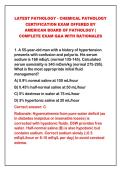
LATEST PATHOLOGY - CHEMICAL PATHOLOGY
CERTIFICATION EXAM OFFERED BY
AMERICAN BOARD OF PATHOLOGY |
COMPLETE EXAM Q&A WITH RATIONALES
1. A 55-year-old man with a history of hypertension
presents with confusion and polyuria. His serum
sodium is 168 mEq/L (normal 135-145). Calculated
serum osmolality is 340 mOsm/kg (normal 275-295).
What is the most appropriate initial fluid
management?
A) 0.9% normal saline at 100 mL/hour
B) 0.45% half-normal saline at 50 mL/hour
C) 5% dextrose in water at 75 mL/hour
D) 3% hypertonic saline at 20 mL/hour
Correct answer: C
Rationale: Hypernatremia from pure water deficit (as
in diabetes insipidus or insensible losses) is
corrected with hypotonic fluids. D5W provides free
water. Half-normal saline (B) is also hypotonic but
contains sodium. Correct sodium slowly (≤0.5
mEq/L/hour or 8-10 mEq/L per day) to avoid cerebral
edema.
,2. A 45-year-old woman presents with fatigue and
proximal muscle weakness. Laboratory studies show
serum potassium 2.8 mEq/L (normal 3.5-5.0),
magnesium 1.2 mg/dL (normal 1.5-2.5), and arterial
blood pH 7.48 with a normal anion gap. Her urine
potassium is 40 mEq/L. What is the most likely
diagnosis?
A) Diuretic abuse
B) Gitelman syndrome
C) Bartter syndrome
D) Primary hyperaldosteronism
Correct answer: B
Rationale: Hypokalemia with metabolic alkalosis,
hypomagnesemia, and low urinary calcium (not given
but characteristic) with normal blood pressure
suggests Gitelman syndrome (mutations in SLC12A3,
thiazide-sensitive NCC transporter). Bartter (C) has
hypercalciuria and often presents in childhood.
3. A 60-year-old man with chronic kidney disease
stage 4 has a serum phosphorus of 7.2 mg/dL (normal
2.5-4.5) and calcium of 8.0 mg/dL (normal 8.5-10.2).
His PTH is 450 pg/mL (normal 10-65). What is the
most appropriate initial treatment for
hyperphosphatemia?
,A) Intravenous calcium gluconate
B) Oral calcium acetate (calcium-based phosphate
binder)
C) Sevelamer carbonate (non-calcium phosphate
binder)
D) Cinacalcet
Correct answer: C
Rationale: In CKD with hyperphosphatemia, non-
calcium-based phosphate binders (sevelamer,
lanthanum) are preferred to avoid calcium loading
and vascular calcification. Calcium-based binders (B)
are used but increase calcium load. Cinacalcet (D)
lowers PTH but not phosphorus.
4. A 32-year-old man presents with recurrent
nephrolithiasis. Serum calcium is 11.2 mg/dL (normal
8.5-10.2), PTH is 120 pg/mL (normal 10-65), and 25-
hydroxyvitamin D is 30 ng/mL (normal 30-80). What is
the most likely diagnosis?
A) Familial hypocalciuric hypercalcemia
B) Primary hyperparathyroidism
C) Malignancy-associated hypercalcemia
D) Vitamin D toxicity
Correct answer: B
, Rationale: Primary hyperparathyroidism presents
with hypercalcemia, elevated PTH (inappropriately
normal or high), and normal or low phosphorus. FHH
(A) has hypercalcemia with inappropriately normal
PTH but very low urinary calcium/creatinine
clearance ratio (<0.01).
5. A 28-year-old woman with type 1 diabetes mellitus
presents with nausea, vomiting, and abdominal pain.
Her capillary blood glucose is 450 mg/dL. Serum
laboratory results: sodium 132 mEq/L, potassium 5.2
mEq/L, chloride 98 mEq/L, bicarbonate 12 mEq/L,
BUN 35 mg/dL, creatinine 1.2 mg/dL. Beta-
hydroxybutyrate is elevated. What is the calculated
anion gap?
A) 12 mEq/L
B) 22 mEq/L
C) 32 mEq/L
D) 42 mEq/L
Correct answer: B
Rationale: Anion gap = Na - (Cl + HCO3) = 132 - (98 +
12) = 22. Normal anion gap is 8-12. Elevated anion
gap metabolic acidosis in a diabetic patient indicates
diabetic ketoacidosis (DKA). Calculate delta gap
(Delta gap = (AG - 12) / (24 - HCO3)) to assess for
concurrent metabolic alkalosis.
CERTIFICATION EXAM OFFERED BY
AMERICAN BOARD OF PATHOLOGY |
COMPLETE EXAM Q&A WITH RATIONALES
1. A 55-year-old man with a history of hypertension
presents with confusion and polyuria. His serum
sodium is 168 mEq/L (normal 135-145). Calculated
serum osmolality is 340 mOsm/kg (normal 275-295).
What is the most appropriate initial fluid
management?
A) 0.9% normal saline at 100 mL/hour
B) 0.45% half-normal saline at 50 mL/hour
C) 5% dextrose in water at 75 mL/hour
D) 3% hypertonic saline at 20 mL/hour
Correct answer: C
Rationale: Hypernatremia from pure water deficit (as
in diabetes insipidus or insensible losses) is
corrected with hypotonic fluids. D5W provides free
water. Half-normal saline (B) is also hypotonic but
contains sodium. Correct sodium slowly (≤0.5
mEq/L/hour or 8-10 mEq/L per day) to avoid cerebral
edema.
,2. A 45-year-old woman presents with fatigue and
proximal muscle weakness. Laboratory studies show
serum potassium 2.8 mEq/L (normal 3.5-5.0),
magnesium 1.2 mg/dL (normal 1.5-2.5), and arterial
blood pH 7.48 with a normal anion gap. Her urine
potassium is 40 mEq/L. What is the most likely
diagnosis?
A) Diuretic abuse
B) Gitelman syndrome
C) Bartter syndrome
D) Primary hyperaldosteronism
Correct answer: B
Rationale: Hypokalemia with metabolic alkalosis,
hypomagnesemia, and low urinary calcium (not given
but characteristic) with normal blood pressure
suggests Gitelman syndrome (mutations in SLC12A3,
thiazide-sensitive NCC transporter). Bartter (C) has
hypercalciuria and often presents in childhood.
3. A 60-year-old man with chronic kidney disease
stage 4 has a serum phosphorus of 7.2 mg/dL (normal
2.5-4.5) and calcium of 8.0 mg/dL (normal 8.5-10.2).
His PTH is 450 pg/mL (normal 10-65). What is the
most appropriate initial treatment for
hyperphosphatemia?
,A) Intravenous calcium gluconate
B) Oral calcium acetate (calcium-based phosphate
binder)
C) Sevelamer carbonate (non-calcium phosphate
binder)
D) Cinacalcet
Correct answer: C
Rationale: In CKD with hyperphosphatemia, non-
calcium-based phosphate binders (sevelamer,
lanthanum) are preferred to avoid calcium loading
and vascular calcification. Calcium-based binders (B)
are used but increase calcium load. Cinacalcet (D)
lowers PTH but not phosphorus.
4. A 32-year-old man presents with recurrent
nephrolithiasis. Serum calcium is 11.2 mg/dL (normal
8.5-10.2), PTH is 120 pg/mL (normal 10-65), and 25-
hydroxyvitamin D is 30 ng/mL (normal 30-80). What is
the most likely diagnosis?
A) Familial hypocalciuric hypercalcemia
B) Primary hyperparathyroidism
C) Malignancy-associated hypercalcemia
D) Vitamin D toxicity
Correct answer: B
, Rationale: Primary hyperparathyroidism presents
with hypercalcemia, elevated PTH (inappropriately
normal or high), and normal or low phosphorus. FHH
(A) has hypercalcemia with inappropriately normal
PTH but very low urinary calcium/creatinine
clearance ratio (<0.01).
5. A 28-year-old woman with type 1 diabetes mellitus
presents with nausea, vomiting, and abdominal pain.
Her capillary blood glucose is 450 mg/dL. Serum
laboratory results: sodium 132 mEq/L, potassium 5.2
mEq/L, chloride 98 mEq/L, bicarbonate 12 mEq/L,
BUN 35 mg/dL, creatinine 1.2 mg/dL. Beta-
hydroxybutyrate is elevated. What is the calculated
anion gap?
A) 12 mEq/L
B) 22 mEq/L
C) 32 mEq/L
D) 42 mEq/L
Correct answer: B
Rationale: Anion gap = Na - (Cl + HCO3) = 132 - (98 +
12) = 22. Normal anion gap is 8-12. Elevated anion
gap metabolic acidosis in a diabetic patient indicates
diabetic ketoacidosis (DKA). Calculate delta gap
(Delta gap = (AG - 12) / (24 - HCO3)) to assess for
concurrent metabolic alkalosis.


