

Written by students who passed Immediately available after payment Read online or as PDF Wrong document? Swap it for free 4.6 TrustPilot
logo-home
Document preview thumbnail
Preview 2 out of 9 pages
Exam (elaborations)

Quiz: Introduction to Professional Responsibility: JURI580: Ethics and Professional Responsibility (D02)| Score for this quiz: 50 out of 50.

Document preview thumbnail
Preview 2 out of 9 pages

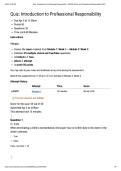
Quiz: Introduction to Professional Responsibility Due Apr 5 at 11:59pm Points 50 Questions 25 Time Limit 60 Minutes Instructions Attempt History Attempt Time Score LATEST Attempt 1 15 minutes 50 out of 50  Correct answers are hidden. Score for this quiz: 50 out of 50 Submitted Apr 5 at 2:09pm This attempt took 15 minutes.  Q uestion 1 2 / 2 pts True False False. See Rule 1.16. Th  e quiz: Covers the Learn material from Module 1: Week 1 — Module 2: Week 2. Contains 25 multiple-choice and true/false questions. Is limited to 1 hour. Allows 1 attempt. Is worth 50 points. You may refer to your notes and textbooks at any time during the assessment. Submit this assignment by 11:59 p.m. (ET) on Sunday of Module 2: Week 2. When terminating a client's representation, the lawyer has no further duty to the client or the client's interests. 4/5/26, 2:09 PM Quiz: Introduction to Professional Responsibility: JURI580: Ethics and Professional Responsibility (D02) 2 / 2 pts The client must orally agree to the division of the fee The fee can be no greater than 25% of the total fee charged to the client The total fee must be reasonable The court must approve any referral fee arrangement See Rule 1.5 (e).  Q uestion 3 2 / 2 pts A court has the power to reduce the amount of fee charged by an attorney if the court finds the fee to be unreasonable A court can summarily award punitive damages to a client who has been charged an unreasonable fee A court can generally set the fee that an attorney charges in a case A court can impose a fee schedule on all attorneys who practice within a local jurisdiction to set a range of fees in a case A is the only correct answer here. B is incorrect because a court cannot summarily award punitive damages. C. is incorrect because courts do not generally set fees. D. is incorrect, because the courts do not set a range of fees for attorneys in a given case.  Q uestion 4 2 / 2 pts True False See Rule 1.16(a)(1). W  hich of the following is a requirement Under Rule 1.5 (e) for a referral fee to be valid? Which of the following is a method to regulate the reasonableness of a lawyer's fees? A Lawyer may not represent a client if continued representation of the client would result in the violation of the Rules of Conduct or violation of the law. 4/5/26, 2:09 PM Quiz: Introduction to Professional Responsibility: JURI580: Ethics and Professional Responsibility (D02) 2 / 2 pts True False See Rule 1.16(d) Upon termination of representation, a lawyer shall take steps to the extent reasonably practicable to protect a client's interests, such as giving reasonable notice to the client, allowing time for employment of other counsel, surrendering papers and property to which the client is entitled and refunding any advance payment of fee or expense that has not been earned or incurred. The lawyer may retain papers relating to the client to the extent permitted by other law.  Q uestion 6 2 / 2 pts True False This is true. The State Supreme Court has the direct supervisory authority over the lawyers who practice in the State and the State Bar for each state.  Q uestion 7 2 / 2 pts Batson v. Kentucky In re White Strickland v. Washington Rancman v. Interim Settlement Funding Corp Strickland v. Washington establishes; the 2-part test for ineffective assistance of counsel. (1) counsel's performance must be deficient; and (2) the deficient performance must have prejudiced the defense so as to deprive the defendant of a fair trial. La  wyers are permitted to file a lien on the client's case when a client refuses to pay or obtains new representation without payment to the lawyer. In most States, the authority to regulate the practice of law in the STATE courts, rests with the highest court in the State. Which of the following cases set a two-part test for determining when ineffective representation by an attorney requires reversal of a conviction? 4/5/26, 2:09 PM Quiz: Introduction to Professional Responsibility: JURI580: Ethics and Professional Responsibility (D02) 2 / 2 pts True False True. The ABA Model Rules are a model code of conduct. The ABA does not have any direct disciplinary authority, nor does the ABA have the authority to force the code on States. Some States have not adopted all of the ABA Code, and some States have modified provisions of the code.  Q uestion 9 2 / 2 pts True False True. A lawyer is a fidicuiary. A lawyer has a duty of loyalty, confidentiality and competence when representing a client.  Q uestion 10 2 / 2 pts True False See Rule 1.8 (h)(1). A lawyer shall not: make an agreement prospectively limiting the lawyer's liability to a client for malpractice unless the client is independently represented in making the agreement;  Q uestion 11 2 / 2 pts The terms of the transaction must be fair and reasonable to the client and must be fully disclosed in writing The ABA Model Rules of Professional Responsibility is a Model Code of Conduct that individual jurisdictions may, but are not required, to adopt in whole or part? As fiduciaries to their clients, Attorneys have a duty of loyalty, confidentiality, and competence when representing clients. Lawyers CANNOT, under any circumstances, ethically limit their liability for malpractice. Which of the following are required of a lawyer who enters into a business transaction with a client? 4/5/26, 2:09 PM Quiz: Introduction to Professional Responsibility: JURI580: Ethics and Professional Responsibility (D02) the transaction and the client must have a reasonable opportunity to seek such advice The client must give informed consent in writing signed by the client to the essential terms of the transaction All the above See Rule 1.8(a).  Q uestion 12 2 / 2 pts True False False. The ABA does not have direct disciplinary authority over lawyers. Instead, lawyer discipline is delegated to State Bars or to the State Supreme Court.  Q uestion 13 2 / 2 pts True False The rules of conduct are often open to interpretation and ethical situations are often unclear.  Q uestion 14 2 / 2 pts True False See Rule 1.2. The American Bar Association (ABA) has direct disciplinary authority over lawyers for violation of the ABA Model Rules of Professional Conduct. The rules of professional conduct are ALWAYS clear and provide direct guidance to lawyers regarding prohibited conduct during the practice of law. A lawyer is generally required to follow a client's decisions concerning the goals of any representation and must consult with a client about the means used to carry out the client's objectives. 4/5/26, 2:09 PM Quiz: Introduction to Professional Responsibility: JURI580: Ethics and Professional Responsibility (D02) uestion 15 2 / 2 pts Articulated in a writing signed by the client Clearly identify the party responsible for the expenses regardless of the outcome State the method by which the fee is computed All of the above See Rule 1.5.  Q uestion 16 2 / 2 pts True False This is false. The Sixth Amendment does not prohibit a lawyer from disclosing a true threat to commit imminent harm. Rule 1.6(b)(1) would also authorize disclosure in such a circumstance.  Q uestion 17 2 / 2 pts True False See Rule 8.3. A lawyer who knows that another lawyer has committed a violation of the Rules of Professional Conduct that raises a substantial question as to that lawyer's honesty, trustworthiness or fitness as a lawyer in other respects, shall inform the appropriate professional authority.  Q uestion 18 2 / 2 pts Contingent fee agreements must be: The Sixth Amendment prohibits a lawyer from disclosing information regarding a client's threat to commit imminent harm against another person. The rules of professional conduct ALWAYS require attorneys to report the SUSPECTED misconduct of other attorneys. 4/5/26, 2:09 PM Quiz: Introduction to Professional Responsibility: JURI580: Ethics and Professional Responsibility (D02) False See Rule 1.1.  Q uestion 19 2 / 2 pts Graft Champerty Maintenance Barratry Champerty is the common law term that refers to purchasing a lawsuit. See pages 89-90 of the Crystal text.  Q uestion 20 2 / 2 pts Local court rules The Restatement of the Law Governing Lawyers Professional policy statements Bar association minutes The Restatements, professional policy statements and bar association minutes are persuasive authority only. None of these directly regulate the legal profession. Local court rules however, do directly govern the conduct of lawyers who appear in a specific jurisdiction. See Crystal pages 17-20.  Q uestion 21 2 / 2 pts Whether to accept a plea offer The ethical duty of competency includes knowledge of the law, skill and preparation. Which of the following is a term used in the common law to refer to the purchase of a portion of a lawsuit? A variety of sources govern the regulation of lawyers, these include court decisions, statutory law, the Rules of Professional Conduct and: Clients have the authority to make ultimate decisions about their cases. This authority extends to all of the following, EXCEPT: 4/5/26, 2:09 PM Quiz: Introduction to Professional Responsibility: JURI580: Ethics and Professional Responsibility (D02) Whether to Appeal Whether to Cross-examine a witness Whether to cross-examine a specific witness is trial strategy that belongs to a lawyer, not the client. See Crystal pages 107-109.  Q uestion 22 2 / 2 pts A retainer agreement A representation agreement An investigation agreement A pre-action agreement An investigation agreement is the agreement used to investigate a matter before undertaking representation. See page 114 of the Crystal text.  Q uestion 23 2 / 2 pts True False True. A lawyer cannot demand that a client sign a release as a condition for releasing the file. See also page 115 of Crystal.  Q uestion 24 2 / 2 pts True False An agreement used by lawyers to agree with a client to investigate a matter before undertaking representation is called: It is generally unethical for a lawyer to demand that a client sign a release of liability as a condition of releasing the client's file after non-payment. When a lawyer is charged with formal misconduct, the lawyer MUST be given representation by bar counsel at no cost to the lawyer. 4/5/26, 2:09 PM Quiz: Introduction to Professional Responsibility: JURI580: Ethics and Professional Responsibility (D02) requires the appointment of a lawyer at no cost to the accused lawyer.  Q uestion 25 2 / 2 pts The Lawyer can proceed with this fee arrangement, because as outlined by Comment Six to Model Rule 1.5, contingent fees are permissible for actions involving recovery of post-judgment alimony The lawyer cannot proceed with this contingent fee agreement because it is a family law matter Lawyer cannot proceed with this contingent fee agreement because to take 25% of a gross amount recovered by the lawyer is always unfair and unreasonable Lawyer can proceed with this fee agreement because lawyers can charge any fee that they wish for a case See Comment 6, Rule 1.5. See also page 86 of the Crystal text. Quiz Score: 50 out of 50 Client contacts Lawyer and requests representation. The Client was represented in a divorce action by another attorney and had been awarded a substantial judgment for alimony. The Client's ex-spouse has not paid the court ordered alimony. Client wishes to retain the Lawyer to collect the alimony. Lawyer agrees to represent the client for 25% of the gross amount recovered by the Lawyer. 4/5/26, 2:09 PM Quiz: Introduction to Professional Responsibility: JURI580: Ethics and Professional Responsibility (D02)

Content preview

4/5/26, 2:09 PM Quiz: Introduction to Professional Responsibility: JURI580: Ethics and Professional Responsibility (D02)


Quiz: Introduction to Professional Responsibility
Due Apr 5 at 11:59pm
Points 50
Questions 25
Time Limit 60 Minutes

Instructions

The quiz:

Covers the Learn material from Module 1: Week 1 — Module 2: Week 2.
Contains 25 multiple-choice and true/false questions.
Is limited to 1 hour.
Allows 1 attempt.
Is worth 50 points.

You may refer to your notes and textbooks at any time during the assessment.

Submit this assignment by 11:59 p.m. (ET) on Sunday of Module 2: Week 2.

Attempt History

Attempt Time Score

LATEST Attempt 1 15 minutes 50 out of 50


 Correct answers are hidden.
Score for this quiz: 50 out of 50
Submitted Apr 5 at 2:09pm
This attempt took 15 minutes.


Question 1
pts
When terminating a client's representation, the lawyer has no further duty to the client or the
client's interests.
True

False

False. See Rule 1.16.


https://canvas.liberty.edu/courses/920699/quizzes/4607505 1/9

, 4/5/26, 2:09 PM Quiz: Introduction to Professional Responsibility: JURI580: Ethics and Professional Responsibility (D02)

Question 2
pts
Which of the following is a requirement Under Rule 1.5 (e) for a referral fee to be valid?
The client must orally agree to the division of the fee

The fee can be no greater than 25% of the total fee charged to the client

The total fee must be reasonable

The court must approve any referral fee arrangement

See Rule 1.5 (e).


Question 3
pts
Which of the following is a method to regulate the reasonableness of a lawyer's fees?


A court has the power to reduce the amount of fee charged by an attorney if the court finds the fee to be
unreasonable

A court can summarily award punitive damages to a client who has been charged an unreasonable fee

A court can generally set the fee that an attorney charges in a case


A court can impose a fee schedule on all attorneys who practice within a local jurisdiction to set a range of
fees in a case

A is the only correct answer here. B is incorrect because a court cannot summarily award punitive damages.
C. is incorrect because courts do not generally set fees. D. is incorrect, because the courts do not set a range
of fees for attorneys in a given case.


Question 4
pts
A Lawyer may not represent a client if continued representation of the client would result in the
violation of the Rules of Conduct or violation of the law.
True

False

See Rule 1.16(a)(1).


https://canvas.liberty.edu/courses/920699/quizzes/4607505 2/9

Document information

Uploaded on
June 4, 2026
Number of pages
9
Written in
2025/2026
Type
Exam (elaborations)
Contains
Questions & answers
$15.89

Wrong document? Swap it for free Within 14 days of purchase and before downloading, you can choose a different document. You can simply spend the amount again.
Written by students who passed
Immediately available after payment
Read online or as PDF

Seller avatar
Reputation scores are based on the amount of documents a seller has sold for a fee and the reviews they have received for those documents. There are three levels: Bronze, Silver and Gold. The better the reputation, the more your can rely on the quality of the sellers work.
MindCraft
3.8
(47)
Sold
368
Followers
7
Items
2789
Last sold
16 hours ago


Why students choose Stuvia

Created by fellow students, verified by reviews

Quality you can trust: written by students who passed their tests and reviewed by others who've used these notes.

Didn't get what you expected? Choose another document

No worries! You can instantly pick a different document that better fits what you're looking for.

Pay as you like, start learning right away

No subscription, no commitments. Pay the way you're used to via credit card and download your PDF document instantly.

Student with book image

“Bought, downloaded, and aced it. It really can be that simple.”

Alisha Student

Working on your references?

Create accurate citations in APA, MLA and Harvard with our free citation generator.

Working on your references?

Frequently asked questions

