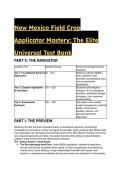
New Mexico Field Crop
Applicator Mastery: The Elite
Universal Test Bank
PART 0: THE NAVIGATOR
Cognitive Tier Question Range Primary Knowledge Domains
Assessed
Tier 1: Foundational Syntax & Q1 – Q10 Statutory authority (NMDA),
Application basic calibration math,
hard-deck recordkeeping rules,
and core pest/weed
identification.
Tier 2: Complex Application Q11 – Q20 Situational drift mitigation,
& Simulation Category 1A/1B overlapping
scenarios, specialized storage
compliance, and equipment
troubleshooting.
Tier 3: Grandmaster Q21 – Q30 High-stakes multi-variable
Synthesis incident management, pesticide
liability, compounding
regulatory failures, and
advanced agronomic
diagnostics.
PART I: THE PREVIEW
Mastering this elite test bank translates directly to operational superiority, transforming
candidates from procedural novices into legally invulnerable, highly analytical New Mexico Field
Crop Applicators. By internalizing the rigid frameworks of the New Mexico Pesticide Control Act
and advanced agronomic principles, the student hardwires their ability to execute flawless
judgment under extreme field and administrative pressure.
The "Critical Axioms" Cheat Sheet:
● The Recordkeeping Hard Deck: Under NMDA regulations, commercial application
records must be fully completed within exactly 24 hours of application and retained for
exactly two (2) years. Missing a single meteorological variable (wind speed, wind
direction, or temperature) invalidates the log and exposes the applicator to civil penalties.
, ● The 2,4-D Restriction Matrix: In New Mexico, 2,4-D herbicides are inherently classified
as state-restricted-use pesticides ONLY if their labels outline directions primarily for
agriculture, rangelands, rights-of-way, or non-croplands. Products labeled for turf,
ornamental, or home garden use remain unrestricted.
● The Calibration Axiom: Ground speed and nozzle orifice size are the only
mathematically viable methods to practically alter sprayer output. Increasing pressure is
an aerodynamic liability; mathematically doubling the volumetric output requires a 400%
increase in pressure, massively escalating drift potential.
● The Storage Visual Mandate: Pesticides intended for use by commercial applicators
must be stored in enclosed, secured areas permanently posted with warning signs
explicitly in BOTH English and Spanish.
● The Category Distinction: Category 1A exclusively governs agricultural pests (insects,
plant pathogens, nematodes), while Category 1B exclusively governs agricultural weeds,
desiccants, and defoliants.
PART II: THE ELITE TEST BANK
Tier 1: Foundational Syntax & Application
Q1: Under the authority of the New Mexico Pesticide Control Act, a Commercial Applicator
applies a restricted-use herbicide but fails to record the environmental temperature at the time
of application. According to NMDA enforcement standards, what is the MAXIMUM civil penalty
the courts can legally assess for this specific regulatory violation? A) A strict written warning for
the first offense, with fines escalating to $500 for subsequent offenses. B) Immediate license
suspension with no financial penalty assessed by the courts. C) A civil penalty of $1,000 per
violation. D) A federal FIFRA-level penalty of $5,000 per violation.
● The Answer: C (A civil penalty of $1,000 per violation.)
● Distractor Analysis:
○ A is incorrect: The statute does not mandate a grace period or a simple written
warning cap for clear recordkeeping violations.
○ B is incorrect: While administrative license action can occur, the courts are
specifically and statutorily authorized to assess financial civil penalties.
○ D is incorrect: While $5,000 is a standard federal FIFRA penalty limit for
commercial applicators, New Mexico state law explicitly caps this specific
state-level civil penalty at $1,000 per violation.
The Mentor's Analysis: The New Mexico Pesticide Control Act explicitly grants the courts
authority to assess a civil penalty up to $1,000 for each violation. By maintaining complete
records, the applicator bypasses the common trap of petty misdemeanor charges that arise from
administrative negligence. Professional/Academic Intuition: Complete documentation is a
legal shield; missing a single required meteorological variable constitutes a punishable offense
and an assumption of liability.
Q2: A New Mexico commercial applicator utilizes a restricted-use pesticide on a large acreage
field crop. To maintain compliance with NMDA regulations, what is the EXACT statutory timeline
required for completing the application record and the mandatory retention period? A) The
record must be completed immediately upon leaving the field and retained for 1 year. B) The
record must be completed within 24 hours of the application and retained for 2 years. C) The
record must be completed within 48 hours of the application and retained for 3 years to align
Applicator Mastery: The Elite
Universal Test Bank
PART 0: THE NAVIGATOR
Cognitive Tier Question Range Primary Knowledge Domains
Assessed
Tier 1: Foundational Syntax & Q1 – Q10 Statutory authority (NMDA),
Application basic calibration math,
hard-deck recordkeeping rules,
and core pest/weed
identification.
Tier 2: Complex Application Q11 – Q20 Situational drift mitigation,
& Simulation Category 1A/1B overlapping
scenarios, specialized storage
compliance, and equipment
troubleshooting.
Tier 3: Grandmaster Q21 – Q30 High-stakes multi-variable
Synthesis incident management, pesticide
liability, compounding
regulatory failures, and
advanced agronomic
diagnostics.
PART I: THE PREVIEW
Mastering this elite test bank translates directly to operational superiority, transforming
candidates from procedural novices into legally invulnerable, highly analytical New Mexico Field
Crop Applicators. By internalizing the rigid frameworks of the New Mexico Pesticide Control Act
and advanced agronomic principles, the student hardwires their ability to execute flawless
judgment under extreme field and administrative pressure.
The "Critical Axioms" Cheat Sheet:
● The Recordkeeping Hard Deck: Under NMDA regulations, commercial application
records must be fully completed within exactly 24 hours of application and retained for
exactly two (2) years. Missing a single meteorological variable (wind speed, wind
direction, or temperature) invalidates the log and exposes the applicator to civil penalties.
, ● The 2,4-D Restriction Matrix: In New Mexico, 2,4-D herbicides are inherently classified
as state-restricted-use pesticides ONLY if their labels outline directions primarily for
agriculture, rangelands, rights-of-way, or non-croplands. Products labeled for turf,
ornamental, or home garden use remain unrestricted.
● The Calibration Axiom: Ground speed and nozzle orifice size are the only
mathematically viable methods to practically alter sprayer output. Increasing pressure is
an aerodynamic liability; mathematically doubling the volumetric output requires a 400%
increase in pressure, massively escalating drift potential.
● The Storage Visual Mandate: Pesticides intended for use by commercial applicators
must be stored in enclosed, secured areas permanently posted with warning signs
explicitly in BOTH English and Spanish.
● The Category Distinction: Category 1A exclusively governs agricultural pests (insects,
plant pathogens, nematodes), while Category 1B exclusively governs agricultural weeds,
desiccants, and defoliants.
PART II: THE ELITE TEST BANK
Tier 1: Foundational Syntax & Application
Q1: Under the authority of the New Mexico Pesticide Control Act, a Commercial Applicator
applies a restricted-use herbicide but fails to record the environmental temperature at the time
of application. According to NMDA enforcement standards, what is the MAXIMUM civil penalty
the courts can legally assess for this specific regulatory violation? A) A strict written warning for
the first offense, with fines escalating to $500 for subsequent offenses. B) Immediate license
suspension with no financial penalty assessed by the courts. C) A civil penalty of $1,000 per
violation. D) A federal FIFRA-level penalty of $5,000 per violation.
● The Answer: C (A civil penalty of $1,000 per violation.)
● Distractor Analysis:
○ A is incorrect: The statute does not mandate a grace period or a simple written
warning cap for clear recordkeeping violations.
○ B is incorrect: While administrative license action can occur, the courts are
specifically and statutorily authorized to assess financial civil penalties.
○ D is incorrect: While $5,000 is a standard federal FIFRA penalty limit for
commercial applicators, New Mexico state law explicitly caps this specific
state-level civil penalty at $1,000 per violation.
The Mentor's Analysis: The New Mexico Pesticide Control Act explicitly grants the courts
authority to assess a civil penalty up to $1,000 for each violation. By maintaining complete
records, the applicator bypasses the common trap of petty misdemeanor charges that arise from
administrative negligence. Professional/Academic Intuition: Complete documentation is a
legal shield; missing a single required meteorological variable constitutes a punishable offense
and an assumption of liability.
Q2: A New Mexico commercial applicator utilizes a restricted-use pesticide on a large acreage
field crop. To maintain compliance with NMDA regulations, what is the EXACT statutory timeline
required for completing the application record and the mandatory retention period? A) The
record must be completed immediately upon leaving the field and retained for 1 year. B) The
record must be completed within 24 hours of the application and retained for 2 years. C) The
record must be completed within 48 hours of the application and retained for 3 years to align