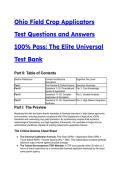
Ohio Field Crop Applicators
Test Questions and Answers
100% Pass: The Elite Universal
Test Bank
Part 0: Table of Contents
Section Reference Content Architecture Cognitive Tier Level
Description
Part I The Preview & Critical Axioms Executive Summary
Part II Questions 1–10: Foundational Tier 1: Core Knowledge
Syntax & Application
Part II Questions 11–20: Complex Tier 2: Variable Analysis
Application & Simulation
Part II Questions 21–30: Grandmaster Tier 3: High-Stakes Integration
Synthesis
Part I: The Preview
Mastering this elite test bank directly translates to flawless execution in high-stakes agronomic
environments, ensuring absolute compliance with Ohio Department of Agriculture (ODA)
standards and maximizing crop yield protection. By synthesizing complex fluid dynamics,
meteorological forecasting, and rigid regulatory frameworks, the candidate is forged into an
authoritative practitioner capable of averting catastrophic application failures.
The Critical Axioms Cheat Sheet
● The Universal Calibration Formula: Flow Rate (GPM) = (Application Rate (GPA) ×
Travel Speed (MPH) × Nozzle Spacing (W)) ÷ 5940. This mathematical constant perfectly
balances output volume against physical acreage.
● The Trained Serviceperson (TSP) Mandate: A TSP must operate within 25 miles or 2
hours of direct supervision by a commercially licensed applicator employed by the exact
same parent agency.
, ● The Three-Year Retention Law: Both Commercial and Private applicators must strictly
retain comprehensive records of restricted-use pesticide (RUP) applications for precisely
three years from the exact date of execution.
● The Inversion Prohibition: Applications must absolutely cease when horizontal smoke
layers, dispersed evening cumulus clouds, and intensified distant acoustics indicate a
temperature inversion, trapping micro-droplets in suspended lateral drift.
● The Recertification Matrix: Commercial applicators require 5 total hours (1 hr Core, 0.5
hr per Category), while Private applicators require 3 total hours (1 hr Core, 0.5 hr per
Category) every three years.
Ohio Pesticide Licensing Architecture
Classification Primary Scope of Fee Structure Recertification
Authority Requirement
Private Applicator Applying RUPs on $30 every 3 years 3 Hours (1 Core +
owned/rented land for 0.5/Category)
commodity production.
Commercial Applying pesticides for $35 annually 5 Hours (1 Core +
Applicator hire on property owned 0.5/Category)
by another entity.
Trained Unlicensed handler No Fee Employer-documented
Serviceperson operating under direct training
supervision of a
licensee.
Part II: The Elite Test Bank
Tier 1: Foundational Syntax & Application
Q1: A newly established agricultural enterprise in Ohio intends to apply restricted-use pesticides
(RUP) exclusively on land owned and rented by the enterprise to produce a field corn
commodity. Based on the principles of Ohio Pesticide Law (OAC 901:5-11), which license
classification and associated fee structure is the MOST ACCURATE? A) Commercial Applicator
License requiring an annual $35 fee. B) Trained Serviceperson designation requiring an annual
$30 fee. C) Private Applicator License requiring a $30 fee every three years. D) Private
Applicator License requiring a $35 fee every three years.
● The Answer: C (Private Applicator License requiring a $30 fee every three years.)
● Distractor Analysis:
○ A is incorrect: Commercial licenses are mandated when applying pesticides for hire
on another entity's property, which explicitly contradicts the scenario of an
enterprise applying on its own commodity-producing land.
○ B is incorrect: A Trained Serviceperson (TSP) does not hold an independent license
nor pay a state fee; they operate under the documented, direct supervision of a
licensed applicator.
○ D is incorrect: While the three-year statutory cycle is correct, the $35 fee is the
annual cost for a Commercial license, not the Private license structure.
The Mentor's Analysis: The fundamental distinction between Private and Commercial
classifications hinges entirely on property ownership and commodity production. When
, applications are restricted to land owned or rented by the applicator for agricultural production, a
Private license is legally mandated by the state. By utilizing the Private Applicator classification,
the candidate bypasses the common trap of conflating for-hire commercial operations with
self-sustained agronomic production. Professional/Academic Intuition: Commercial equals
for-hire applications at $35 annually; Private equals owned/rented production at $30 every three
years.
Q2: A licensed commercial applicator is hired to control a severe infestation of Western Bean
Cutworm in a client's field corn. Based on the ODA pesticide use categories, which specific
certification category MUST the applicator possess to legally perform this action? A) Category
2a - Agronomic Pest Control B) Category 2c - Agricultural Weed Control C) Category 1 - Grain
and Cereal Crops D) Category 1 - Aerial Pest Control
● The Answer: A (Category 2a - Agronomic Pest Control)
● Distractor Analysis:
○ B is incorrect: Category 2c strictly covers the application of herbicides for weed
control, providing absolutely no legal coverage for insect or fungal control.
○ C is incorrect: Category 1 (Grain and Cereal Crops) is explicitly a Private Applicator
category. A commercial applicator hired by a client cannot operate under a private
category syntax.
○ D is incorrect: Category 1 for Commercial applicators designates Aerial Pest
Control, which assumes aircraft deployment rather than standard ground-based
agronomic application.
The Mentor's Analysis: Category syntax in Ohio is strictly bifurcated between Private and
Commercial domains. For a commercial operator, insects and diseases in agronomic crops fall
explicitly under Category 2a (Agronomic Pest Control), while weeds fall strictly under Category
2c. By utilizing Category 2a, the applicator bypasses the novice error of selecting a Private
category for a commercial task. Professional/Academic Intuition: In commercial applications,
2a neutralizes the insects and pathogens; 2c neutralizes the weeds.
Q3: To maintain legal compliance, an Ohio Private Pesticide Applicator holding Category 1 and
Category 2 is approaching the expiration of their three-year certification cycle. What is the
MINIMUM continuing education requirement they must fulfill to recertify without retesting? A) 5
total hours, including 1 hour of Core and 0.5 hours per Category. B) 3 total hours, including 1
hour of Core and 0.5 hours per Category. C) 3 total hours, consisting entirely of Core credits. D)
5 total hours, consisting entirely of Category 1 and 2 credits.
● The Answer: B (3 total hours, including 1 hour of Core and 0.5 hours per Category.)
● Distractor Analysis:
○ A is incorrect: 5 total hours is the mandatory requirement for Commercial
applicators, not Private applicators.
○ C is incorrect: While 1 hour of Core is non-negotiable, the remaining 2 hours must
legally include at least 0.5 hours in each specific category listed on the applicator's
license.
○ D is incorrect: Core credit is mandatory for all renewals; ignoring Core violates
baseline environmental safety and regulatory mandates.
The Mentor's Analysis: Private applicator recertification operates on a streamlined metric
compared to commercial counterparts, requiring 3 total hours rather than 5. When facing license
renewal, the immediate priority is satisfying the mandatory Core and Category-specific
minimums before filling the remaining temporal requirement. Professional/Academic Intuition:
The Private recertification formula: 3 Total Hours = 1 Core + (0.5 × Number of Categories) +
Elective.
Test Questions and Answers
100% Pass: The Elite Universal
Test Bank
Part 0: Table of Contents
Section Reference Content Architecture Cognitive Tier Level
Description
Part I The Preview & Critical Axioms Executive Summary
Part II Questions 1–10: Foundational Tier 1: Core Knowledge
Syntax & Application
Part II Questions 11–20: Complex Tier 2: Variable Analysis
Application & Simulation
Part II Questions 21–30: Grandmaster Tier 3: High-Stakes Integration
Synthesis
Part I: The Preview
Mastering this elite test bank directly translates to flawless execution in high-stakes agronomic
environments, ensuring absolute compliance with Ohio Department of Agriculture (ODA)
standards and maximizing crop yield protection. By synthesizing complex fluid dynamics,
meteorological forecasting, and rigid regulatory frameworks, the candidate is forged into an
authoritative practitioner capable of averting catastrophic application failures.
The Critical Axioms Cheat Sheet
● The Universal Calibration Formula: Flow Rate (GPM) = (Application Rate (GPA) ×
Travel Speed (MPH) × Nozzle Spacing (W)) ÷ 5940. This mathematical constant perfectly
balances output volume against physical acreage.
● The Trained Serviceperson (TSP) Mandate: A TSP must operate within 25 miles or 2
hours of direct supervision by a commercially licensed applicator employed by the exact
same parent agency.
, ● The Three-Year Retention Law: Both Commercial and Private applicators must strictly
retain comprehensive records of restricted-use pesticide (RUP) applications for precisely
three years from the exact date of execution.
● The Inversion Prohibition: Applications must absolutely cease when horizontal smoke
layers, dispersed evening cumulus clouds, and intensified distant acoustics indicate a
temperature inversion, trapping micro-droplets in suspended lateral drift.
● The Recertification Matrix: Commercial applicators require 5 total hours (1 hr Core, 0.5
hr per Category), while Private applicators require 3 total hours (1 hr Core, 0.5 hr per
Category) every three years.
Ohio Pesticide Licensing Architecture
Classification Primary Scope of Fee Structure Recertification
Authority Requirement
Private Applicator Applying RUPs on $30 every 3 years 3 Hours (1 Core +
owned/rented land for 0.5/Category)
commodity production.
Commercial Applying pesticides for $35 annually 5 Hours (1 Core +
Applicator hire on property owned 0.5/Category)
by another entity.
Trained Unlicensed handler No Fee Employer-documented
Serviceperson operating under direct training
supervision of a
licensee.
Part II: The Elite Test Bank
Tier 1: Foundational Syntax & Application
Q1: A newly established agricultural enterprise in Ohio intends to apply restricted-use pesticides
(RUP) exclusively on land owned and rented by the enterprise to produce a field corn
commodity. Based on the principles of Ohio Pesticide Law (OAC 901:5-11), which license
classification and associated fee structure is the MOST ACCURATE? A) Commercial Applicator
License requiring an annual $35 fee. B) Trained Serviceperson designation requiring an annual
$30 fee. C) Private Applicator License requiring a $30 fee every three years. D) Private
Applicator License requiring a $35 fee every three years.
● The Answer: C (Private Applicator License requiring a $30 fee every three years.)
● Distractor Analysis:
○ A is incorrect: Commercial licenses are mandated when applying pesticides for hire
on another entity's property, which explicitly contradicts the scenario of an
enterprise applying on its own commodity-producing land.
○ B is incorrect: A Trained Serviceperson (TSP) does not hold an independent license
nor pay a state fee; they operate under the documented, direct supervision of a
licensed applicator.
○ D is incorrect: While the three-year statutory cycle is correct, the $35 fee is the
annual cost for a Commercial license, not the Private license structure.
The Mentor's Analysis: The fundamental distinction between Private and Commercial
classifications hinges entirely on property ownership and commodity production. When
, applications are restricted to land owned or rented by the applicator for agricultural production, a
Private license is legally mandated by the state. By utilizing the Private Applicator classification,
the candidate bypasses the common trap of conflating for-hire commercial operations with
self-sustained agronomic production. Professional/Academic Intuition: Commercial equals
for-hire applications at $35 annually; Private equals owned/rented production at $30 every three
years.
Q2: A licensed commercial applicator is hired to control a severe infestation of Western Bean
Cutworm in a client's field corn. Based on the ODA pesticide use categories, which specific
certification category MUST the applicator possess to legally perform this action? A) Category
2a - Agronomic Pest Control B) Category 2c - Agricultural Weed Control C) Category 1 - Grain
and Cereal Crops D) Category 1 - Aerial Pest Control
● The Answer: A (Category 2a - Agronomic Pest Control)
● Distractor Analysis:
○ B is incorrect: Category 2c strictly covers the application of herbicides for weed
control, providing absolutely no legal coverage for insect or fungal control.
○ C is incorrect: Category 1 (Grain and Cereal Crops) is explicitly a Private Applicator
category. A commercial applicator hired by a client cannot operate under a private
category syntax.
○ D is incorrect: Category 1 for Commercial applicators designates Aerial Pest
Control, which assumes aircraft deployment rather than standard ground-based
agronomic application.
The Mentor's Analysis: Category syntax in Ohio is strictly bifurcated between Private and
Commercial domains. For a commercial operator, insects and diseases in agronomic crops fall
explicitly under Category 2a (Agronomic Pest Control), while weeds fall strictly under Category
2c. By utilizing Category 2a, the applicator bypasses the novice error of selecting a Private
category for a commercial task. Professional/Academic Intuition: In commercial applications,
2a neutralizes the insects and pathogens; 2c neutralizes the weeds.
Q3: To maintain legal compliance, an Ohio Private Pesticide Applicator holding Category 1 and
Category 2 is approaching the expiration of their three-year certification cycle. What is the
MINIMUM continuing education requirement they must fulfill to recertify without retesting? A) 5
total hours, including 1 hour of Core and 0.5 hours per Category. B) 3 total hours, including 1
hour of Core and 0.5 hours per Category. C) 3 total hours, consisting entirely of Core credits. D)
5 total hours, consisting entirely of Category 1 and 2 credits.
● The Answer: B (3 total hours, including 1 hour of Core and 0.5 hours per Category.)
● Distractor Analysis:
○ A is incorrect: 5 total hours is the mandatory requirement for Commercial
applicators, not Private applicators.
○ C is incorrect: While 1 hour of Core is non-negotiable, the remaining 2 hours must
legally include at least 0.5 hours in each specific category listed on the applicator's
license.
○ D is incorrect: Core credit is mandatory for all renewals; ignoring Core violates
baseline environmental safety and regulatory mandates.
The Mentor's Analysis: Private applicator recertification operates on a streamlined metric
compared to commercial counterparts, requiring 3 total hours rather than 5. When facing license
renewal, the immediate priority is satisfying the mandatory Core and Category-specific
minimums before filling the remaining temporal requirement. Professional/Academic Intuition:
The Private recertification formula: 3 Total Hours = 1 Core + (0.5 × Number of Categories) +
Elective.