

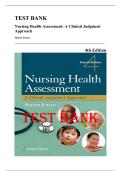
TEST BANK
Nursing Health Assessment: A Clinical Judgment
Approach
ST
Sharon Jensen
────────────────────────────────────────────────────
UV
4th Edition
IA
?_
AP
PR
OV
TEST BANK
ED
? ?
, TABLE OF CONTENTS
Test Bank: Nursing Health Assessment A Clinical Judgment Approach, 4th Edition
ST
By Sharon Jensen
UV
UNIT 1: FOUNDATIONS OF NURSING HEALTH ASSESSMENT
CHAPTER 1 The Nurse’s Role in Health Assessment
CHAPTER 2 Health History and Interview
CHAPTER 3 Assessment Techniques, Safety, and Infection Control
IA
CHAPTER 4 Documentation and Interprofessional Communication
UNIT 2: GENERAL EXAMINATIONS
?_
CHAPTER 5 Vital Signs and General Survey
CHAPTER 6 Pain Assessment
CHAPTER 7 Nutrition Assessment
AP
CHAPTER 8 Assessment of Developmental Stages
CHAPTER 9 Mental Health, Violence, and Substance Use Disorder
CHAPTER 10 Cultural Assessment
PR
UNIT 3: REGIONAL EXAMINATIONS
CHAPTER 11 Skin, Hair, and Nails
CHAPTER 12 Head and Neck, with Vision and Hearing Basics
OV
CHAPTER 13 Eye Assessment for Advanced and Specialty Practice
CHAPTER 14 Ear Assessment for Advanced and Specialty Practice
CHAPTER 15 Nose, Sinuses, Mouth, and Throat
ED
CHAPTER 16 Thorax and Lungs
CHAPTER 17 Heart and Neck Vessels
CHAPTER 18 Peripheral Vascular with Lymphatics
??
CHAPTER 19 Breast and Axillae Assessment
CHAPTER 20 Abdominal Assessment
CHAPTER 21 Musculoskeletal Assessment
, CHAPTER 22 Neurological and Mental Status
CHAPTER 23 Male Genitalia and Rectum
CHAPTER 24 Female Genitalia and Rectum
ST
UNIT 4: SPECIAL POPULATIONS AND FOCI
CHAPTER 25 Pregnancy
CHAPTER 26 Newborns and Infants
UV
CHAPTER 27 Children and Adolescents
CHAPTER 28 Older Adults
UNIT 5: PUTTING IT ALL TOGETHER
IA
CHAPTER 29 Assessment of the Hospitalized Adult
CHAPTER 30 Head-to-Toe Assessment of Adult
?_
AP
PR
OV
ED
??
, Chapter 01: The Nurse's Role in Health Assessment
1. What is one of the broad goals within nursing?
A. To provide cost effective care
B. To form broad nursing diagnoses
C. To promote self-care
D. To treat human responses
ST
ANS: D
Feedback: Four broad goals are within nursing: (1) to promote health (state of optimal
functioning or well-being with physical, social, and mental components); (2) to prevent
illness; (3) to treat human responses to health or illness; and (4) to advocate for
UV
individuals, families, communities, and populations. The other options listed are not
broad goals. Nursing, focuses on promoting health; while cost-effective care is strived
for, is not a part of the broad goal, therefore, this is not a broad goal within nursing.
Nursing looks to develop specific nursing diagnoses, not broad. Promoting self-care is
important, but does not correctly answer the question.
IA
PTS: 1 REF: p. 4 OBJ: 1
NAT: Client Needs: Safe, Effective Care Environment: Management of Care
TOP: Chapter 1: The Nurse's Role in Health Assessment
?_
KEY: Integrated Process: Caring BLM: Cognitive Level: Remember
NOT: Multiple Choice
2. What do nursing activities that promote health and prevent disease accomplish? (Select
AP
all that apply.)
A. Reduce the risk of disease
B. Maintain optimal functioning
C. Reinforce good habits
PR
D. Optimize self-care abilities
E. Create home care safety
ANS: A, B, C
Feedback: Nursing activities that promote health and prevent illness reduce the risk of
OV
disease, reinforce good habits, and maintain optimal functioning. They do not optimize
self-care abilities or create home care safety.
PTS: 1 REF: p. 4 OBJ: 1
NAT: Client Needs: Health Promotion and Maintenance
TOP: Chapter 1: The Nurse's Role in Health Assessment
ED
KEY: Integrated Process: Teaching/Learning
BLM: Cognitive Level: Analyze NOT: Multiple Select
3. The purpose of a health assessment includes what? (Select all that apply.)
??
A. Identifying the client's major disease process
B. Collecting information about the health status of the client
C. Clarifying the client's ability to pay for health care
D. Evaluating client outcomes
E. Synthesizing collected data
Nursing Health Assessment: A Clinical Judgment
Approach
ST
Sharon Jensen
────────────────────────────────────────────────────
UV
4th Edition
IA
?_
AP
PR
OV
TEST BANK
ED
? ?
, TABLE OF CONTENTS
Test Bank: Nursing Health Assessment A Clinical Judgment Approach, 4th Edition
ST
By Sharon Jensen
UV
UNIT 1: FOUNDATIONS OF NURSING HEALTH ASSESSMENT
CHAPTER 1 The Nurse’s Role in Health Assessment
CHAPTER 2 Health History and Interview
CHAPTER 3 Assessment Techniques, Safety, and Infection Control
IA
CHAPTER 4 Documentation and Interprofessional Communication
UNIT 2: GENERAL EXAMINATIONS
?_
CHAPTER 5 Vital Signs and General Survey
CHAPTER 6 Pain Assessment
CHAPTER 7 Nutrition Assessment
AP
CHAPTER 8 Assessment of Developmental Stages
CHAPTER 9 Mental Health, Violence, and Substance Use Disorder
CHAPTER 10 Cultural Assessment
PR
UNIT 3: REGIONAL EXAMINATIONS
CHAPTER 11 Skin, Hair, and Nails
CHAPTER 12 Head and Neck, with Vision and Hearing Basics
OV
CHAPTER 13 Eye Assessment for Advanced and Specialty Practice
CHAPTER 14 Ear Assessment for Advanced and Specialty Practice
CHAPTER 15 Nose, Sinuses, Mouth, and Throat
ED
CHAPTER 16 Thorax and Lungs
CHAPTER 17 Heart and Neck Vessels
CHAPTER 18 Peripheral Vascular with Lymphatics
??
CHAPTER 19 Breast and Axillae Assessment
CHAPTER 20 Abdominal Assessment
CHAPTER 21 Musculoskeletal Assessment
, CHAPTER 22 Neurological and Mental Status
CHAPTER 23 Male Genitalia and Rectum
CHAPTER 24 Female Genitalia and Rectum
ST
UNIT 4: SPECIAL POPULATIONS AND FOCI
CHAPTER 25 Pregnancy
CHAPTER 26 Newborns and Infants
UV
CHAPTER 27 Children and Adolescents
CHAPTER 28 Older Adults
UNIT 5: PUTTING IT ALL TOGETHER
IA
CHAPTER 29 Assessment of the Hospitalized Adult
CHAPTER 30 Head-to-Toe Assessment of Adult
?_
AP
PR
OV
ED
??
, Chapter 01: The Nurse's Role in Health Assessment
1. What is one of the broad goals within nursing?
A. To provide cost effective care
B. To form broad nursing diagnoses
C. To promote self-care
D. To treat human responses
ST
ANS: D
Feedback: Four broad goals are within nursing: (1) to promote health (state of optimal
functioning or well-being with physical, social, and mental components); (2) to prevent
illness; (3) to treat human responses to health or illness; and (4) to advocate for
UV
individuals, families, communities, and populations. The other options listed are not
broad goals. Nursing, focuses on promoting health; while cost-effective care is strived
for, is not a part of the broad goal, therefore, this is not a broad goal within nursing.
Nursing looks to develop specific nursing diagnoses, not broad. Promoting self-care is
important, but does not correctly answer the question.
IA
PTS: 1 REF: p. 4 OBJ: 1
NAT: Client Needs: Safe, Effective Care Environment: Management of Care
TOP: Chapter 1: The Nurse's Role in Health Assessment
?_
KEY: Integrated Process: Caring BLM: Cognitive Level: Remember
NOT: Multiple Choice
2. What do nursing activities that promote health and prevent disease accomplish? (Select
AP
all that apply.)
A. Reduce the risk of disease
B. Maintain optimal functioning
C. Reinforce good habits
PR
D. Optimize self-care abilities
E. Create home care safety
ANS: A, B, C
Feedback: Nursing activities that promote health and prevent illness reduce the risk of
OV
disease, reinforce good habits, and maintain optimal functioning. They do not optimize
self-care abilities or create home care safety.
PTS: 1 REF: p. 4 OBJ: 1
NAT: Client Needs: Health Promotion and Maintenance
TOP: Chapter 1: The Nurse's Role in Health Assessment
ED
KEY: Integrated Process: Teaching/Learning
BLM: Cognitive Level: Analyze NOT: Multiple Select
3. The purpose of a health assessment includes what? (Select all that apply.)
??
A. Identifying the client's major disease process
B. Collecting information about the health status of the client
C. Clarifying the client's ability to pay for health care
D. Evaluating client outcomes
E. Synthesizing collected data


