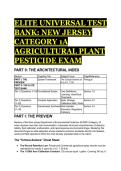
ELITE UNIVERSAL TEST
BANK: NEW JERSEY
CATEGORY 1A
AGRICULTURAL PLANT
PESTICIDE EXAM
PART 0: THE ARCHITECTURAL INDEX
Section Cognitive Tier Subject Focus Page/Reference
PART I: THE System Framework The Critical Axioms of Prologue
PREVIEW N.J.A.C. 7:30
PART II: THE ELITE
TEST BANK
Tier 1 (Questions 1–10) Foundational Syntax Core Definitions, Section 1.0
Licensing, Hard-Deck
Thresholds
Tier 2 (Questions Complex Application Spills, Storage, Section 2.0
11–20) Calibration Math, Pests
Tier 3 (Questions Grandmaster Synthesis Multi-Variable Section 3.0
21–30) Scenarios, Regulatory
Collisions
PART I: THE PREVIEW
Mastery of the New Jersey Department of Environmental Protection (NJDEP) Category 1A
exam requires more than rote memorization; it demands structural comprehension of statutory
liability, fluid calibration mathematics, and rapid-response environmental triage. Mastering this
document forges an elite applicator whose academic precision translates directly into flawless,
audit-proof field operations within the most densely populated state in the nation.
The "Critical Axioms" Cheat Sheet
● The Record Retention Law: Private and Commercial agricultural spray records must be
maintained for exactly 3 years (N.J.A.C. 7:30-8.8).
● The 1/128th Acre Calibration Constant: 128 ounces equal 1 gallon. Covering 340 sq. ft.
, (1/128th of an acre) means the ounces caught per nozzle directly equal the Gallons Per
Acre (GPA).
● The May 1st Storage Mandate: An annual storage inventory and cover letter must be
submitted to the local fire department by May 1st, explicitly citing compliance with
N.J.A.C. 7:30-9.5(b).
● The Spill Threshold Trigger: Immediate reporting to 1-877-WARN-DEP is legally
triggered if a spill exceeds 1 lb of Active Ingredient outside, 1 lb of dry formulation inside,
or 1 gallon of liquid inside (N.J.A.C. 7:30-9.17). A written report is due within 10 days.
● The Beekeeper Matrix: Applicators must notify registered apiarists within a 3-mile radius
at least 24 hours prior to applying highly toxic pesticides. The apiary must have been
registered by March 1st.
NJDEP Regulatory Threshold Statutory Metric / Deadline
Commercial OJT Applications (Category 1A) 5 Applications
Recertification Units (5-Year Cycle) 8 Core + 16 Category Units
Transport Identification Signage on minimum 2 sides
Emergency Weather Delay (Beekeeper) Notify by 10:00 P.M. prior to new date
PART II: THE ELITE TEST BANK
TIER 1: Foundational Syntax & Application
Q1: A New Jersey farmer owns a 500-acre operation producing corn and soybeans. The farmer
regularly purchases and applies Restricted Use Pesticides (RUPs) exclusively to their own
crops to produce an agricultural commodity. Based on the principles of N.J.A.C. 7:30 licensing
frameworks, which certification classification is MOST ACCURATE for this individual? A)
Commercial Pesticide Applicator B) Commercial Pesticide Operator C) Private Pesticide
Applicator D) Certified Pesticide Dealer
● The Answer: C (Private Pesticide Applicator)
● Distractor Analysis:
○ A is incorrect: A Commercial Pesticide Applicator applies pesticides for
non-agricultural purposes or operates on a "for hire" basis, which directly
contradicts the scenario of an owner operating on their own commodity.
○ B is incorrect: A Commercial Pesticide Operator applies pesticides strictly under the
direct supervision of a Commercial Applicator and does not hold independent
certification for commodity production.
○ D is incorrect: A Certified Pesticide Dealer is a specialized license for the individual
controlling the distribution and sale of restricted use pesticides at an outlet, not the
end-user applying them to the field.
The Mentor's Analysis: The fundamental dividing line in New Jersey pesticide law is the
purpose of the application and the ownership of the commodity. When facing licensing
classifications, the immediate priority is identifying if the chemical is used to produce an
agricultural commodity on owned or rented land. By utilizing the Private Pesticide Applicator
definition, you bypass the common trap of assuming large-scale or RUP use automatically
dictates commercial status. Professional/Academic Intuition: Ownership of the crop
dictates the license. Agricultural commodities on owned/rented land require a Private
license; "for-hire" or non-agricultural applications require a Commercial license.
Q2: A candidate is training to become a Category 1A (Agricultural Plant) Commercial Pesticide
Applicator in New Jersey. Prior to becoming fully licensed, the regulations dictate that the
, candidate must complete a specific number of on-the-job (OJT) practical training applications.
Based on the principles of N.J.A.C. 7:30-6.2, which action/conclusion is the MOST ACCURATE
regarding this requirement? A) The candidate must complete a minimum of 2 applications under
direct supervision. B) The candidate is exempt from OJT if they pass the Core exam with a
score above 90%. C) The candidate must complete a minimum of 5 applications under direct
supervision. D) The candidate must complete a minimum of 15 applications under direct
supervision.
● The Answer: C (The candidate must complete a minimum of 5 applications under direct
supervision.)
● Distractor Analysis:
○ A is incorrect: 2 applications are the statutory requirement for Category 1B
(Agricultural Animal) and Category 2 (Forest Pest Control), not plant agriculture.
○ B is incorrect: The Core exam demonstrates theoretical safety knowledge, but it
never overrides the strict 40-hour OJT practical requirement mandated by the
NJDEP for commercial applicators.
○ D is incorrect: 15 applications represent the maximum threshold, reserved for
high-frequency or high-risk structural/ornamental categories like 3A (Ornamental),
3B (Turf), and 7A (General Household).
The Mentor's Analysis: The NJDEP mathematically weights OJT requirements based on the
spatial scale, frequency, and environmental risk inherent to the specific category. When facing
certification prerequisites, the immediate priority is mapping the specific subcategory to its
statutory minimums. By utilizing the 5-application rule for Category 1A, you bypass the common
novice error of confusing field crop standards with structural or ornamental standards.
Professional/Academic Intuition: Agricultural Plant (1A) always demands exactly 5
supervised applications to legally satisfy the practical OJT mandate.
Q3: To maintain commercial certification in New Jersey without retaking the examination, a
Category 1A applicator must accrue recertification credits over a 5-year period. Based on the
principles of continuing education compliance, which action/conclusion is the MOST
ACCURATE prior to the October 31st deadline of the fifth year? A) The applicator must
accumulate 8 units of Core subject matter and 8 units of Category 1A subject matter. B) The
applicator must accumulate 16 units of Core subject matter and 8 units of Category 1A subject
matter. C) The applicator must accumulate 8 units of Core subject matter and 16 units of
Category 1A subject matter. D) The applicator is only required to pay the annual renewal fee;
continuing education is strictly voluntary in Category 1A.
● The Answer: C (The applicator must accumulate 8 units of Core subject matter and 16
units of Category 1A subject matter.)
● Distractor Analysis:
○ A is incorrect: While 8 Core credits are accurate, 8 Category credits are entirely
insufficient; the state requires double that amount to ensure category-specific
mastery.
○ B is incorrect: This perfectly reverses the statutory requirement, overemphasizing
general safety (Core) at the expense of specialized agricultural plant knowledge
(Category).
○ D is incorrect: Continuing education is a non-negotiable legal mandate. Failing to
accrue credits forces the applicator to re-test, halting all legal commercial
operations.
The Mentor's Analysis: Recertification is not a suggestion; it is the mechanism by which the
state ensures applicators remain aligned with evolving global and local standards. When facing
BANK: NEW JERSEY
CATEGORY 1A
AGRICULTURAL PLANT
PESTICIDE EXAM
PART 0: THE ARCHITECTURAL INDEX
Section Cognitive Tier Subject Focus Page/Reference
PART I: THE System Framework The Critical Axioms of Prologue
PREVIEW N.J.A.C. 7:30
PART II: THE ELITE
TEST BANK
Tier 1 (Questions 1–10) Foundational Syntax Core Definitions, Section 1.0
Licensing, Hard-Deck
Thresholds
Tier 2 (Questions Complex Application Spills, Storage, Section 2.0
11–20) Calibration Math, Pests
Tier 3 (Questions Grandmaster Synthesis Multi-Variable Section 3.0
21–30) Scenarios, Regulatory
Collisions
PART I: THE PREVIEW
Mastery of the New Jersey Department of Environmental Protection (NJDEP) Category 1A
exam requires more than rote memorization; it demands structural comprehension of statutory
liability, fluid calibration mathematics, and rapid-response environmental triage. Mastering this
document forges an elite applicator whose academic precision translates directly into flawless,
audit-proof field operations within the most densely populated state in the nation.
The "Critical Axioms" Cheat Sheet
● The Record Retention Law: Private and Commercial agricultural spray records must be
maintained for exactly 3 years (N.J.A.C. 7:30-8.8).
● The 1/128th Acre Calibration Constant: 128 ounces equal 1 gallon. Covering 340 sq. ft.
, (1/128th of an acre) means the ounces caught per nozzle directly equal the Gallons Per
Acre (GPA).
● The May 1st Storage Mandate: An annual storage inventory and cover letter must be
submitted to the local fire department by May 1st, explicitly citing compliance with
N.J.A.C. 7:30-9.5(b).
● The Spill Threshold Trigger: Immediate reporting to 1-877-WARN-DEP is legally
triggered if a spill exceeds 1 lb of Active Ingredient outside, 1 lb of dry formulation inside,
or 1 gallon of liquid inside (N.J.A.C. 7:30-9.17). A written report is due within 10 days.
● The Beekeeper Matrix: Applicators must notify registered apiarists within a 3-mile radius
at least 24 hours prior to applying highly toxic pesticides. The apiary must have been
registered by March 1st.
NJDEP Regulatory Threshold Statutory Metric / Deadline
Commercial OJT Applications (Category 1A) 5 Applications
Recertification Units (5-Year Cycle) 8 Core + 16 Category Units
Transport Identification Signage on minimum 2 sides
Emergency Weather Delay (Beekeeper) Notify by 10:00 P.M. prior to new date
PART II: THE ELITE TEST BANK
TIER 1: Foundational Syntax & Application
Q1: A New Jersey farmer owns a 500-acre operation producing corn and soybeans. The farmer
regularly purchases and applies Restricted Use Pesticides (RUPs) exclusively to their own
crops to produce an agricultural commodity. Based on the principles of N.J.A.C. 7:30 licensing
frameworks, which certification classification is MOST ACCURATE for this individual? A)
Commercial Pesticide Applicator B) Commercial Pesticide Operator C) Private Pesticide
Applicator D) Certified Pesticide Dealer
● The Answer: C (Private Pesticide Applicator)
● Distractor Analysis:
○ A is incorrect: A Commercial Pesticide Applicator applies pesticides for
non-agricultural purposes or operates on a "for hire" basis, which directly
contradicts the scenario of an owner operating on their own commodity.
○ B is incorrect: A Commercial Pesticide Operator applies pesticides strictly under the
direct supervision of a Commercial Applicator and does not hold independent
certification for commodity production.
○ D is incorrect: A Certified Pesticide Dealer is a specialized license for the individual
controlling the distribution and sale of restricted use pesticides at an outlet, not the
end-user applying them to the field.
The Mentor's Analysis: The fundamental dividing line in New Jersey pesticide law is the
purpose of the application and the ownership of the commodity. When facing licensing
classifications, the immediate priority is identifying if the chemical is used to produce an
agricultural commodity on owned or rented land. By utilizing the Private Pesticide Applicator
definition, you bypass the common trap of assuming large-scale or RUP use automatically
dictates commercial status. Professional/Academic Intuition: Ownership of the crop
dictates the license. Agricultural commodities on owned/rented land require a Private
license; "for-hire" or non-agricultural applications require a Commercial license.
Q2: A candidate is training to become a Category 1A (Agricultural Plant) Commercial Pesticide
Applicator in New Jersey. Prior to becoming fully licensed, the regulations dictate that the
, candidate must complete a specific number of on-the-job (OJT) practical training applications.
Based on the principles of N.J.A.C. 7:30-6.2, which action/conclusion is the MOST ACCURATE
regarding this requirement? A) The candidate must complete a minimum of 2 applications under
direct supervision. B) The candidate is exempt from OJT if they pass the Core exam with a
score above 90%. C) The candidate must complete a minimum of 5 applications under direct
supervision. D) The candidate must complete a minimum of 15 applications under direct
supervision.
● The Answer: C (The candidate must complete a minimum of 5 applications under direct
supervision.)
● Distractor Analysis:
○ A is incorrect: 2 applications are the statutory requirement for Category 1B
(Agricultural Animal) and Category 2 (Forest Pest Control), not plant agriculture.
○ B is incorrect: The Core exam demonstrates theoretical safety knowledge, but it
never overrides the strict 40-hour OJT practical requirement mandated by the
NJDEP for commercial applicators.
○ D is incorrect: 15 applications represent the maximum threshold, reserved for
high-frequency or high-risk structural/ornamental categories like 3A (Ornamental),
3B (Turf), and 7A (General Household).
The Mentor's Analysis: The NJDEP mathematically weights OJT requirements based on the
spatial scale, frequency, and environmental risk inherent to the specific category. When facing
certification prerequisites, the immediate priority is mapping the specific subcategory to its
statutory minimums. By utilizing the 5-application rule for Category 1A, you bypass the common
novice error of confusing field crop standards with structural or ornamental standards.
Professional/Academic Intuition: Agricultural Plant (1A) always demands exactly 5
supervised applications to legally satisfy the practical OJT mandate.
Q3: To maintain commercial certification in New Jersey without retaking the examination, a
Category 1A applicator must accrue recertification credits over a 5-year period. Based on the
principles of continuing education compliance, which action/conclusion is the MOST
ACCURATE prior to the October 31st deadline of the fifth year? A) The applicator must
accumulate 8 units of Core subject matter and 8 units of Category 1A subject matter. B) The
applicator must accumulate 16 units of Core subject matter and 8 units of Category 1A subject
matter. C) The applicator must accumulate 8 units of Core subject matter and 16 units of
Category 1A subject matter. D) The applicator is only required to pay the annual renewal fee;
continuing education is strictly voluntary in Category 1A.
● The Answer: C (The applicator must accumulate 8 units of Core subject matter and 16
units of Category 1A subject matter.)
● Distractor Analysis:
○ A is incorrect: While 8 Core credits are accurate, 8 Category credits are entirely
insufficient; the state requires double that amount to ensure category-specific
mastery.
○ B is incorrect: This perfectly reverses the statutory requirement, overemphasizing
general safety (Core) at the expense of specialized agricultural plant knowledge
(Category).
○ D is incorrect: Continuing education is a non-negotiable legal mandate. Failing to
accrue credits forces the applicator to re-test, halting all legal commercial
operations.
The Mentor's Analysis: Recertification is not a suggestion; it is the mechanism by which the
state ensures applicators remain aligned with evolving global and local standards. When facing