Exam (elaborations) ATI Active Stack-Pharmacology Flash Cards (Pharmacology)
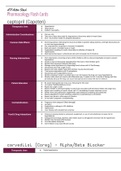
Therapeutic Uses Hypertension Heart failure Diabetic neuropathy Administration Considerations Oral use only Take two to three times daily for hypertension; three times daily for heart failure Give 1 hour before meals for adequate absorption Common Side Effects Severe hypotension following first dose (most likely in patients taking diuretics, with high blood pressure, or who have hyponatremia) Dry, nonproductive cough due to increase in bradykinin Rash and report of metallic taste in mouth Angioedema (swelling of mouth, throat [due to inhibition of kinase II]) Hyperkalemia Neutropenia (decrease in white blood cells with increased risk of infection) Nursing Interventions Start angiotensin-converting enzyme (ACE) inhibitors with low dose and gradually increase to prevent hypotension Diuretics may be temporarily stopped before first dose of ACE inhibitor given Monitor blood pressure following first dose Manage severe hypotension by expanding blood volume with IV fluid therapy Discontinue use if dry cough occurs Reports rash and metallic taste (ACE inhibitor may be discontinued) Treat severe angioedema with IV epinephrine Discontinue use if angioedema occurs Monitor potassium levels in a patient who is at risk, because the drug can cause hyperkalemia Monitor white blood cell counts with differential every 2 weeks for first 3 months of therapy and then periodically, because the drug can cause neutropenia and increase the risk for infectionTherapeutic Uses Hypertension Heart failure Diabetic neuropathy Administration Considerations Oral use only Take two to three times daily for hypertension; three times daily for heart failure Give 1 hour before meals for adequate absorption Common Side Effects Severe hypotension following first dose (most likely in patients taking diuretics, with high blood pressure, or who have hyponatremia) Dry, nonproductive cough due to increase in bradykinin Rash and report of metallic taste in mouth Angioedema (swelling of mouth, throat [due to inhibition of kinase II]) Hyperkalemia Neutropenia (decrease in white blood cells with increased risk of infection) Nursing Interventions Start angiotensin-converting enzyme (ACE) inhibitors with low dose and gradually increase to prevent hypotension Diuretics may be temporarily stopped before first dose of ACE inhibitor given Monitor blood pressure following first dose Manage severe hypotension by expanding blood volume with IV fluid therapy Discontinue use if dry cough occurs Reports rash and metallic taste (ACE inhibitor may be discontinued) Treat severe angioedema with IV epinephrine Discontinue use if angioedema occurs Monitor potassium levels in a patient who is at risk, because the drug can cause hyperkalemia Monitor white blood cell counts with differential every 2 weeks for first 3 months of therapy and then periodically, because the drug can cause neutropenia and increase the risk for infection
Document information
- Uploaded on
- May 30, 2021
- Number of pages
- 14
- Written in
- 2020/2021
- Type
- Exam (elaborations)
- Contains
- Questions & answers