
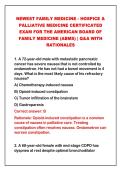
NEWEST FAMILY MEDICINE - HOSPICE &
PALLIATIVE MEDICINE CERTIFICATED
EXAM FOR THE AMERICAN BOARD OF
FAMILY MEDICINE (ABMS) | Q&A WITH
RATIONALES
1. A 72-year-old male with metastatic pancreatic
cancer has severe nausea that is not controlled by
ondansetron. He has not had a bowel movement in 4
days. What is the most likely cause of his refractory
nausea?
A) Chemotherapy-induced nausea
B) Opioid-induced constipation
C) Tumor infiltration of the brainstem
D) Gastroparesis
Correct answer: B
Rationale: Opioid-induced constipation is a common
cause of nausea in palliative care. Treating
constipation often resolves nausea. Ondansetron can
worsen constipation.
2. A 68-year-old female with end-stage COPD has
dyspnea at rest despite optimal bronchodilator
,therapy and low-dose oxygen. Her anxiety is
increasing. What is the most appropriate
pharmacologic intervention for her dyspnea?
A) Morphine 2.5 mg orally every 4 hours as needed
B) Albuterol nebulizer every 2 hours
C) Lorazepam 0.5 mg sublingual
D) Increase oxygen to 6 L/min
Correct answer: A
Rationale: Low-dose oral or subcutaneous morphine
reduces the sensation of dyspnea in advanced COPD
by decreasing central respiratory drive and anxiety.
Benzodiazepines are second-line.
3. A 55-year-old male with terminal liver cancer is
agitated and moaning. He is unconscious. His
breathing is irregular with periods of apnea. What is
the most appropriate next step?
A) Start continuous subcutaneous infusion of
midazolam and morphine
B) Administer haloperidol 5 mg IM
C) Check serum glucose and electrolytes
D) Transfer to ICU for possible reversible cause
Correct answer: A
,Rationale: Terminal delirium with signs of distress in
an actively dying patient requires continuous
palliative sedation. Midazolam plus an opioid is first-
line. Reversible causes should have been addressed
earlier.
4. A 78-year-old female with heart failure is admitted
with dyspnea and pain from bony metastases. She is
on furosemide 80 mg IV twice daily and
hydromorphone 2 mg IV every 2 hours. She becomes
acutely confused and has a myoclonic jerk. What is
the most likely cause?
A) Opioid neurotoxicity (hydromorphone)
B) Uremia from prerenal azotemia
C) Benzodiazepine withdrawal
D) Hypercalcemia of malignancy
Correct answer: A
Rationale: Opioid neurotoxicity presents with
confusion, myoclonus, and sometimes seizures. It is
more common with hydromorphone and morphine in
renal impairment. Dose reduction or rotation is
needed.
5. A 65-year-old male with metastatic lung cancer has
anorexia and has lost 15% of his body weight over 3
, months. He is not in severe pain or dyspnea. What is
the most appropriate intervention for cachexia?
A) Megestrol acetate 400 mg daily
B) Counseling on high-calorie supplements
C) Dexamethasone 4 mg daily
D) Discuss goals of care and avoid artificial nutrition
Correct answer: D
Rationale: Cancer cachexia does not respond to
nutritional supplements or appetite stimulants in
terms of functional outcomes. Artificial nutrition does
not improve survival or quality of life. Steroids are
short-term.
6. A 70-year-old female with advanced dementia and
recurrent aspiration pneumonia develops a fever and
increased secretions. She is unconscious and has a
do-not-resuscitate order. Her family wants
"everything except the breathing tube." What is the
most appropriate approach to antibiotics?
A) IV antibiotics for presumed pneumonia
B) Oral antibiotics only
C) Antibiotics only if signs of discomfort (e.g.,
grimacing, moaning)
D) No antibiotics under any circumstance
PALLIATIVE MEDICINE CERTIFICATED
EXAM FOR THE AMERICAN BOARD OF
FAMILY MEDICINE (ABMS) | Q&A WITH
RATIONALES
1. A 72-year-old male with metastatic pancreatic
cancer has severe nausea that is not controlled by
ondansetron. He has not had a bowel movement in 4
days. What is the most likely cause of his refractory
nausea?
A) Chemotherapy-induced nausea
B) Opioid-induced constipation
C) Tumor infiltration of the brainstem
D) Gastroparesis
Correct answer: B
Rationale: Opioid-induced constipation is a common
cause of nausea in palliative care. Treating
constipation often resolves nausea. Ondansetron can
worsen constipation.
2. A 68-year-old female with end-stage COPD has
dyspnea at rest despite optimal bronchodilator
,therapy and low-dose oxygen. Her anxiety is
increasing. What is the most appropriate
pharmacologic intervention for her dyspnea?
A) Morphine 2.5 mg orally every 4 hours as needed
B) Albuterol nebulizer every 2 hours
C) Lorazepam 0.5 mg sublingual
D) Increase oxygen to 6 L/min
Correct answer: A
Rationale: Low-dose oral or subcutaneous morphine
reduces the sensation of dyspnea in advanced COPD
by decreasing central respiratory drive and anxiety.
Benzodiazepines are second-line.
3. A 55-year-old male with terminal liver cancer is
agitated and moaning. He is unconscious. His
breathing is irregular with periods of apnea. What is
the most appropriate next step?
A) Start continuous subcutaneous infusion of
midazolam and morphine
B) Administer haloperidol 5 mg IM
C) Check serum glucose and electrolytes
D) Transfer to ICU for possible reversible cause
Correct answer: A
,Rationale: Terminal delirium with signs of distress in
an actively dying patient requires continuous
palliative sedation. Midazolam plus an opioid is first-
line. Reversible causes should have been addressed
earlier.
4. A 78-year-old female with heart failure is admitted
with dyspnea and pain from bony metastases. She is
on furosemide 80 mg IV twice daily and
hydromorphone 2 mg IV every 2 hours. She becomes
acutely confused and has a myoclonic jerk. What is
the most likely cause?
A) Opioid neurotoxicity (hydromorphone)
B) Uremia from prerenal azotemia
C) Benzodiazepine withdrawal
D) Hypercalcemia of malignancy
Correct answer: A
Rationale: Opioid neurotoxicity presents with
confusion, myoclonus, and sometimes seizures. It is
more common with hydromorphone and morphine in
renal impairment. Dose reduction or rotation is
needed.
5. A 65-year-old male with metastatic lung cancer has
anorexia and has lost 15% of his body weight over 3
, months. He is not in severe pain or dyspnea. What is
the most appropriate intervention for cachexia?
A) Megestrol acetate 400 mg daily
B) Counseling on high-calorie supplements
C) Dexamethasone 4 mg daily
D) Discuss goals of care and avoid artificial nutrition
Correct answer: D
Rationale: Cancer cachexia does not respond to
nutritional supplements or appetite stimulants in
terms of functional outcomes. Artificial nutrition does
not improve survival or quality of life. Steroids are
short-term.
6. A 70-year-old female with advanced dementia and
recurrent aspiration pneumonia develops a fever and
increased secretions. She is unconscious and has a
do-not-resuscitate order. Her family wants
"everything except the breathing tube." What is the
most appropriate approach to antibiotics?
A) IV antibiotics for presumed pneumonia
B) Oral antibiotics only
C) Antibiotics only if signs of discomfort (e.g.,
grimacing, moaning)
D) No antibiotics under any circumstance


