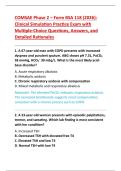
COMSAE Phase 2 – Form BSA 118 (2026):
Clinical Simulation Practice Exam with
Multiple-Choice Questions, Answers, and
Detailed Rationales
1. A 67-year-old man with COPD presents with increased
dyspnea and purulent sputum. ABG shows pH 7.31, PaCO₂
58 mmHg, HCO₃⁻ 30 mEq/L. What is the most likely acid-
base disorder?
A. Acute respiratory alkalosis
B. Metabolic acidosis
C. Chronic respiratory acidosis with compensation
D. Mixed metabolic and respiratory alkalosis
Rationale: The elevated PaCO₂ indicates respiratory acidosis.
The increased bicarbonate suggests renal compensation,
consistent with a chronic process such as COPD.
2. A 23-year-old woman presents with episodic palpitations,
tremor, and sweating. Which lab finding is most consistent
with her condition?
A. Increased TSH
B. Decreased TSH with elevated free T4
C. Elevated TSH and low T4
D. Normal TSH with low T4
,Rationale: Symptoms suggest hyperthyroidism, most
commonly Graves disease, characterized by suppressed TSH
and elevated T4.
3. A 58-year-old man has chest pain radiating to the left
arm. ECG shows ST elevation in leads II, III, and aVF. Which
coronary artery is most likely occluded?
A. Left anterior descending artery
B. Left circumflex artery
C. Right coronary artery
D. Posterior descending artery
Rationale: Inferior wall MI (II, III, aVF) is most commonly due
to right coronary artery occlusion.
4. A child presents with edema, proteinuria, and
hypoalbuminemia. Which pathology is most likely?
A. Post-streptococcal glomerulonephritis
B. Minimal change disease
C. IgA nephropathy
D. Alport syndrome
Rationale: Minimal change disease is the most common cause
of nephrotic syndrome in children.
5. A patient develops a fixed, dilated pupil after head
trauma. Which structure is most likely compressed?
,A. Optic nerve
B. Oculomotor nerve (CN III)
C. Trochlear nerve
D. Abducens nerve
Rationale: CN III compression leads to unopposed
sympathetic dilation causing a fixed, dilated pupil.
6. A 45-year-old woman presents with fatigue, cold
intolerance, and weight gain. Labs show elevated TSH and
low free T4. Diagnosis?
A. Graves disease
B. Hashimoto thyroiditis
C. Subacute thyroiditis
D. Thyroid cancer
Rationale: High TSH with low T4 indicates primary
hypothyroidism, commonly due to Hashimoto thyroiditis.
7. A patient is started on heparin. Which lab should be
monitored?
A. INR
B. aPTT
C. Bleeding time
D. Platelet count only
Rationale: Heparin therapy is monitored using aPTT, which
reflects intrinsic pathway activity.
, 8. A newborn fails to pass meconium and has abdominal
distension. Biopsy shows absence of ganglion cells.
Diagnosis?
A. Meconium ileus
B. Hirschsprung disease
C. Pyloric stenosis
D. Intussusception
Rationale: Absence of ganglion cells in distal colon indicates
Hirschsprung disease.
9. A 30-year-old man presents with urethral discharge. Gram
stain shows intracellular gram-negative diplococci.
Organism?
A. Chlamydia trachomatis
B. Neisseria gonorrhoeae
C. Treponema pallidum
D. Ureaplasma urealyticum
Rationale: Intracellular gram-negative diplococci are
characteristic of Neisseria gonorrhoeae.
10. A patient has muscle weakness that improves with
activity. Diagnosis?
A. Myasthenia gravis
B. Lambert-Eaton syndrome
C. Botulism
D. ALS
Clinical Simulation Practice Exam with
Multiple-Choice Questions, Answers, and
Detailed Rationales
1. A 67-year-old man with COPD presents with increased
dyspnea and purulent sputum. ABG shows pH 7.31, PaCO₂
58 mmHg, HCO₃⁻ 30 mEq/L. What is the most likely acid-
base disorder?
A. Acute respiratory alkalosis
B. Metabolic acidosis
C. Chronic respiratory acidosis with compensation
D. Mixed metabolic and respiratory alkalosis
Rationale: The elevated PaCO₂ indicates respiratory acidosis.
The increased bicarbonate suggests renal compensation,
consistent with a chronic process such as COPD.
2. A 23-year-old woman presents with episodic palpitations,
tremor, and sweating. Which lab finding is most consistent
with her condition?
A. Increased TSH
B. Decreased TSH with elevated free T4
C. Elevated TSH and low T4
D. Normal TSH with low T4
,Rationale: Symptoms suggest hyperthyroidism, most
commonly Graves disease, characterized by suppressed TSH
and elevated T4.
3. A 58-year-old man has chest pain radiating to the left
arm. ECG shows ST elevation in leads II, III, and aVF. Which
coronary artery is most likely occluded?
A. Left anterior descending artery
B. Left circumflex artery
C. Right coronary artery
D. Posterior descending artery
Rationale: Inferior wall MI (II, III, aVF) is most commonly due
to right coronary artery occlusion.
4. A child presents with edema, proteinuria, and
hypoalbuminemia. Which pathology is most likely?
A. Post-streptococcal glomerulonephritis
B. Minimal change disease
C. IgA nephropathy
D. Alport syndrome
Rationale: Minimal change disease is the most common cause
of nephrotic syndrome in children.
5. A patient develops a fixed, dilated pupil after head
trauma. Which structure is most likely compressed?
,A. Optic nerve
B. Oculomotor nerve (CN III)
C. Trochlear nerve
D. Abducens nerve
Rationale: CN III compression leads to unopposed
sympathetic dilation causing a fixed, dilated pupil.
6. A 45-year-old woman presents with fatigue, cold
intolerance, and weight gain. Labs show elevated TSH and
low free T4. Diagnosis?
A. Graves disease
B. Hashimoto thyroiditis
C. Subacute thyroiditis
D. Thyroid cancer
Rationale: High TSH with low T4 indicates primary
hypothyroidism, commonly due to Hashimoto thyroiditis.
7. A patient is started on heparin. Which lab should be
monitored?
A. INR
B. aPTT
C. Bleeding time
D. Platelet count only
Rationale: Heparin therapy is monitored using aPTT, which
reflects intrinsic pathway activity.
, 8. A newborn fails to pass meconium and has abdominal
distension. Biopsy shows absence of ganglion cells.
Diagnosis?
A. Meconium ileus
B. Hirschsprung disease
C. Pyloric stenosis
D. Intussusception
Rationale: Absence of ganglion cells in distal colon indicates
Hirschsprung disease.
9. A 30-year-old man presents with urethral discharge. Gram
stain shows intracellular gram-negative diplococci.
Organism?
A. Chlamydia trachomatis
B. Neisseria gonorrhoeae
C. Treponema pallidum
D. Ureaplasma urealyticum
Rationale: Intracellular gram-negative diplococci are
characteristic of Neisseria gonorrhoeae.
10. A patient has muscle weakness that improves with
activity. Diagnosis?
A. Myasthenia gravis
B. Lambert-Eaton syndrome
C. Botulism
D. ALS