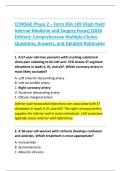
COMSAE Phase 2 – Form BSA 109 (High-Yield
Internal Medicine and Surgery Focus) (2026
Edition): Comprehensive Multiple-Choice
Questions, Answers, and Detailed Rationales
1. A 67-year-old man presents with crushing substernal
chest pain radiating to his left arm. ECG shows ST-segment
elevations in leads II, III, and aVF. Which coronary artery is
most likely occluded?
A. Left anterior descending artery
B. Left circumflex artery
C. Right coronary artery
D. Posterior descending artery
E. Obtuse marginal artery
Inferior wall myocardial infarctions are associated with ST
elevations in leads II, III, and aVF. The right coronary artery
supplies the inferior wall in most individuals. LAD occlusions
typically cause anterior wall infarctions.
2. A 58-year-old woman with cirrhosis develops confusion
and asterixis. Which treatment is most appropriate?
A. Furosemide
B. Spironolactone
C. Albumin infusion
,D. Lactulose
E. Propranolol
This patient has hepatic encephalopathy. Lactulose acidifies
the colon, converting ammonia into nonabsorbable
ammonium and reducing serum ammonia levels. It is first-line
therapy.
3. A patient develops sudden unilateral leg swelling after
prolonged travel. Which diagnostic test is most appropriate
initially?
A. CT angiography
B. Venography
C. D-dimer only
D. MRI
E. Compression ultrasonography
Compression ultrasonography is the preferred initial test for
suspected deep venous thrombosis because it is sensitive,
specific, noninvasive, and readily available.
4. A 72-year-old man with a history of smoking presents
with a pulsatile abdominal mass. What is the most likely
diagnosis?
A. Mesenteric ischemia
B. Aortic dissection
C. Abdominal aortic aneurysm
,D. Retroperitoneal fibrosis
E. Renal artery stenosis
An abdominal aortic aneurysm commonly presents as a
pulsatile abdominal mass in older male smokers. Ultrasound
is the preferred screening modality.
5. Which organism is the most common cause of
spontaneous bacterial peritonitis?
A. Staphylococcus aureus
B. Bacteroides fragilis
C. Enterococcus faecalis
D. Escherichia coli
E. Clostridium difficile
Escherichia coli is the most common cause of spontaneous
bacterial peritonitis due to bacterial translocation from the
gastrointestinal tract.
6. A patient presents with severe epigastric pain radiating to
the back and elevated lipase. What is the most likely
diagnosis?
A. Cholecystitis
B. Gastritis
C. Peptic ulcer disease
D. Appendicitis
E. Acute pancreatitis
, Acute pancreatitis classically presents with severe epigastric
pain radiating to the back and elevated serum lipase levels.
7. Which physical examination finding is most suggestive of
aortic stenosis?
A. Holosystolic murmur at apex
B. Continuous machinery murmur
C. Mid-systolic click
D. Crescendo-decrescendo systolic murmur at right upper
sternal border
E. Opening snap
Aortic stenosis produces a harsh crescendo-decrescendo
systolic murmur heard best at the right upper sternal border
with radiation to the carotids.
8. A patient develops fever, hypotension, and warm
extremities after pneumonia. Which type of shock is most
likely?
A. Cardiogenic
B. Hypovolemic
C. Obstructive
D. Neurogenic
E. Septic
Septic shock results from systemic vasodilation and
inflammatory mediator release, often causing warm
extremities and hypotension early in the disease.
Internal Medicine and Surgery Focus) (2026
Edition): Comprehensive Multiple-Choice
Questions, Answers, and Detailed Rationales
1. A 67-year-old man presents with crushing substernal
chest pain radiating to his left arm. ECG shows ST-segment
elevations in leads II, III, and aVF. Which coronary artery is
most likely occluded?
A. Left anterior descending artery
B. Left circumflex artery
C. Right coronary artery
D. Posterior descending artery
E. Obtuse marginal artery
Inferior wall myocardial infarctions are associated with ST
elevations in leads II, III, and aVF. The right coronary artery
supplies the inferior wall in most individuals. LAD occlusions
typically cause anterior wall infarctions.
2. A 58-year-old woman with cirrhosis develops confusion
and asterixis. Which treatment is most appropriate?
A. Furosemide
B. Spironolactone
C. Albumin infusion
,D. Lactulose
E. Propranolol
This patient has hepatic encephalopathy. Lactulose acidifies
the colon, converting ammonia into nonabsorbable
ammonium and reducing serum ammonia levels. It is first-line
therapy.
3. A patient develops sudden unilateral leg swelling after
prolonged travel. Which diagnostic test is most appropriate
initially?
A. CT angiography
B. Venography
C. D-dimer only
D. MRI
E. Compression ultrasonography
Compression ultrasonography is the preferred initial test for
suspected deep venous thrombosis because it is sensitive,
specific, noninvasive, and readily available.
4. A 72-year-old man with a history of smoking presents
with a pulsatile abdominal mass. What is the most likely
diagnosis?
A. Mesenteric ischemia
B. Aortic dissection
C. Abdominal aortic aneurysm
,D. Retroperitoneal fibrosis
E. Renal artery stenosis
An abdominal aortic aneurysm commonly presents as a
pulsatile abdominal mass in older male smokers. Ultrasound
is the preferred screening modality.
5. Which organism is the most common cause of
spontaneous bacterial peritonitis?
A. Staphylococcus aureus
B. Bacteroides fragilis
C. Enterococcus faecalis
D. Escherichia coli
E. Clostridium difficile
Escherichia coli is the most common cause of spontaneous
bacterial peritonitis due to bacterial translocation from the
gastrointestinal tract.
6. A patient presents with severe epigastric pain radiating to
the back and elevated lipase. What is the most likely
diagnosis?
A. Cholecystitis
B. Gastritis
C. Peptic ulcer disease
D. Appendicitis
E. Acute pancreatitis
, Acute pancreatitis classically presents with severe epigastric
pain radiating to the back and elevated serum lipase levels.
7. Which physical examination finding is most suggestive of
aortic stenosis?
A. Holosystolic murmur at apex
B. Continuous machinery murmur
C. Mid-systolic click
D. Crescendo-decrescendo systolic murmur at right upper
sternal border
E. Opening snap
Aortic stenosis produces a harsh crescendo-decrescendo
systolic murmur heard best at the right upper sternal border
with radiation to the carotids.
8. A patient develops fever, hypotension, and warm
extremities after pneumonia. Which type of shock is most
likely?
A. Cardiogenic
B. Hypovolemic
C. Obstructive
D. Neurogenic
E. Septic
Septic shock results from systemic vasodilation and
inflammatory mediator release, often causing warm
extremities and hypotension early in the disease.