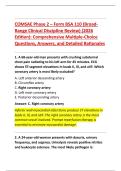
COMSAE Phase 2 – Form BSA 110 (Broad-
Range Clinical Discipline Review) (2026
Edition): Comprehensive Multiple-Choice
Questions, Answers, and Detailed Rationales
1. A 68-year-old man presents with crushing substernal
chest pain radiating to his left arm for 45 minutes. ECG
shows ST-segment elevations in leads II, III, and aVF. Which
coronary artery is most likely occluded?
A. Left anterior descending artery
B. Circumflex artery
C. Right coronary artery
D. Left main coronary artery
E. Posterior descending artery
Answer: C. Right coronary artery
Inferior wall myocardial infarctions produce ST elevations in
leads II, III, and aVF. The right coronary artery is the most
common vessel involved. Prompt reperfusion therapy is
essential to minimize myocardial damage.
2. A 24-year-old woman presents with dysuria, urinary
frequency, and urgency. Urinalysis reveals positive nitrites
and leukocyte esterase. The most likely pathogen is:
,A. Staphylococcus saprophyticus
B. Enterococcus faecalis
C. Proteus mirabilis
D. Escherichia coli
E. Klebsiella pneumoniae
Answer: D. Escherichia coli
E. coli is responsible for approximately 80–85% of
uncomplicated urinary tract infections. Nitrite positivity
reflects nitrate-reducing gram-negative organisms, especially
E. coli.
3. A patient with chronic alcohol use presents with
confusion, ophthalmoplegia, and ataxia. Which vitamin
deficiency is most likely responsible?
A. Vitamin B12
B. Niacin
C. Pyridoxine
D. Folate
E. Thiamine
Answer: E. Thiamine
The classic triad of Wernicke encephalopathy consists of
confusion, ophthalmoplegia, and ataxia. It results from
thiamine deficiency and requires immediate intravenous
thiamine administration.
,4. A 5-year-old boy develops fever, conjunctivitis, cracked
lips, and cervical lymphadenopathy. What is the most
serious complication?
A. Rheumatic heart disease
B. Endocarditis
C. Coronary artery aneurysm
D. Pulmonary hypertension
E. Myocarditis
Answer: C. Coronary artery aneurysm
Kawasaki disease causes medium-vessel vasculitis and may
result in coronary artery aneurysms. Early treatment with
IVIG and aspirin reduces this risk.
5. A 30-year-old woman presents with tremor, heat
intolerance, weight loss, and exophthalmos. The diagnosis
is:
A. Toxic multinodular goiter
B. Hashimoto thyroiditis
C. Subacute thyroiditis
D. Thyroid adenoma
E. Graves disease
Answer: E. Graves disease
Graves disease is an autoimmune hyperthyroid disorder
caused by thyroid-stimulating immunoglobulins.
Exophthalmos is highly characteristic.
, 6. A patient develops sudden unilateral facial weakness
involving the forehead. The diagnosis is:
A. Stroke
B. Trigeminal neuralgia
C. Myasthenia gravis
D. Bell palsy
E. Multiple sclerosis
Answer: D. Bell palsy
Bell palsy is a lower motor neuron facial nerve palsy affecting
both upper and lower facial muscles. Forehead involvement
distinguishes it from most cortical strokes.
7. A 55-year-old smoker presents with hematuria. Which
diagnosis should be strongly suspected?
A. Renal cyst
B. Pyelonephritis
C. Nephrolithiasis
D. Glomerulonephritis
E. Bladder cancer
Answer: E. Bladder cancer
Painless gross hematuria in a smoker is bladder cancer until
proven otherwise. Transitional cell carcinoma is the most
common type.
8. Which organism is the most common cause of
community-acquired pneumonia?
Range Clinical Discipline Review) (2026
Edition): Comprehensive Multiple-Choice
Questions, Answers, and Detailed Rationales
1. A 68-year-old man presents with crushing substernal
chest pain radiating to his left arm for 45 minutes. ECG
shows ST-segment elevations in leads II, III, and aVF. Which
coronary artery is most likely occluded?
A. Left anterior descending artery
B. Circumflex artery
C. Right coronary artery
D. Left main coronary artery
E. Posterior descending artery
Answer: C. Right coronary artery
Inferior wall myocardial infarctions produce ST elevations in
leads II, III, and aVF. The right coronary artery is the most
common vessel involved. Prompt reperfusion therapy is
essential to minimize myocardial damage.
2. A 24-year-old woman presents with dysuria, urinary
frequency, and urgency. Urinalysis reveals positive nitrites
and leukocyte esterase. The most likely pathogen is:
,A. Staphylococcus saprophyticus
B. Enterococcus faecalis
C. Proteus mirabilis
D. Escherichia coli
E. Klebsiella pneumoniae
Answer: D. Escherichia coli
E. coli is responsible for approximately 80–85% of
uncomplicated urinary tract infections. Nitrite positivity
reflects nitrate-reducing gram-negative organisms, especially
E. coli.
3. A patient with chronic alcohol use presents with
confusion, ophthalmoplegia, and ataxia. Which vitamin
deficiency is most likely responsible?
A. Vitamin B12
B. Niacin
C. Pyridoxine
D. Folate
E. Thiamine
Answer: E. Thiamine
The classic triad of Wernicke encephalopathy consists of
confusion, ophthalmoplegia, and ataxia. It results from
thiamine deficiency and requires immediate intravenous
thiamine administration.
,4. A 5-year-old boy develops fever, conjunctivitis, cracked
lips, and cervical lymphadenopathy. What is the most
serious complication?
A. Rheumatic heart disease
B. Endocarditis
C. Coronary artery aneurysm
D. Pulmonary hypertension
E. Myocarditis
Answer: C. Coronary artery aneurysm
Kawasaki disease causes medium-vessel vasculitis and may
result in coronary artery aneurysms. Early treatment with
IVIG and aspirin reduces this risk.
5. A 30-year-old woman presents with tremor, heat
intolerance, weight loss, and exophthalmos. The diagnosis
is:
A. Toxic multinodular goiter
B. Hashimoto thyroiditis
C. Subacute thyroiditis
D. Thyroid adenoma
E. Graves disease
Answer: E. Graves disease
Graves disease is an autoimmune hyperthyroid disorder
caused by thyroid-stimulating immunoglobulins.
Exophthalmos is highly characteristic.
, 6. A patient develops sudden unilateral facial weakness
involving the forehead. The diagnosis is:
A. Stroke
B. Trigeminal neuralgia
C. Myasthenia gravis
D. Bell palsy
E. Multiple sclerosis
Answer: D. Bell palsy
Bell palsy is a lower motor neuron facial nerve palsy affecting
both upper and lower facial muscles. Forehead involvement
distinguishes it from most cortical strokes.
7. A 55-year-old smoker presents with hematuria. Which
diagnosis should be strongly suspected?
A. Renal cyst
B. Pyelonephritis
C. Nephrolithiasis
D. Glomerulonephritis
E. Bladder cancer
Answer: E. Bladder cancer
Painless gross hematuria in a smoker is bladder cancer until
proven otherwise. Transitional cell carcinoma is the most
common type.
8. Which organism is the most common cause of
community-acquired pneumonia?