COMSAE Phase 2 – Form BSA 105 (Classic
Multi-Disciplinary Clerkship Simulation)
(2026 Edition): Comprehensive Multiple-
Choice Questions, Answers, and Detailed
Rationales
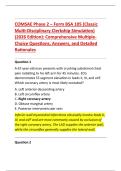
Question 1
A 67-year-old man presents with crushing substernal chest
pain radiating to his left arm for 45 minutes. ECG
demonstrates ST-segment elevation in leads II, III, and aVF.
Which coronary artery is most likely occluded?
A. Left anterior descending artery
B. Left circumflex artery
C. Right coronary artery
D. Obtuse marginal artery
E. Posterior interventricular vein
Inferior wall myocardial infarctions classically involve leads II,
III, and aVF and are most commonly caused by occlusion of
the right coronary artery. The LAD supplies the anterior wall,
while the circumflex generally supplies the lateral wall.
Question 2
,A 24-year-old woman develops fever, dysuria, flank pain, and
costovertebral angle tenderness. Urinalysis reveals white
blood cell casts. What is the most likely diagnosis?
A. Acute cystitis
B. Nephrolithiasis
C. Interstitial nephritis
D. Acute pyelonephritis
E. Glomerulonephritis
White blood cell casts indicate inflammation within the renal
tubules and are characteristic of pyelonephritis. Flank pain
and fever further support upper urinary tract infection.
Question 3
A newborn develops respiratory distress shortly after
delivery. Chest radiograph reveals diffuse ground-glass
opacities. The underlying problem is deficiency of:
A. Elastase
B. Type I collagen
C. Alpha-1 antitrypsin
D. Surfactant
E. Fibrinogen
Neonatal respiratory distress syndrome results from
insufficient surfactant production by type II pneumocytes,
causing alveolar collapse and impaired gas exchange.
Question 4
,A 54-year-old woman reports fatigue, pruritus, and jaundice.
Laboratory studies reveal elevated alkaline phosphatase and
positive antimitochondrial antibodies. Diagnosis?
A. Primary sclerosing cholangitis
B. Autoimmune hepatitis
C. Viral hepatitis B
D. Alcoholic hepatitis
E. Primary biliary cholangitis
Primary biliary cholangitis is characterized by autoimmune
destruction of intrahepatic bile ducts, elevated alkaline
phosphatase, and antimitochondrial antibodies.
Question 5
A patient develops sudden unilateral facial paralysis affecting
both the forehead and lower face. Which diagnosis is most
likely?
A. Stroke
B. Trigeminal neuralgia
C. Myasthenia gravis
D. Bell palsy
E. Temporal arteritis
Bell palsy is a peripheral facial nerve palsy affecting the entire
ipsilateral face, including the forehead. Central lesions such as
stroke usually spare forehead movement.
Question 6
, A 72-year-old smoker presents with painless hematuria.
Which diagnosis should be considered most strongly?
A. Pyelonephritis
B. Urethritis
C. Renal infarction
D. Benign prostatic hyperplasia
E. Bladder cancer
Painless gross hematuria in an older smoker is bladder cancer
until proven otherwise. Cigarette smoking is a major risk
factor for urothelial carcinoma.
Question 7
A 6-year-old child presents with a barking cough and
inspiratory stridor. Symptoms worsen at night. Most likely
diagnosis?
A. Epiglottitis
B. Asthma
C. Bronchiolitis
D. Croup
E. Foreign body aspiration
Croup is typically caused by parainfluenza virus and presents
with barking cough, hoarseness, and inspiratory stridor.
Question 8
A woman at 32 weeks gestation develops hypertension,
proteinuria, and edema. What is the diagnosis?
Multi-Disciplinary Clerkship Simulation)
(2026 Edition): Comprehensive Multiple-
Choice Questions, Answers, and Detailed
Rationales
Question 1
A 67-year-old man presents with crushing substernal chest
pain radiating to his left arm for 45 minutes. ECG
demonstrates ST-segment elevation in leads II, III, and aVF.
Which coronary artery is most likely occluded?
A. Left anterior descending artery
B. Left circumflex artery
C. Right coronary artery
D. Obtuse marginal artery
E. Posterior interventricular vein
Inferior wall myocardial infarctions classically involve leads II,
III, and aVF and are most commonly caused by occlusion of
the right coronary artery. The LAD supplies the anterior wall,
while the circumflex generally supplies the lateral wall.
Question 2
,A 24-year-old woman develops fever, dysuria, flank pain, and
costovertebral angle tenderness. Urinalysis reveals white
blood cell casts. What is the most likely diagnosis?
A. Acute cystitis
B. Nephrolithiasis
C. Interstitial nephritis
D. Acute pyelonephritis
E. Glomerulonephritis
White blood cell casts indicate inflammation within the renal
tubules and are characteristic of pyelonephritis. Flank pain
and fever further support upper urinary tract infection.
Question 3
A newborn develops respiratory distress shortly after
delivery. Chest radiograph reveals diffuse ground-glass
opacities. The underlying problem is deficiency of:
A. Elastase
B. Type I collagen
C. Alpha-1 antitrypsin
D. Surfactant
E. Fibrinogen
Neonatal respiratory distress syndrome results from
insufficient surfactant production by type II pneumocytes,
causing alveolar collapse and impaired gas exchange.
Question 4
,A 54-year-old woman reports fatigue, pruritus, and jaundice.
Laboratory studies reveal elevated alkaline phosphatase and
positive antimitochondrial antibodies. Diagnosis?
A. Primary sclerosing cholangitis
B. Autoimmune hepatitis
C. Viral hepatitis B
D. Alcoholic hepatitis
E. Primary biliary cholangitis
Primary biliary cholangitis is characterized by autoimmune
destruction of intrahepatic bile ducts, elevated alkaline
phosphatase, and antimitochondrial antibodies.
Question 5
A patient develops sudden unilateral facial paralysis affecting
both the forehead and lower face. Which diagnosis is most
likely?
A. Stroke
B. Trigeminal neuralgia
C. Myasthenia gravis
D. Bell palsy
E. Temporal arteritis
Bell palsy is a peripheral facial nerve palsy affecting the entire
ipsilateral face, including the forehead. Central lesions such as
stroke usually spare forehead movement.
Question 6
, A 72-year-old smoker presents with painless hematuria.
Which diagnosis should be considered most strongly?
A. Pyelonephritis
B. Urethritis
C. Renal infarction
D. Benign prostatic hyperplasia
E. Bladder cancer
Painless gross hematuria in an older smoker is bladder cancer
until proven otherwise. Cigarette smoking is a major risk
factor for urothelial carcinoma.
Question 7
A 6-year-old child presents with a barking cough and
inspiratory stridor. Symptoms worsen at night. Most likely
diagnosis?
A. Epiglottitis
B. Asthma
C. Bronchiolitis
D. Croup
E. Foreign body aspiration
Croup is typically caused by parainfluenza virus and presents
with barking cough, hoarseness, and inspiratory stridor.
Question 8
A woman at 32 weeks gestation develops hypertension,
proteinuria, and edema. What is the diagnosis?