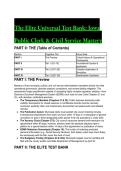
The Elite Universal Test Bank: Iowa
Public Clerk & Civil Service Mastery
PART 0: THE (Table of Contents)
Section Cognitive Tier Focus Area
PART I The Preview Critical Axioms & Operational
Frameworks
PART II Tier 1 (Q1-10) Foundational Syntax &
Application
PART III Tier 2 (Q11-20) Complex Application &
Simulation
PART IV Tier 3 (Q21-30) Grandmaster Synthesis
PART I: THE Preview
Mastery of Iowa municipal, judicial, and civil service administration translates directly into elite
operational governance, absolute statutory compliance, and severe liability mitigation. This
assessment forges practitioners capable of navigating highly complex regulatory statutes—from
Electronic Document Management System (EDMS) court rules to Iowa Code Chapters 21 and
22—with absolute, methodical precision.
● The Transparency Mandate (Chapters 21 & 22): Public business demands public
visibility. Exemptions for closed sessions or confidential records must be narrowly
construed, explicitly cited, and meticulously documented via sealed audio and detailed
minutes.
● The Publication Axiom: Municipal clerks must publish city council meeting minutes,
including total expenditures from each city fund, within 15 days in a newspaper of general
circulation (or post in three designated public places if the city population is under 200).
● The Vacancy Clock (Chapter 372): City council vacancies demand swift resolution via
appointment within 60 days; however, electors retain the absolute statutory right to
petition for a special election within 14 days of the appointment or publication of notice.
● EDMS Redaction Sovereignty (Chapter 16): The burden of redacting protected
personal information (e.g., Social Security Numbers, birth dates) under Iowa Court Rules
lies exclusively with the filer, never the clerk of court.
● The Budgetary Finality (Chapters 24 & 384): Municipal budgets must be certified and
filed with the county auditor and State Department of Management by April 30.
PART II: THE ELITE TEST BANK
,Tier 1 - Foundational Syntax & Application
Q1: A city council in Iowa concludes a regular meeting where several large financial claims were
approved. The City Clerk is preparing the official record for public distribution. Based on the
principles of Iowa Code Section 372.13, which action/conclusion is the MOST ACCURATE? A)
The clerk must publish the minutes in a newspaper of general circulation within 30 days,
summarizing all claims into a single gross figure. B) The clerk must post the minutes on the
city's official website within 7 business days to satisfy the legal publication requirement. C) The
clerk must publish the minutes, including a list of all claims allowed and total expenditures from
each fund, within 15 days in a newspaper of general circulation. D) The clerk must submit the
minutes exclusively to the county auditor within 10 days for official retention and publication.
● The Answer: C (The clerk must publish the minutes, including a list of all claims allowed
and total expenditures from each fund, within 15 days in a newspaper of general
circulation.)
● Distractor Analysis:
○ A is incorrect: The statutory deadline is 15 days, not 30, and claims must be listed
individually alongside total expenditures, not hidden within a single gross figure.
○ B is incorrect: Website posting does not legally satisfy the statutory requirement for
newspaper publication for cities over 200 in population.
○ D is incorrect: Minutes are not submitted to the county auditor for publication; this is
a direct, unilateral municipal clerk responsibility.
The Mentor's Analysis: Transparency in municipal finance requires prompt, accessible, and
detailed public reporting. When finalizing meeting records, the immediate priority is adhering to
the rigid statutory timeline for print publication. By utilizing Section 372.13(6) compliance, the
practitioner bypasses the common trap of treating website updates as legal equivalents to
statutory publication. Professional/Academic Intuition: The 15-day publication rule is a hard
deck; failure to publish detailed minutes and claims constitutes a simple misdemeanor in Iowa.
Q2: A citizen submits a broad request to a city clerk to examine public records under Iowa Code
Chapter 22. The clerk suspects that several of the requested documents contain confidential
personnel information that must be redacted. Based on the principles of the Iowa Open Records
Law, which action/conclusion is the MOST ACCURATE? A) The clerk may delay the release
indefinitely until the city attorney returns from a month-long leave to review the documents. B)
The clerk must immediately release all documents, as public access supersedes all
confidentiality claims. C) The clerk may enact a good-faith, reasonable delay—ordinarily not
exceeding 10 business days—to determine if a confidential record exemption applies. D) The
clerk should require the citizen to obtain a judicial subpoena before processing any request that
involves potentially confidential files.
● The Answer: C (The clerk may enact a good-faith, reasonable delay—ordinarily not
exceeding 10 business days—to determine if a confidential record exemption applies.)
● Distractor Analysis:
○ A is incorrect: Indefinite delays explicitly violate the statute; delays must be
reasonable and bounded by specific statutory guidelines, capping absolutely at 20
calendar days.
○ B is incorrect: Chapter 22 explicitly defines numerous exceptions where records
must be kept confidential (e.g., medical records, specific personnel data).
○ D is incorrect: A subpoena is not required to trigger an open records request
review; the clerk acts as the lawful custodian and must evaluate the request
, internally first.
The Mentor's Analysis: The law delicately balances the public's right to know against the
individual's right to statutory privacy. When facing a complex records request, the immediate
priority is isolating exempt data without obstructing lawful access. By utilizing the good-faith
delay provision, the practitioner bypasses the common trap of either executing illegal data
dumps or engaging in unlawful obstruction. Professional/Academic Intuition: A delay in
records release is only defensible if it is actively utilized to determine the legal confidentiality of
the requested artifacts, capping ordinarily at 10 business days.
Q3: An attorney submits a civil filing through the Iowa Judicial Branch Electronic Document
Management System (EDMS) at 11:58 PM on the day the statute of limitations expires. The
clerk's office reviews and approves the document the following morning at 8:15 AM. Based on
the principles of Iowa Court Rules Chapter 16, which action/conclusion is the MOST
ACCURATE? A) The filing is rejected because it was not manually approved by the clerk before
midnight on the deadline. B) The filing is deemed timely for statute of limitations purposes
because the system returned a "Received" status before midnight. C) The filing is deemed
timely only if the attorney files a motion for retroactive application the next business day. D) The
filing is invalid because EDMS submissions must be completed during standard courthouse
business hours (8:00 AM - 4:30 PM).
● The Answer: B (The filing is deemed timely for statute of limitations purposes because
the system returned a "Received" status before midnight.)
● Distractor Analysis:
○ A is incorrect: The clerk's manual approval (triggering the "Filed" status) dictates
general completeness, but the automated "Received" timestamp strictly governs the
statute of limitations.
○ C is incorrect: No retroactive motion is necessary; the system's automated
electronic receipt inherently establishes the legal timeline.
○ D is incorrect: EDMS infrastructure allows 24/7 electronic submission; the concept
of physical business hours does not restrict the electronic timestamp.
The Mentor's Analysis: Digital infrastructure decouples legal filing from physical courthouse
operations. When facing deadline-driven electronic submissions, the immediate priority is
securing the automated receipt timestamp. By utilizing the distinction between "Received" and
"Filed" statuses, the practitioner bypasses the common trap of conflating administrative
processing times with legal submission deadlines. Professional/Academic Intuition: For
statutes of limitations, the EDMS "Received" status is the absolute anchor of timeliness.
Q4: A city council enters a closed session to discuss strategy involving imminent litigation
against a former vendor. Based on the principles of Iowa Code Chapter 21 (Open Meetings),
which action/conclusion is the MOST ACCURATE? A) The council must keep written minutes
but may turn off all audio recording devices to ensure complete attorney-client candor. B) The
council must audio record the entire closed session and keep detailed minutes, both of which
must be sealed. C) The council must allow the press to remain in the room but forbid them from
publishing the discussion. D) The council may vote on the final financial settlement agreement
during the closed session to protect the city's negotiation leverage.
● The Answer: B (The council must audio record the entire closed session and keep
detailed minutes, both of which must be sealed.)
● Distractor Analysis:
○ A is incorrect: Chapter 21.5(4) explicitly mandates that all closed sessions must be
audio recorded; failure to do so is a severe, indefensible statutory violation.
○ C is incorrect: Closed sessions exclude the public and press entirely; gag orders on
Public Clerk & Civil Service Mastery
PART 0: THE (Table of Contents)
Section Cognitive Tier Focus Area
PART I The Preview Critical Axioms & Operational
Frameworks
PART II Tier 1 (Q1-10) Foundational Syntax &
Application
PART III Tier 2 (Q11-20) Complex Application &
Simulation
PART IV Tier 3 (Q21-30) Grandmaster Synthesis
PART I: THE Preview
Mastery of Iowa municipal, judicial, and civil service administration translates directly into elite
operational governance, absolute statutory compliance, and severe liability mitigation. This
assessment forges practitioners capable of navigating highly complex regulatory statutes—from
Electronic Document Management System (EDMS) court rules to Iowa Code Chapters 21 and
22—with absolute, methodical precision.
● The Transparency Mandate (Chapters 21 & 22): Public business demands public
visibility. Exemptions for closed sessions or confidential records must be narrowly
construed, explicitly cited, and meticulously documented via sealed audio and detailed
minutes.
● The Publication Axiom: Municipal clerks must publish city council meeting minutes,
including total expenditures from each city fund, within 15 days in a newspaper of general
circulation (or post in three designated public places if the city population is under 200).
● The Vacancy Clock (Chapter 372): City council vacancies demand swift resolution via
appointment within 60 days; however, electors retain the absolute statutory right to
petition for a special election within 14 days of the appointment or publication of notice.
● EDMS Redaction Sovereignty (Chapter 16): The burden of redacting protected
personal information (e.g., Social Security Numbers, birth dates) under Iowa Court Rules
lies exclusively with the filer, never the clerk of court.
● The Budgetary Finality (Chapters 24 & 384): Municipal budgets must be certified and
filed with the county auditor and State Department of Management by April 30.
PART II: THE ELITE TEST BANK
,Tier 1 - Foundational Syntax & Application
Q1: A city council in Iowa concludes a regular meeting where several large financial claims were
approved. The City Clerk is preparing the official record for public distribution. Based on the
principles of Iowa Code Section 372.13, which action/conclusion is the MOST ACCURATE? A)
The clerk must publish the minutes in a newspaper of general circulation within 30 days,
summarizing all claims into a single gross figure. B) The clerk must post the minutes on the
city's official website within 7 business days to satisfy the legal publication requirement. C) The
clerk must publish the minutes, including a list of all claims allowed and total expenditures from
each fund, within 15 days in a newspaper of general circulation. D) The clerk must submit the
minutes exclusively to the county auditor within 10 days for official retention and publication.
● The Answer: C (The clerk must publish the minutes, including a list of all claims allowed
and total expenditures from each fund, within 15 days in a newspaper of general
circulation.)
● Distractor Analysis:
○ A is incorrect: The statutory deadline is 15 days, not 30, and claims must be listed
individually alongside total expenditures, not hidden within a single gross figure.
○ B is incorrect: Website posting does not legally satisfy the statutory requirement for
newspaper publication for cities over 200 in population.
○ D is incorrect: Minutes are not submitted to the county auditor for publication; this is
a direct, unilateral municipal clerk responsibility.
The Mentor's Analysis: Transparency in municipal finance requires prompt, accessible, and
detailed public reporting. When finalizing meeting records, the immediate priority is adhering to
the rigid statutory timeline for print publication. By utilizing Section 372.13(6) compliance, the
practitioner bypasses the common trap of treating website updates as legal equivalents to
statutory publication. Professional/Academic Intuition: The 15-day publication rule is a hard
deck; failure to publish detailed minutes and claims constitutes a simple misdemeanor in Iowa.
Q2: A citizen submits a broad request to a city clerk to examine public records under Iowa Code
Chapter 22. The clerk suspects that several of the requested documents contain confidential
personnel information that must be redacted. Based on the principles of the Iowa Open Records
Law, which action/conclusion is the MOST ACCURATE? A) The clerk may delay the release
indefinitely until the city attorney returns from a month-long leave to review the documents. B)
The clerk must immediately release all documents, as public access supersedes all
confidentiality claims. C) The clerk may enact a good-faith, reasonable delay—ordinarily not
exceeding 10 business days—to determine if a confidential record exemption applies. D) The
clerk should require the citizen to obtain a judicial subpoena before processing any request that
involves potentially confidential files.
● The Answer: C (The clerk may enact a good-faith, reasonable delay—ordinarily not
exceeding 10 business days—to determine if a confidential record exemption applies.)
● Distractor Analysis:
○ A is incorrect: Indefinite delays explicitly violate the statute; delays must be
reasonable and bounded by specific statutory guidelines, capping absolutely at 20
calendar days.
○ B is incorrect: Chapter 22 explicitly defines numerous exceptions where records
must be kept confidential (e.g., medical records, specific personnel data).
○ D is incorrect: A subpoena is not required to trigger an open records request
review; the clerk acts as the lawful custodian and must evaluate the request
, internally first.
The Mentor's Analysis: The law delicately balances the public's right to know against the
individual's right to statutory privacy. When facing a complex records request, the immediate
priority is isolating exempt data without obstructing lawful access. By utilizing the good-faith
delay provision, the practitioner bypasses the common trap of either executing illegal data
dumps or engaging in unlawful obstruction. Professional/Academic Intuition: A delay in
records release is only defensible if it is actively utilized to determine the legal confidentiality of
the requested artifacts, capping ordinarily at 10 business days.
Q3: An attorney submits a civil filing through the Iowa Judicial Branch Electronic Document
Management System (EDMS) at 11:58 PM on the day the statute of limitations expires. The
clerk's office reviews and approves the document the following morning at 8:15 AM. Based on
the principles of Iowa Court Rules Chapter 16, which action/conclusion is the MOST
ACCURATE? A) The filing is rejected because it was not manually approved by the clerk before
midnight on the deadline. B) The filing is deemed timely for statute of limitations purposes
because the system returned a "Received" status before midnight. C) The filing is deemed
timely only if the attorney files a motion for retroactive application the next business day. D) The
filing is invalid because EDMS submissions must be completed during standard courthouse
business hours (8:00 AM - 4:30 PM).
● The Answer: B (The filing is deemed timely for statute of limitations purposes because
the system returned a "Received" status before midnight.)
● Distractor Analysis:
○ A is incorrect: The clerk's manual approval (triggering the "Filed" status) dictates
general completeness, but the automated "Received" timestamp strictly governs the
statute of limitations.
○ C is incorrect: No retroactive motion is necessary; the system's automated
electronic receipt inherently establishes the legal timeline.
○ D is incorrect: EDMS infrastructure allows 24/7 electronic submission; the concept
of physical business hours does not restrict the electronic timestamp.
The Mentor's Analysis: Digital infrastructure decouples legal filing from physical courthouse
operations. When facing deadline-driven electronic submissions, the immediate priority is
securing the automated receipt timestamp. By utilizing the distinction between "Received" and
"Filed" statuses, the practitioner bypasses the common trap of conflating administrative
processing times with legal submission deadlines. Professional/Academic Intuition: For
statutes of limitations, the EDMS "Received" status is the absolute anchor of timeliness.
Q4: A city council enters a closed session to discuss strategy involving imminent litigation
against a former vendor. Based on the principles of Iowa Code Chapter 21 (Open Meetings),
which action/conclusion is the MOST ACCURATE? A) The council must keep written minutes
but may turn off all audio recording devices to ensure complete attorney-client candor. B) The
council must audio record the entire closed session and keep detailed minutes, both of which
must be sealed. C) The council must allow the press to remain in the room but forbid them from
publishing the discussion. D) The council may vote on the final financial settlement agreement
during the closed session to protect the city's negotiation leverage.
● The Answer: B (The council must audio record the entire closed session and keep
detailed minutes, both of which must be sealed.)
● Distractor Analysis:
○ A is incorrect: Chapter 21.5(4) explicitly mandates that all closed sessions must be
audio recorded; failure to do so is a severe, indefensible statutory violation.
○ C is incorrect: Closed sessions exclude the public and press entirely; gag orders on