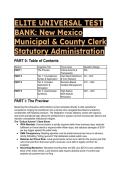
ELITE UNIVERSAL TEST
BANK: New Mexico
Municipal & County Clerk
Statutory Administration
PART 0: Table of Contents
Section Cognitive Tier Focus Area Question Range
PART I The Preview Critical Axioms & N/A
Frameworks
PART II Tier 1: Foundational Hard Deck Definitions Q1 – Q10
Syntax & Application & Core Statutes
PART II Tier 2: Complex Scenario-Based Q11 – Q20
Application & Variable Management
Simulation
PART II Tier 3: Grandmaster High-Stakes Q21 – Q30
Synthesis Multi-Statute
Resolution
PART I: The Preview
Mastering this exhaustive administrative review translates directly to elite operational
competence, forging the practitioner into a scholar who navigates New Mexico's statutory
complexities with flawless precision. The integration of exact statutory syntax with rigorous,
real-world operational logic allows the professional to bypass common bureaucratic failures and
maintain unassailable institutional integrity.
The "Critical Axioms" Cheat Sheet:
● IPRA Mandate: Communication is strictly required within three business days; absolute
fulfillment or formal denial is required within fifteen days, lest statutory damages of $100
per day trigger against the public body.
● OMA Transparency: Meeting agendas must be posted seventy-two hours in advance,
strictly forbidding "rolling quorums" that deliberate outside public view.
● Bateman Act Fiscal Rule: Local governments cannot incur debt for the current year that
cannot be paid from that exact year's revenues; such debt is legally void from its
inception.
● Recording Mechanics: Standard recording fees are $25, plus $25 for every additional
block of ten index entries. Land division plats require absolute proof of current-year
property tax payment prior to filing.
, ● Notarial Surety: A New Mexico notary requires a $10,000 surety bond spanning a
four-year term. County clerks and un-licensed deputies may serve as automatic notarial
officers.
PART II: THE ELITE TEST BANK
Tier 1: Foundational Syntax & Application
Q1: A citizen files a written request under the Inspection of Public Records Act (IPRA) for
archived county documents. The records cannot be produced immediately due to off-site
storage. Based on the principles of the New Mexico Inspection of Public Records Act, which
action is the FIRST required step if the inspection is not permitted within three business days?
A) The custodian must deny the request entirely due to excessive administrative burden and
notify the requester. B) The custodian must forward the request to the state Attorney General for
a timeline extension. C) The custodian must provide a written explanation stating when the
records will be available or when the public body will respond. D) The custodian must assess a
retrieval fee and wait fifteen days before issuing a formal response to the requester.
● The Answer: C (The custodian must provide a written explanation stating when the
records will be available or when the public body will respond)
● Distractor Analysis:
○ A is incorrect: Immediate denial is unlawful under statutory guidelines; an
excessively burdensome request grants the agency additional time, not the right to
execute an automatic rejection.
○ B is incorrect: The Attorney General enforces IPRA compliance globally but does
not micromanage individual request extensions or grant waivers at the three-day
mark.
○ D is incorrect: Custodians cannot arbitrarily wait fifteen days without prior
communication, nor can they legally charge a fee merely to search for or determine
the disclosability of a public record.
The Mentor's Analysis: The core underlying principle of IPRA is that delayed public access
requires immediate governmental communication. When facing archived record retrieval that
exceeds standard operational speeds, the immediate priority is preserving compliance via
formal written notice. By utilizing a written explanation within the 72-hour window, the
practitioner bypasses the common trap of negligent delay. Professional/Academic Intuition: A
three-day delay requires formal communication; a fifteen-day delay without
communication constitutes an actionable, heavily penalized denial.
Q2: A citizen submits an IPRA request seeking the personnel file of a recently terminated
municipal employee, specifically requesting letters of reference and internal memorandums
detailing the supervisor's opinions on the employee's performance. Based on the principles of
NMSA 14-2-1, which conclusion is the MOST ACCURATE regarding the disclosure of these
documents? A) The entire personnel file must be released immediately, as the employee's
termination waives all privacy rights. B) The request must be denied entirely, as all personnel
files are categorically shielded from IPRA review. C) The letters of reference and matters of
opinion must be redacted or withheld, as they are explicitly exempt from inspection. D) The
records must be released, but the citizen must sign a non-disclosure agreement before viewing
the supervisor's opinions.
● The Answer: C (The letters of reference and matters of opinion must be redacted or
, withheld, as they are explicitly exempt from inspection)
● Distractor Analysis:
○ A is incorrect: The employment status of the individual does not nullify statutory
exemptions regarding specific, protected document types within a personnel file.
○ B is incorrect: There is no blanket exemption for all personnel records; only specific
qualitative components (e.g., opinions, references) are exempt, while factual data
often remains public.
○ D is incorrect: IPRA does not utilize non-disclosure agreements for public records; a
record is either public and freely accessible, or legally exempt and withheld by the
custodian.
The Mentor's Analysis: IPRA balances the public's fundamental right to know with the
necessity of candid internal governmental evaluations. When facing personnel file requests, the
immediate priority is surgical redaction rather than blanket denial. By utilizing Section 14-2-1
exceptions for opinions and references, the practitioner bypasses the common trap of violating
internal confidentiality protocols. Professional/Academic Intuition: Factual data within a
personnel file is inherently public; subjective opinions and reference letters are
perpetually shielded.
Q3: A public body completely fails to deliver a written explanation of denial for an IPRA request
within fifteen days. A district court subsequently determines this failure was entirely
unreasonable. Based on the principles of NMSA 14-2-11, what is the MAXIMUM statutory
penalty that can be assessed against the public body? A) $50 per day, accruing immediately
upon the expiration of the three-day notice window. B) $100 per day, payable from the funds of
the public body, accruing from the day of noncompliance. C) $500 per day, payable personally
by the records custodian to the requester. D) A flat fine of $10,000, plus mandatory attorney's
fees payable to the state.
● The Answer: B ($100 per day, payable from the funds of the public body, accruing from
the day of noncompliance)
● Distractor Analysis:
○ A is incorrect: The statutory cap is specifically set at $100 per day, not $50.
○ C is incorrect: Damages are statutorily payable from the funds of the public body,
not by the custodian in their personal, individual capacity.
○ D is incorrect: The penalty is calculated on a per diem basis to incentivize
immediate compliance, not as a flat punitive fine, though attorney's fees may also
be awarded separately in successful IPRA litigation.
The Mentor's Analysis: IPRA utilizes sharp financial penalties to enforce transparency and
discourage bureaucratic stonewalling. When a denial is legally warranted, the immediate priority
is formally issuing that denial within the strict fifteen-day window. By utilizing timely, written
explanations of denial, the practitioner bypasses the common trap of accruing ruinous per-diem
damages that bleed the public treasury. Professional/Academic Intuition: Silence in
response to an IPRA request is never a valid defense; it represents a continuously
compounding statutory violation.
Q4: A custodian of records determines that a received IPRA request is excessively burdensome
and broad, requiring the review of thousands of archived emails. Based on the principles of
NMSA 14-2-10, what is the MOST APPROPRIATE procedural action the custodian must take?
A) Ignore the request until the requester narrows the scope of the inquiry to a manageable
volume. B) Provide written notification to the requester within fifteen days of receipt that
additional time will be needed to respond. C) Automatically grant the agency a ninety-day
extension without notifying the requester. D) Charge an upfront fee of $1.00 per anticipated
BANK: New Mexico
Municipal & County Clerk
Statutory Administration
PART 0: Table of Contents
Section Cognitive Tier Focus Area Question Range
PART I The Preview Critical Axioms & N/A
Frameworks
PART II Tier 1: Foundational Hard Deck Definitions Q1 – Q10
Syntax & Application & Core Statutes
PART II Tier 2: Complex Scenario-Based Q11 – Q20
Application & Variable Management
Simulation
PART II Tier 3: Grandmaster High-Stakes Q21 – Q30
Synthesis Multi-Statute
Resolution
PART I: The Preview
Mastering this exhaustive administrative review translates directly to elite operational
competence, forging the practitioner into a scholar who navigates New Mexico's statutory
complexities with flawless precision. The integration of exact statutory syntax with rigorous,
real-world operational logic allows the professional to bypass common bureaucratic failures and
maintain unassailable institutional integrity.
The "Critical Axioms" Cheat Sheet:
● IPRA Mandate: Communication is strictly required within three business days; absolute
fulfillment or formal denial is required within fifteen days, lest statutory damages of $100
per day trigger against the public body.
● OMA Transparency: Meeting agendas must be posted seventy-two hours in advance,
strictly forbidding "rolling quorums" that deliberate outside public view.
● Bateman Act Fiscal Rule: Local governments cannot incur debt for the current year that
cannot be paid from that exact year's revenues; such debt is legally void from its
inception.
● Recording Mechanics: Standard recording fees are $25, plus $25 for every additional
block of ten index entries. Land division plats require absolute proof of current-year
property tax payment prior to filing.
, ● Notarial Surety: A New Mexico notary requires a $10,000 surety bond spanning a
four-year term. County clerks and un-licensed deputies may serve as automatic notarial
officers.
PART II: THE ELITE TEST BANK
Tier 1: Foundational Syntax & Application
Q1: A citizen files a written request under the Inspection of Public Records Act (IPRA) for
archived county documents. The records cannot be produced immediately due to off-site
storage. Based on the principles of the New Mexico Inspection of Public Records Act, which
action is the FIRST required step if the inspection is not permitted within three business days?
A) The custodian must deny the request entirely due to excessive administrative burden and
notify the requester. B) The custodian must forward the request to the state Attorney General for
a timeline extension. C) The custodian must provide a written explanation stating when the
records will be available or when the public body will respond. D) The custodian must assess a
retrieval fee and wait fifteen days before issuing a formal response to the requester.
● The Answer: C (The custodian must provide a written explanation stating when the
records will be available or when the public body will respond)
● Distractor Analysis:
○ A is incorrect: Immediate denial is unlawful under statutory guidelines; an
excessively burdensome request grants the agency additional time, not the right to
execute an automatic rejection.
○ B is incorrect: The Attorney General enforces IPRA compliance globally but does
not micromanage individual request extensions or grant waivers at the three-day
mark.
○ D is incorrect: Custodians cannot arbitrarily wait fifteen days without prior
communication, nor can they legally charge a fee merely to search for or determine
the disclosability of a public record.
The Mentor's Analysis: The core underlying principle of IPRA is that delayed public access
requires immediate governmental communication. When facing archived record retrieval that
exceeds standard operational speeds, the immediate priority is preserving compliance via
formal written notice. By utilizing a written explanation within the 72-hour window, the
practitioner bypasses the common trap of negligent delay. Professional/Academic Intuition: A
three-day delay requires formal communication; a fifteen-day delay without
communication constitutes an actionable, heavily penalized denial.
Q2: A citizen submits an IPRA request seeking the personnel file of a recently terminated
municipal employee, specifically requesting letters of reference and internal memorandums
detailing the supervisor's opinions on the employee's performance. Based on the principles of
NMSA 14-2-1, which conclusion is the MOST ACCURATE regarding the disclosure of these
documents? A) The entire personnel file must be released immediately, as the employee's
termination waives all privacy rights. B) The request must be denied entirely, as all personnel
files are categorically shielded from IPRA review. C) The letters of reference and matters of
opinion must be redacted or withheld, as they are explicitly exempt from inspection. D) The
records must be released, but the citizen must sign a non-disclosure agreement before viewing
the supervisor's opinions.
● The Answer: C (The letters of reference and matters of opinion must be redacted or
, withheld, as they are explicitly exempt from inspection)
● Distractor Analysis:
○ A is incorrect: The employment status of the individual does not nullify statutory
exemptions regarding specific, protected document types within a personnel file.
○ B is incorrect: There is no blanket exemption for all personnel records; only specific
qualitative components (e.g., opinions, references) are exempt, while factual data
often remains public.
○ D is incorrect: IPRA does not utilize non-disclosure agreements for public records; a
record is either public and freely accessible, or legally exempt and withheld by the
custodian.
The Mentor's Analysis: IPRA balances the public's fundamental right to know with the
necessity of candid internal governmental evaluations. When facing personnel file requests, the
immediate priority is surgical redaction rather than blanket denial. By utilizing Section 14-2-1
exceptions for opinions and references, the practitioner bypasses the common trap of violating
internal confidentiality protocols. Professional/Academic Intuition: Factual data within a
personnel file is inherently public; subjective opinions and reference letters are
perpetually shielded.
Q3: A public body completely fails to deliver a written explanation of denial for an IPRA request
within fifteen days. A district court subsequently determines this failure was entirely
unreasonable. Based on the principles of NMSA 14-2-11, what is the MAXIMUM statutory
penalty that can be assessed against the public body? A) $50 per day, accruing immediately
upon the expiration of the three-day notice window. B) $100 per day, payable from the funds of
the public body, accruing from the day of noncompliance. C) $500 per day, payable personally
by the records custodian to the requester. D) A flat fine of $10,000, plus mandatory attorney's
fees payable to the state.
● The Answer: B ($100 per day, payable from the funds of the public body, accruing from
the day of noncompliance)
● Distractor Analysis:
○ A is incorrect: The statutory cap is specifically set at $100 per day, not $50.
○ C is incorrect: Damages are statutorily payable from the funds of the public body,
not by the custodian in their personal, individual capacity.
○ D is incorrect: The penalty is calculated on a per diem basis to incentivize
immediate compliance, not as a flat punitive fine, though attorney's fees may also
be awarded separately in successful IPRA litigation.
The Mentor's Analysis: IPRA utilizes sharp financial penalties to enforce transparency and
discourage bureaucratic stonewalling. When a denial is legally warranted, the immediate priority
is formally issuing that denial within the strict fifteen-day window. By utilizing timely, written
explanations of denial, the practitioner bypasses the common trap of accruing ruinous per-diem
damages that bleed the public treasury. Professional/Academic Intuition: Silence in
response to an IPRA request is never a valid defense; it represents a continuously
compounding statutory violation.
Q4: A custodian of records determines that a received IPRA request is excessively burdensome
and broad, requiring the review of thousands of archived emails. Based on the principles of
NMSA 14-2-10, what is the MOST APPROPRIATE procedural action the custodian must take?
A) Ignore the request until the requester narrows the scope of the inquiry to a manageable
volume. B) Provide written notification to the requester within fifteen days of receipt that
additional time will be needed to respond. C) Automatically grant the agency a ninety-day
extension without notifying the requester. D) Charge an upfront fee of $1.00 per anticipated