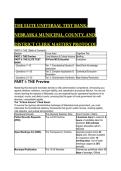
THE ELITE UNIVERSAL TEST BANK:
NEBRASKA MUNICIPAL, COUNTY, AND
DISTRICT CLERK MASTERY PROTOCOL
PART 0: THE (Table of Contents)
Section Focus Area Cognitive Tier
PART I: THE Preview Core Mission & Critical Axioms Briefing
PART II: THE ELITE TEST 30-Point MCQ Gauntlet Evaluation
BANK
- Questions 1–10 Tier 1: Foundational Syntax & Hard-Deck Knowledge
Application
- Questions 11–20 Tier 2: Complex Application & Contextual Execution
Simulation
- Questions 21–30 Tier 3: Grandmaster Synthesis High-Stakes Resolution
PART I: THE Preview
Mastering this test bank translates directly to elite administrative competence, immunizing you
against statutory violations, municipal liability, and catastrophic procedural failures. You are not
merely learning the statutes of Nebraska; you are engineering the operational backbone of its
municipal, county, and district courts, ensuring that the gears of local government turn with
absolute, unassailable legality.
The "Critical Axioms" Cheat Sheet:
To survive the rigorous administrative landscape of Nebraska local government, you must
internalize the foundational statutory frameworks that govern public access, meeting legality,
vital statistics, and judicial administration.
Operational Domain The Absolute Statutory Rule Core Function / Metric
Public Records Requests The 4-8-50 Doctrine 4 business days to respond. 8
(PRR) hours of unbillable labor for
residents. $50 estimate
triggers allowable upfront
deposits.
Open Meetings Act (OMA) The Transparency Timeline Agendas posted online 24
hours prior. Minutes available
for inspection within 10
working days. Out-of-state
meetings capped at 25%
annually.
Municipal Publication The 15-30 Mandate Ordinances published within 15
days of passage. Official
,Operational Domain The Absolute Statutory Rule Core Function / Metric
council proceedings published
within 30 days.
Vital Statistics (Marriage) The 17/19 Threshold Age of majority is 19. Ages 17
and 18 require notarized
guardian consent. No individual
under 17 may legally marry.
Divorce Decrees The 6-Month Freeze Neither party may apply for a
new marriage license for 6
months following the entry of a
divorce decree.
Jurisdictional Delegation The 7,000 Population Pivot In counties under 7,000
inhabitants, the County Clerk
automatically assumes ex
officio duties of the Clerk of the
District Court.
PART II: THE ELITE TEST BANK
Tier 1: Foundational Syntax & Application
Q1: A Nebraska citizen files a written request with the City Clerk to inspect a specific set of
municipal zoning permits. According to Neb. Rev. Stat. § 84-712, what is the strict statutory
deadline for the Clerk to provide the records, issue a denial, or provide a written explanation for
a delay? A) 4 calendar days B) 10 working days C) 4 business days D) 15 business days
● The Answer: C (4 business days)
● Distractor Analysis:
○ A is incorrect: The statute explicitly utilizes business days to protect municipal
offices from the administrative burden of weekends and recognized holidays.
Utilizing calendar days would unlawfully truncate the operational response window.
○ B is incorrect: The 10-working-day timeframe dictates the deadline for drafting and
making Open Meetings Act minutes available, not responding to document
requests.
○ D is incorrect: A 15-day timeline governs the Attorney General's mandatory review
of a public records denial, representing an appellate function rather than the initial
municipal response limit.
The Mentor's Analysis: The primary mechanism of government transparency relies on rapid,
predictable access to documents. The 4-business-day rule is a rigid statutory floor, engineered
to prevent bureaucratic stalling while allowing practical time for retrieval.
Professional/Academic Intuition: When the public records clock starts, calendar days are
irrelevant; calculate exclusively using active municipal business days.
Q2: A resident submits a massive public records request to a Nebraska county requiring 12 total
hours of staff time to search, physically redact, and copy. Based on the provisions of Neb. Rev.
Stat. § 84-712(3)(c), how many hours of staff labor can the public body legally bill to the
resident? A) 4 hours B) 8 hours C) 12 hours D) 0 hours
● The Answer: A (4 hours)
● Distractor Analysis:
○ B is incorrect: The first 8 cumulative hours of searching, identifying, and redacting
, are strictly unbillable for Nebraska residents. Agencies do not bill for the 8 hours;
they bill for the excess.
○ C is incorrect: Billing for the total 12 hours violates the statutory exemption
protecting the initial labor block, constituting an unlawful financial barrier to public
information.
○ D is incorrect: Once the 8-hour threshold is crossed, the agency is legally
authorized to apply a special service charge for the remaining 4 hours of excess
labor.
The Mentor's Analysis: The legislature balances public access against administrative burden
by providing a generous baseline of free labor for residents, while protecting agencies from
highly disruptive, massive requests. Professional/Academic Intuition: Never bill a Nebraska
resident for the first 8 hours of labor; the financial meter only starts ticking at hour 8:01.
Q3: The City Council of a Nebraska City of the Second Class passes an ordinance of a general
nature. To ensure the ordinance takes legal effect, what is the maximum timeframe the
Municipal Clerk has to publish it in a legal newspaper or electronic form? A) 4 business days B)
10 working days C) 15 days D) 30 days
● The Answer: C (15 days)
● Distractor Analysis:
○ A is incorrect: This dictates the response deadline for public records requests,
completely distinct from the legislative publication process.
○ B is incorrect: 10 working days is the deadline for drafting and publishing general
meeting minutes.
○ D is incorrect: 30 days is the deadline for publishing the official proceedings
(minutes and claims) of a city council meeting, which is distinct from publishing a
newly codified ordinance.
The Mentor's Analysis: Ordinances carry the force of law and cannot bind the public without
proper, timely notification. The 15-day window ensures swift public awareness of new municipal
regulations and maintains due process. Professional/Academic Intuition: Differentiate your
municipal deadlines: Ordinances demand a 15-day publication, while general council
proceedings demand a 30-day publication.
Q4: A 17-year-old Nebraska resident arrives at the County Clerk's office to apply for a marriage
license. Which specific documentation is ABSOLUTELY REQUIRED for the Clerk to legally
issue the license under Nebraska law? A) A waiver of the mandatory 48-hour waiting period
signed by a district judge. B) A notarized consent form signed by a parent or legal guardian. C)
A negative blood test certificate from a licensed Nebraska physician. D) Proof of legal
emancipation granted by a Nebraska District Court.
● The Answer: B (A notarized consent form signed by a parent or legal guardian.)
● Distractor Analysis:
○ A is incorrect: Nebraska has fundamentally abolished statutory waiting periods for
marriage licenses; applicants may marry immediately upon issuance.
○ C is incorrect: Nebraska does not require a blood test or any medical examinations
to issue a valid marriage license.
○ D is incorrect: While emancipation alters minor status, Neb. Rev. Stat. § 42-105
specifically mandates written parental or guardian consent for applicants aged 17,
making emancipation an unnecessary and overly complex distractor.
The Mentor's Analysis: The age of majority in Nebraska is 19. Minors aged 17 and 18 occupy
a conditional legal space where marriage is permitted exclusively with verified parental or
guardian oversight. Professional/Academic Intuition: Treat age 17 as the absolute hard
NEBRASKA MUNICIPAL, COUNTY, AND
DISTRICT CLERK MASTERY PROTOCOL
PART 0: THE (Table of Contents)
Section Focus Area Cognitive Tier
PART I: THE Preview Core Mission & Critical Axioms Briefing
PART II: THE ELITE TEST 30-Point MCQ Gauntlet Evaluation
BANK
- Questions 1–10 Tier 1: Foundational Syntax & Hard-Deck Knowledge
Application
- Questions 11–20 Tier 2: Complex Application & Contextual Execution
Simulation
- Questions 21–30 Tier 3: Grandmaster Synthesis High-Stakes Resolution
PART I: THE Preview
Mastering this test bank translates directly to elite administrative competence, immunizing you
against statutory violations, municipal liability, and catastrophic procedural failures. You are not
merely learning the statutes of Nebraska; you are engineering the operational backbone of its
municipal, county, and district courts, ensuring that the gears of local government turn with
absolute, unassailable legality.
The "Critical Axioms" Cheat Sheet:
To survive the rigorous administrative landscape of Nebraska local government, you must
internalize the foundational statutory frameworks that govern public access, meeting legality,
vital statistics, and judicial administration.
Operational Domain The Absolute Statutory Rule Core Function / Metric
Public Records Requests The 4-8-50 Doctrine 4 business days to respond. 8
(PRR) hours of unbillable labor for
residents. $50 estimate
triggers allowable upfront
deposits.
Open Meetings Act (OMA) The Transparency Timeline Agendas posted online 24
hours prior. Minutes available
for inspection within 10
working days. Out-of-state
meetings capped at 25%
annually.
Municipal Publication The 15-30 Mandate Ordinances published within 15
days of passage. Official
,Operational Domain The Absolute Statutory Rule Core Function / Metric
council proceedings published
within 30 days.
Vital Statistics (Marriage) The 17/19 Threshold Age of majority is 19. Ages 17
and 18 require notarized
guardian consent. No individual
under 17 may legally marry.
Divorce Decrees The 6-Month Freeze Neither party may apply for a
new marriage license for 6
months following the entry of a
divorce decree.
Jurisdictional Delegation The 7,000 Population Pivot In counties under 7,000
inhabitants, the County Clerk
automatically assumes ex
officio duties of the Clerk of the
District Court.
PART II: THE ELITE TEST BANK
Tier 1: Foundational Syntax & Application
Q1: A Nebraska citizen files a written request with the City Clerk to inspect a specific set of
municipal zoning permits. According to Neb. Rev. Stat. § 84-712, what is the strict statutory
deadline for the Clerk to provide the records, issue a denial, or provide a written explanation for
a delay? A) 4 calendar days B) 10 working days C) 4 business days D) 15 business days
● The Answer: C (4 business days)
● Distractor Analysis:
○ A is incorrect: The statute explicitly utilizes business days to protect municipal
offices from the administrative burden of weekends and recognized holidays.
Utilizing calendar days would unlawfully truncate the operational response window.
○ B is incorrect: The 10-working-day timeframe dictates the deadline for drafting and
making Open Meetings Act minutes available, not responding to document
requests.
○ D is incorrect: A 15-day timeline governs the Attorney General's mandatory review
of a public records denial, representing an appellate function rather than the initial
municipal response limit.
The Mentor's Analysis: The primary mechanism of government transparency relies on rapid,
predictable access to documents. The 4-business-day rule is a rigid statutory floor, engineered
to prevent bureaucratic stalling while allowing practical time for retrieval.
Professional/Academic Intuition: When the public records clock starts, calendar days are
irrelevant; calculate exclusively using active municipal business days.
Q2: A resident submits a massive public records request to a Nebraska county requiring 12 total
hours of staff time to search, physically redact, and copy. Based on the provisions of Neb. Rev.
Stat. § 84-712(3)(c), how many hours of staff labor can the public body legally bill to the
resident? A) 4 hours B) 8 hours C) 12 hours D) 0 hours
● The Answer: A (4 hours)
● Distractor Analysis:
○ B is incorrect: The first 8 cumulative hours of searching, identifying, and redacting
, are strictly unbillable for Nebraska residents. Agencies do not bill for the 8 hours;
they bill for the excess.
○ C is incorrect: Billing for the total 12 hours violates the statutory exemption
protecting the initial labor block, constituting an unlawful financial barrier to public
information.
○ D is incorrect: Once the 8-hour threshold is crossed, the agency is legally
authorized to apply a special service charge for the remaining 4 hours of excess
labor.
The Mentor's Analysis: The legislature balances public access against administrative burden
by providing a generous baseline of free labor for residents, while protecting agencies from
highly disruptive, massive requests. Professional/Academic Intuition: Never bill a Nebraska
resident for the first 8 hours of labor; the financial meter only starts ticking at hour 8:01.
Q3: The City Council of a Nebraska City of the Second Class passes an ordinance of a general
nature. To ensure the ordinance takes legal effect, what is the maximum timeframe the
Municipal Clerk has to publish it in a legal newspaper or electronic form? A) 4 business days B)
10 working days C) 15 days D) 30 days
● The Answer: C (15 days)
● Distractor Analysis:
○ A is incorrect: This dictates the response deadline for public records requests,
completely distinct from the legislative publication process.
○ B is incorrect: 10 working days is the deadline for drafting and publishing general
meeting minutes.
○ D is incorrect: 30 days is the deadline for publishing the official proceedings
(minutes and claims) of a city council meeting, which is distinct from publishing a
newly codified ordinance.
The Mentor's Analysis: Ordinances carry the force of law and cannot bind the public without
proper, timely notification. The 15-day window ensures swift public awareness of new municipal
regulations and maintains due process. Professional/Academic Intuition: Differentiate your
municipal deadlines: Ordinances demand a 15-day publication, while general council
proceedings demand a 30-day publication.
Q4: A 17-year-old Nebraska resident arrives at the County Clerk's office to apply for a marriage
license. Which specific documentation is ABSOLUTELY REQUIRED for the Clerk to legally
issue the license under Nebraska law? A) A waiver of the mandatory 48-hour waiting period
signed by a district judge. B) A notarized consent form signed by a parent or legal guardian. C)
A negative blood test certificate from a licensed Nebraska physician. D) Proof of legal
emancipation granted by a Nebraska District Court.
● The Answer: B (A notarized consent form signed by a parent or legal guardian.)
● Distractor Analysis:
○ A is incorrect: Nebraska has fundamentally abolished statutory waiting periods for
marriage licenses; applicants may marry immediately upon issuance.
○ C is incorrect: Nebraska does not require a blood test or any medical examinations
to issue a valid marriage license.
○ D is incorrect: While emancipation alters minor status, Neb. Rev. Stat. § 42-105
specifically mandates written parental or guardian consent for applicants aged 17,
making emancipation an unnecessary and overly complex distractor.
The Mentor's Analysis: The age of majority in Nebraska is 19. Minors aged 17 and 18 occupy
a conditional legal space where marriage is permitted exclusively with verified parental or
guardian oversight. Professional/Academic Intuition: Treat age 17 as the absolute hard