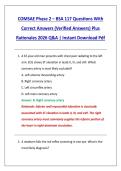
COMSAE Phase 2 – BSA 117 Questions With
Correct Answers (Verified Answers) Plus
Rationales 2026 Q&A | Instant Download Pdf
1. A 67-year-old man presents with chest pain radiating to the left
arm. ECG shows ST elevation in leads II, III, and aVF. Which
coronary artery is most likely occluded?
A. Left anterior descending artery
B. Right coronary artery
C. Left circumflex artery
D. Left main coronary artery
Answer: B. Right coronary artery
Rationale: Inferior wall myocardial infarction is classically
associated with ST elevation in leads II, III, and aVF. The right
coronary artery most commonly supplies the inferior portion of
the heart in right-dominant circulation.
2. A newborn fails the red reflex screening in one eye. What is the
most likely diagnosis?
, A. Retinoblastoma
B. Congenital cataract
C. Glaucoma
D. Optic neuritis
Answer: B. Congenital cataract
Rationale: Congenital cataracts are a common cause of absent
red reflex in newborns and require urgent evaluation to prevent
amblyopia.
3. A patient presents with tremor at rest, bradykinesia, and rigidity.
Which brain structure is most affected?
A. Substantia nigra
B. Caudate nucleus
C. Cerebellum
D. Red nucleus
Answer: A. Substantia nigra
Rationale: Parkinson disease is caused by degeneration of
dopaminergic neurons in the substantia nigra pars compacta.
4. A 25-year-old woman has exophthalmos, heat intolerance, and
weight loss. Which antibody is most likely present?
, A. Anti-thyroid peroxidase
B. Anti-TSH receptor antibody
C. Anti-thyroglobulin antibody
D. Anti-microsomal antibody
Answer: B. Anti-TSH receptor antibody
Rationale: Graves disease is caused by thyroid-stimulating
immunoglobulins that activate TSH receptors, leading to
hyperthyroidism.
5. A patient with COPD is given supplemental oxygen and develops
CO2 retention. What is the primary mechanism?
A. Increased Haldane effect
B. Loss of hypoxic respiratory drive
C. Increased bicarbonate excretion
D. Decreased dead space ventilation
Answer: B. Loss of hypoxic respiratory drive
Rationale: In chronic CO2 retainers, hypoxia becomes the main
respiratory drive; high oxygen can suppress ventilation and
worsen hypercapnia.
, 6. A child presents with a “slapped cheek” rash. Which virus is
responsible?
A. Rubella virus
B. Parvovirus B19
C. Measles virus
D. Coxsackievirus
Answer: B. Parvovirus B19
Rationale: Erythema infectiosum (fifth disease) caused by
parvovirus B19 presents with a characteristic slapped-cheek
rash.
7. A patient has prolonged bleeding time but normal PT and PTT.
What condition is most likely?
A. Hemophilia A
B. von Willebrand disease
C. Factor VII deficiency
D. Vitamin K deficiency
Answer: B. von Willebrand disease
Rationale: von Willebrand disease affects platelet adhesion and
stabilizes factor VIII, leading to increased bleeding time with
normal PT and PTT.
Correct Answers (Verified Answers) Plus
Rationales 2026 Q&A | Instant Download Pdf
1. A 67-year-old man presents with chest pain radiating to the left
arm. ECG shows ST elevation in leads II, III, and aVF. Which
coronary artery is most likely occluded?
A. Left anterior descending artery
B. Right coronary artery
C. Left circumflex artery
D. Left main coronary artery
Answer: B. Right coronary artery
Rationale: Inferior wall myocardial infarction is classically
associated with ST elevation in leads II, III, and aVF. The right
coronary artery most commonly supplies the inferior portion of
the heart in right-dominant circulation.
2. A newborn fails the red reflex screening in one eye. What is the
most likely diagnosis?
, A. Retinoblastoma
B. Congenital cataract
C. Glaucoma
D. Optic neuritis
Answer: B. Congenital cataract
Rationale: Congenital cataracts are a common cause of absent
red reflex in newborns and require urgent evaluation to prevent
amblyopia.
3. A patient presents with tremor at rest, bradykinesia, and rigidity.
Which brain structure is most affected?
A. Substantia nigra
B. Caudate nucleus
C. Cerebellum
D. Red nucleus
Answer: A. Substantia nigra
Rationale: Parkinson disease is caused by degeneration of
dopaminergic neurons in the substantia nigra pars compacta.
4. A 25-year-old woman has exophthalmos, heat intolerance, and
weight loss. Which antibody is most likely present?
, A. Anti-thyroid peroxidase
B. Anti-TSH receptor antibody
C. Anti-thyroglobulin antibody
D. Anti-microsomal antibody
Answer: B. Anti-TSH receptor antibody
Rationale: Graves disease is caused by thyroid-stimulating
immunoglobulins that activate TSH receptors, leading to
hyperthyroidism.
5. A patient with COPD is given supplemental oxygen and develops
CO2 retention. What is the primary mechanism?
A. Increased Haldane effect
B. Loss of hypoxic respiratory drive
C. Increased bicarbonate excretion
D. Decreased dead space ventilation
Answer: B. Loss of hypoxic respiratory drive
Rationale: In chronic CO2 retainers, hypoxia becomes the main
respiratory drive; high oxygen can suppress ventilation and
worsen hypercapnia.
, 6. A child presents with a “slapped cheek” rash. Which virus is
responsible?
A. Rubella virus
B. Parvovirus B19
C. Measles virus
D. Coxsackievirus
Answer: B. Parvovirus B19
Rationale: Erythema infectiosum (fifth disease) caused by
parvovirus B19 presents with a characteristic slapped-cheek
rash.
7. A patient has prolonged bleeding time but normal PT and PTT.
What condition is most likely?
A. Hemophilia A
B. von Willebrand disease
C. Factor VII deficiency
D. Vitamin K deficiency
Answer: B. von Willebrand disease
Rationale: von Willebrand disease affects platelet adhesion and
stabilizes factor VIII, leading to increased bleeding time with
normal PT and PTT.