, PLEASE USE THIS DOCUMENT AS A GUIDE ONLY
Question 1
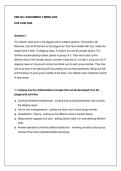
1. Read the following case study and answer the questions that follow:
1.1. Analyze any five mathematical concepts that can be developed from the playground
activities.
The following five mathematical concepts can be developed from the playground activities
described in the case study:
Counting (rote and rational counting): Learners count backwards while jumping, and count
objects such as balls, skipping ropes, wooden blocks, and group members. This involves both
reciting number names (rote counting) and counting with understanding (rational counting)
(EMA1501, Study Guide, p. 50).
One-to-one correspondence: Children put one block next to each group member and throw one
ball to each group member three times. This directly applies the principle that each object
(block or ball) is matched to one other object (a group member) (EMA1501, Study Guide, p.
27).
Ordering/Seriation: Learners pick up five different sizes of wooden blocks. This requires
arranging or ordering objects according to size (e.g., from smallest to largest), which is a
pre-mathematical skill essential for logical thinking (EMA1501, Study Guide, p. 12).
Counting backwards: Children jump and count backwards to return to the starting point. This
skill prepares learners for subtraction and helps them understand that numbers can decrease in
sequence (EMA1501, Study Guide, p. 59).
Classification/Sorting: The activity of picking up five different sizes of blocks implies sorting
or selecting blocks based on the attribute of size. Children must distinguish between blocks of
varying dimensions, grouping them mentally according to a common characteristic (EMA1501,
Study Guide, p. 11).
Question 1
1. Read the following case study and answer the questions that follow:
1.1. Analyze any five mathematical concepts that can be developed from the playground
activities.
The following five mathematical concepts can be developed from the playground activities
described in the case study:
Counting (rote and rational counting): Learners count backwards while jumping, and count
objects such as balls, skipping ropes, wooden blocks, and group members. This involves both
reciting number names (rote counting) and counting with understanding (rational counting)
(EMA1501, Study Guide, p. 50).
One-to-one correspondence: Children put one block next to each group member and throw one
ball to each group member three times. This directly applies the principle that each object
(block or ball) is matched to one other object (a group member) (EMA1501, Study Guide, p.
27).
Ordering/Seriation: Learners pick up five different sizes of wooden blocks. This requires
arranging or ordering objects according to size (e.g., from smallest to largest), which is a
pre-mathematical skill essential for logical thinking (EMA1501, Study Guide, p. 12).
Counting backwards: Children jump and count backwards to return to the starting point. This
skill prepares learners for subtraction and helps them understand that numbers can decrease in
sequence (EMA1501, Study Guide, p. 59).
Classification/Sorting: The activity of picking up five different sizes of blocks implies sorting
or selecting blocks based on the attribute of size. Children must distinguish between blocks of
varying dimensions, grouping them mentally according to a common characteristic (EMA1501,
Study Guide, p. 11).