Lecture 1 – Introduction
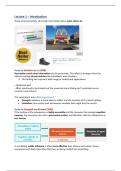
These communications all include information about what others do.
Study by Goldstein et al. (2008)
Descriptive social norm information can be persuasive. This effect is stronger when the
reference group closely matches the individuals’ own situation.
This finding has inspired a wide range of studies and applications.
+ Replicates well
- Effect sized tend to be limited and the provincial norm finding isn’t consistent across
countries and cultures
This experiment was a field experiment:
• Strength: behavior is more likely to reflect real life, because of its natural setting.
• Limitation: less control over extraneous variables that might bias the results.
Study by Campbell and Kirmani (2000)
If the motive of the salesperson is highly accessible and the consumer has enough cognitive
capacity, the consumer can infer a persuasion motive, and therefore rate the salesperson as
less sincere.
In marketing, subtle influence is often more effective than obvious persuasion. Savvy
consumers push back when they feel they are being tricked into something.
,Papers
A room with a viewpoint: Using social norms to motivate environmental conservation in
hotels (Goldstein et al, 2008)
This paper is about getting hotel guests to reuse their towels, and what kinds of messages
work best to convince them.
The problem: Hotels typically hang signs asking guests to reuse towels “to save the
environment.” The researchers wondered: is that really the most effective message?
Experiment 1: They tested two signs. One said the usual “help save the environment”
message. The other added a social fact, that 75% of guests already reuse their towels.
The social message worked better (44% reuse vs. 35%).
Experiment 2: They got more specific. They tested whether it matters who you say is reusing
towels. The options were:
• Fellow guests in general
• Fellow citizens
• People of the same gender
• Guests who stayed in that exact same room before
Surprisingly, the “same room” message worked best (49% reuse), even though sharing a
room with a stranger in the past is pretty meaningless. People don't even consider “guest of
room 313” an important part of their identity, yet it was the most persuasive.
Main takeaway
People are most influenced by what others did in their immediate surroundings, not by
broader groups they actually care about. Closeness in place matters more than closeness in
identity.
Consumers' use of persuasion knowledge: The effects of accessibility and cognitive
capacity on perceptions of an influence agent (Campbell & Kirmani, 2000)
This paper is about how and when people see through a salesperson's tricks, and what stops
them from doing so.
The core idea: People have persuasion knowledge = a general awareness that salespeople
are trying to manipulate them. But just having that knowledge doesn't mean you always use
it. Two things determine whether you do: how obvious the salesperson's motive is, and how
mentally busy you are.
The experiments all used a scenario where a salesperson named “Pat” compliments a
customer on a jacket. The key variables were:
• Timing of the compliment: before the purchase (obvious sales motive) vs. after (less
obvious)
• Your role: are you the customer or just a bystander watching?
• Mental load: are you distracted by another task or free to think?
, The results
• When the sales motive was obvious, everyone saw through it equally
• When the motive was less obvious, bystanders were more skeptical than the actual
customer
• If you were mentally primed beforehand to think about hidden motives, you became
more suspicious even as the busy customer
The person who most needs to detect manipulation (the actual customer in the
conversation) is actually worse at it than someone just watching from the sidelines. Because
being in the interaction takes up mental energy. You're thinking about what to say, how to
respond, what to do next. That leaves less brainpower to step back and think “wait, is this
person just flattering me to make a sale?”
Main takeaway
Being actively involved in a sales conversation makes you less able to think critically about
the salesperson's intentions, unless the manipulation is so obvious it's impossible to miss.
These communications all include information about what others do.
Study by Goldstein et al. (2008)
Descriptive social norm information can be persuasive. This effect is stronger when the
reference group closely matches the individuals’ own situation.
This finding has inspired a wide range of studies and applications.
+ Replicates well
- Effect sized tend to be limited and the provincial norm finding isn’t consistent across
countries and cultures
This experiment was a field experiment:
• Strength: behavior is more likely to reflect real life, because of its natural setting.
• Limitation: less control over extraneous variables that might bias the results.
Study by Campbell and Kirmani (2000)
If the motive of the salesperson is highly accessible and the consumer has enough cognitive
capacity, the consumer can infer a persuasion motive, and therefore rate the salesperson as
less sincere.
In marketing, subtle influence is often more effective than obvious persuasion. Savvy
consumers push back when they feel they are being tricked into something.
,Papers
A room with a viewpoint: Using social norms to motivate environmental conservation in
hotels (Goldstein et al, 2008)
This paper is about getting hotel guests to reuse their towels, and what kinds of messages
work best to convince them.
The problem: Hotels typically hang signs asking guests to reuse towels “to save the
environment.” The researchers wondered: is that really the most effective message?
Experiment 1: They tested two signs. One said the usual “help save the environment”
message. The other added a social fact, that 75% of guests already reuse their towels.
The social message worked better (44% reuse vs. 35%).
Experiment 2: They got more specific. They tested whether it matters who you say is reusing
towels. The options were:
• Fellow guests in general
• Fellow citizens
• People of the same gender
• Guests who stayed in that exact same room before
Surprisingly, the “same room” message worked best (49% reuse), even though sharing a
room with a stranger in the past is pretty meaningless. People don't even consider “guest of
room 313” an important part of their identity, yet it was the most persuasive.
Main takeaway
People are most influenced by what others did in their immediate surroundings, not by
broader groups they actually care about. Closeness in place matters more than closeness in
identity.
Consumers' use of persuasion knowledge: The effects of accessibility and cognitive
capacity on perceptions of an influence agent (Campbell & Kirmani, 2000)
This paper is about how and when people see through a salesperson's tricks, and what stops
them from doing so.
The core idea: People have persuasion knowledge = a general awareness that salespeople
are trying to manipulate them. But just having that knowledge doesn't mean you always use
it. Two things determine whether you do: how obvious the salesperson's motive is, and how
mentally busy you are.
The experiments all used a scenario where a salesperson named “Pat” compliments a
customer on a jacket. The key variables were:
• Timing of the compliment: before the purchase (obvious sales motive) vs. after (less
obvious)
• Your role: are you the customer or just a bystander watching?
• Mental load: are you distracted by another task or free to think?
, The results
• When the sales motive was obvious, everyone saw through it equally
• When the motive was less obvious, bystanders were more skeptical than the actual
customer
• If you were mentally primed beforehand to think about hidden motives, you became
more suspicious even as the busy customer
The person who most needs to detect manipulation (the actual customer in the
conversation) is actually worse at it than someone just watching from the sidelines. Because
being in the interaction takes up mental energy. You're thinking about what to say, how to
respond, what to do next. That leaves less brainpower to step back and think “wait, is this
person just flattering me to make a sale?”
Main takeaway
Being actively involved in a sales conversation makes you less able to think critically about
the salesperson's intentions, unless the manipulation is so obvious it's impossible to miss.