lOMoAR cPSD| 67756003
Foundations of Nursing: Exam 2
Ch. 10 – Critical Thinking
Critical thinking skills
• Analyzing – separating/ breaking whole into parts
• Applying standards – judging according to established personal
• Discriminating - recognizing differences
• Information seeking – search for evidence
• Logical reasoning – drawing inferences
• Predicting – envision a plan
• Transforming knowledge – changing/converting the condition, nature, form/function of concepts
Problem-solving Process
• Trial & error
• Intuition
• Research process
• Examples of problem solving situations: safety/infection o Everything we do as a nurse is backed up by
research (evidence-based practice)
Decision-making Process
• Choosing the best actions to meet a desired goal o Make value decisions time management decisions
o Scheduling decisions o Priority decisions
Ch. 11-14 - Nursing Process
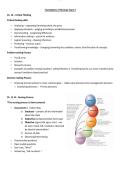
*The nursing process is client centered
• Assessment o Collect data
Database – contains all the information
about the client
Subjective (symptoms/what client says)
Objective (signs/vital signs, chart – can
be seen, heard, felt, smelled or observed
by physical examination)
Sources of data
Observing/Interviewing
• Closed ended questions
• Open ended questions
• Don’t ask, “Why?”
• Instead say, “tell me about…”
, lOMoAR cPSD| 67756003
o Organize data o
Validate data o
Document data
• Nursing Diagnosis o Analyze data
o Identify health problems, risks, and
strengths o Formulate diagnostic
statements Types of diagnoses:
Actual diagnosis
Risk diagnosis
Health promotion diagnosis
Wellness diagnosis
NANDA-1 nursing diagnoses
Prioritization – Maslow’s Hierarchy of Needs
• Planning o Prioritize problems/diagnoses o Formulate
goals/desired outcomes o Select nursing interventions o Write
nursing interventions
• Implementation o Reassess the client o Determine the nurse’s
need for assistance o Implement the nursing interventions o
Supervise delegated care o Document nursing activities
• Evaluation o Collect data related to outcomes o Compare data
with outcomes o Related nursing actions to client goals/outcomes
o Draw conclusions about problem status o Continue, modify or
terminate the client’s care plan
• Writing Nursing Diagnoses o Basic Two-Part Statement (at risk) 2
part
Problem (P)
Etiology (E) o Basic Three-
Part Statement (actual) 3 part
Problem (P)
Etiology (E)
Signs and symptoms (S)
**If the goal is not met, always go back and re-assess**
Ch. 49 - Fecal Elimination
• Defecations is the process of elimination of waste
from the digestive system o Feces or stool
• Feces
o Cases distention of rectum o Stimulates
distention of receptors
, lOMoAR cPSD| 67756003
o The sitting position increases the downward
pressure on the rectum, making it easier to
pass stool
Color Adult: brown Clay or white Absence bile pigment (bile
Infant: yellow obstruction); diagnostic study using
Drug (e.g., iron); bleeding from upper
gi track (e.g., stomach and small
intestine); diet high in rich meat and
dark green vegetables (e.g., spinach)
Bleeding from lower gi tract (e.g.,
rectum); some foods (e.g., beets)
*Other causes of red:
Hemorrhoids
Red Coumadin
Cancer
Pale and milk products and low in meat
Intestinal infection
Consistency Formed, soft, semisolid, moist Hard, dry Dehydration; decreased intestinal
motility resulting from lack of fiber in
diet, lack of exercise, emotional upset,
laxative abuse
Shape Cylindrical (contour of rectum) about Obstructive condition of the rectum
2.5 cm (1 in.) in diameter in adults shaped, or
string like stool
Amount Varies with diet (about 100-400
Pungent Infection, blood
and individual’s own bacterial flora
Constituents Small amounts of undigested Mucus
roughage, sloughed dead bacteria Bacterial infection
and epithelial cells, fat, protein, dried Inflammatory condition
constituents of digestive juices (e.g., Large quantities GI bleeding
bile pigments, inorganic matter) of fat Malabsorption
Foreign objects Accidental ingestion
• Factors Affecting Bowel Elimination o Developmental
Newborns & infants
Foundations of Nursing: Exam 2
Ch. 10 – Critical Thinking
Critical thinking skills
• Analyzing – separating/ breaking whole into parts
• Applying standards – judging according to established personal
• Discriminating - recognizing differences
• Information seeking – search for evidence
• Logical reasoning – drawing inferences
• Predicting – envision a plan
• Transforming knowledge – changing/converting the condition, nature, form/function of concepts
Problem-solving Process
• Trial & error
• Intuition
• Research process
• Examples of problem solving situations: safety/infection o Everything we do as a nurse is backed up by
research (evidence-based practice)
Decision-making Process
• Choosing the best actions to meet a desired goal o Make value decisions time management decisions
o Scheduling decisions o Priority decisions
Ch. 11-14 - Nursing Process
*The nursing process is client centered
• Assessment o Collect data
Database – contains all the information
about the client
Subjective (symptoms/what client says)
Objective (signs/vital signs, chart – can
be seen, heard, felt, smelled or observed
by physical examination)
Sources of data
Observing/Interviewing
• Closed ended questions
• Open ended questions
• Don’t ask, “Why?”
• Instead say, “tell me about…”
, lOMoAR cPSD| 67756003
o Organize data o
Validate data o
Document data
• Nursing Diagnosis o Analyze data
o Identify health problems, risks, and
strengths o Formulate diagnostic
statements Types of diagnoses:
Actual diagnosis
Risk diagnosis
Health promotion diagnosis
Wellness diagnosis
NANDA-1 nursing diagnoses
Prioritization – Maslow’s Hierarchy of Needs
• Planning o Prioritize problems/diagnoses o Formulate
goals/desired outcomes o Select nursing interventions o Write
nursing interventions
• Implementation o Reassess the client o Determine the nurse’s
need for assistance o Implement the nursing interventions o
Supervise delegated care o Document nursing activities
• Evaluation o Collect data related to outcomes o Compare data
with outcomes o Related nursing actions to client goals/outcomes
o Draw conclusions about problem status o Continue, modify or
terminate the client’s care plan
• Writing Nursing Diagnoses o Basic Two-Part Statement (at risk) 2
part
Problem (P)
Etiology (E) o Basic Three-
Part Statement (actual) 3 part
Problem (P)
Etiology (E)
Signs and symptoms (S)
**If the goal is not met, always go back and re-assess**
Ch. 49 - Fecal Elimination
• Defecations is the process of elimination of waste
from the digestive system o Feces or stool
• Feces
o Cases distention of rectum o Stimulates
distention of receptors
, lOMoAR cPSD| 67756003
o The sitting position increases the downward
pressure on the rectum, making it easier to
pass stool
Color Adult: brown Clay or white Absence bile pigment (bile
Infant: yellow obstruction); diagnostic study using
Drug (e.g., iron); bleeding from upper
gi track (e.g., stomach and small
intestine); diet high in rich meat and
dark green vegetables (e.g., spinach)
Bleeding from lower gi tract (e.g.,
rectum); some foods (e.g., beets)
*Other causes of red:
Hemorrhoids
Red Coumadin
Cancer
Pale and milk products and low in meat
Intestinal infection
Consistency Formed, soft, semisolid, moist Hard, dry Dehydration; decreased intestinal
motility resulting from lack of fiber in
diet, lack of exercise, emotional upset,
laxative abuse
Shape Cylindrical (contour of rectum) about Obstructive condition of the rectum
2.5 cm (1 in.) in diameter in adults shaped, or
string like stool
Amount Varies with diet (about 100-400
Pungent Infection, blood
and individual’s own bacterial flora
Constituents Small amounts of undigested Mucus
roughage, sloughed dead bacteria Bacterial infection
and epithelial cells, fat, protein, dried Inflammatory condition
constituents of digestive juices (e.g., Large quantities GI bleeding
bile pigments, inorganic matter) of fat Malabsorption
Foreign objects Accidental ingestion
• Factors Affecting Bowel Elimination o Developmental
Newborns & infants