

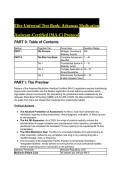
Elite Universal Test Bank: Arkansas Medication
Assistant-Certified (MA-C) Protocol
PART 0: Table of Contents
Section Cognitive Tier Focus Area Question Range
PART I The Preview Strategic Overview & N/A
Statutory Axioms
PART II The Elite Test Bank Complete Assessment 1 – 40
Gauntlet
Tier 1 Foundational Syntax & 1 – 15
Statutory Limits
Tier 2 Complex Application & 16 – 30
Scope Boundaries
Tier 3 Grandmaster Synthesis 31 – 40
& Multi-Variable Crises
PART I: The Preview
Mastery of the Arkansas Medication Assistant-Certified (MA-C) regulations requires transitioning
beyond rote memorization into the flawless application of strict statutory boundaries within
high-stakes clinical environments. By internalizing the jurisdictional limits established by the
Arkansas State Board of Nursing (ASBN) and Act 265 of 2025, the elite practitioner insulates
the public from harm and shields their credential from catastrophic liability.
Critical Axioms
● The Absolute Prohibition on Assessment: An MA-C must never administer any
medication requiring nursing assessment, clinical judgment, evaluation, or follow-up prior
to administration.
● The Act 265 Expansion: As of 2025, the scope of practice explicitly includes the
administration of oxygen inhalation and subcutaneous insulin injections, provided the
practitioner has completed the mandated 115-hour training or the supplemental 15-hour
credentialing.
● The Initial Medication Rule: The MA-C is universally forbidden from administering an
initial medication, defined as any completely new drug or any existing drug with a
modified dosage, route, or frequency.
● The Exclusivity of the Designated Facility: Practice is permanently restricted to
"designated facilities," strictly defined as nursing homes or local correctional facilities
where a supervising nurse is physically on the premises.
Statutory Parameter Absolute Regulatory Limit
Maximum Patient Load 40 patients per shift per MA-C
,Statutory Parameter Absolute Regulatory Limit
Supervision Ratio 1 Licensed Nurse to 2 MA-Cs
Clinical Faculty Ratio 1 Instructor to 6 Students
Continuing Education 8 contact hours every 2 years
Training Requirement 115 total hours (Act 265 standard)
PART II: The Elite Test Bank
Q1: A licensed nursing facility experiences an unexpected severe staffing shortage. The
Director of Nursing instructs the on-duty Certified Medication Assistant (CMA) to administer
scheduled morning oral medications to a census of forty-six (46) residents. Based on the
Arkansas State Board of Nursing (ASBN) administrative limits, which action is the MOST
APPROPRIATE? A) Administer the medications to all 46 residents, provided the Director of
Nursing signs a temporary emergency liability waiver. B) Administer the medications to 40
residents and return the remaining 6 Medication Administration Records (MARs) to the
supervising licensed nurse. C) Proceed with administering to all 46 residents, but ensure the
completion time is documented precisely for the facility's administrative audit. D) Refuse the
assignment entirely and leave the premises to avoid civil liability under the Arkansas Nurse
Practice Act.
● The Answer: B (Administer the medications to 40 residents and return the remaining 6
Medication Administration Records (MARs) to the supervising licensed nurse.)
● Distractor Analysis:
○ A is incorrect: The ASBN enforces a strict, non-negotiable statutory cap. Facility
administrators lack the legal authority to waive state board regulations through
internal waivers.
○ C is incorrect: Documentation accuracy does not negate a scope-of-practice
violation. Exceeding the maximum patient limit is a direct violation of administrative
code.
○ D is incorrect: Abandoning the facility constitutes patient abandonment. The
practitioner must refuse the illegal portion of the assignment while fulfilling the legal
portion.
The Mentor's Analysis: The architecture of safe medication administration relies on strictly
defined operational bandwidths. The ASBN mandates that a CMA must not administer
medications to more than forty (40) patients during a single shift. When facing administrative
pressure, the immediate priority is protecting patient safety by adhering to the statutory ceiling.
By utilizing the forty-patient limit rule, you bypass the common trap of allowing facility
emergencies to compromise licensure standards. Professional/Academic Intuition: Statutory
patient limits are immune to facility-level emergencies; the absolute maximum capacity
for an MA-C is 40 patients per shift.
Q2: A resident has been receiving 10 mg of oral lisinopril daily. Following a morning evaluation,
the attending physician increases the dosage to 20 mg daily, to begin immediately. The
supervising nurse hands the new 20 mg tablet to the MA-C for administration. Which conclusion
regarding this delegation is the MOST ACCURATE? A) The delegation is acceptable because
oral medications are an approved route for the MA-C. B) The delegation is acceptable because
the patient has a six-month tolerance history with the generic drug. C) The delegation is invalid
because the dosage adjustment transforms the drug into an initial medication. D) The
delegation is invalid because lisinopril requires continuous cardiac monitoring during
administration.
, ● The Answer: C (The delegation is invalid because the dosage adjustment transforms the
drug into an initial medication.)
● Distractor Analysis:
○ A is incorrect: While the oral route is authorized, route authorization does not
override the strict prohibition against administering initial medications.
○ B is incorrect: Historical tolerance is irrelevant. Any change in parameters resets
the drug to an initial status under ASBN definitions.
○ D is incorrect: The prohibition is based strictly on the statutory definition of an initial
dose, not the specific pharmacology of the ACE inhibitor.
The Mentor's Analysis: Precision in regulatory definitions prevents unauthorized practice.
Under Arkansas rules, an initial medication encompasses any change in dosage, route, or
frequency of a current medication. The immediate priority is recognizing that the first dose of this
altered regimen requires a licensed nurse's assessment. By utilizing the initial medication
parameter, you bypass the common novice error of assuming a dosage increase is a routine
continuation of care. Professional/Academic Intuition: Any alteration in dose, route, or
frequency legally resets the prescription to an "initial medication," strictly prohibiting
MA-C administration for the first dose.
Q3: A designated facility utilizes multiple CMAs during the night shift. One Registered Nurse
(RN) is assigned to supervise the entire building, overseeing four CMAs administering routine
medications. Based on ASBN supervision ratios, what is the MOST ACCURATE assessment of
this staffing model? A) It is fully compliant, provided the RN remains physically on the premises
at all times. B) It is a severe violation, as a licensed nurse may supervise no more than two
CMAs concurrently. C) It is compliant only if the facility holds a specific waiver from the Long
Term Care Facility Advisory Board. D) It is a violation because CMAs are strictly prohibited from
administering medications during night shifts.
● The Answer: B (It is a severe violation, as a licensed nurse may supervise no more than
two CMAs concurrently.)
● Distractor Analysis:
○ A is incorrect: While the RN must be on the premises, physical presence does not
override the strict numerical ratio limit.
○ C is incorrect: The ASBN ratio limit is an absolute statutory standard; there is no
provision for a routine facility-level waiver.
○ D is incorrect: There are no statutory time-of-day restrictions for CMA practice.
The Mentor's Analysis: Span of control is a critical safety mechanism in delegated nursing
tasks. The regulations enforce strict ratios, prohibiting a licensed nurse from supervising more
than two (2) CMAs during any given shift. The immediate priority is identifying the administrative
failure that dilutes the RN's oversight capacity. By utilizing the 1:2 supervision ratio, you bypass
the dangerous assumption that a single nurse can oversee unlimited subordinate personnel.
Professional/Academic Intuition: Supervision is a measurable metric; the ASBN caps the
licensed nurse to CMA ratio at a rigid 1:2 to ensure adequate clinical oversight.
Q4: A resident requires a scheduled dose of insulin glargine. Based on the expanded scope of
practice established by Arkansas Act 265 of 2025, which action by the CMA is the MOST
ACCURATE and legally permissible? A) Administering the insulin via an intramuscular (IM)
injection into the deltoid. B) Administering the insulin via a subcutaneous injection, provided the
CMA has completed the required 115-hour training or 15-hour supplemental credentialing. C)
Administering the insulin via an intravenous (IV) push under the direct visual observation of the
supervising physician. D) Calculating the required units of insulin based on the resident's
sliding-scale blood glucose reading prior to injection.
Assistant-Certified (MA-C) Protocol
PART 0: Table of Contents
Section Cognitive Tier Focus Area Question Range
PART I The Preview Strategic Overview & N/A
Statutory Axioms
PART II The Elite Test Bank Complete Assessment 1 – 40
Gauntlet
Tier 1 Foundational Syntax & 1 – 15
Statutory Limits
Tier 2 Complex Application & 16 – 30
Scope Boundaries
Tier 3 Grandmaster Synthesis 31 – 40
& Multi-Variable Crises
PART I: The Preview
Mastery of the Arkansas Medication Assistant-Certified (MA-C) regulations requires transitioning
beyond rote memorization into the flawless application of strict statutory boundaries within
high-stakes clinical environments. By internalizing the jurisdictional limits established by the
Arkansas State Board of Nursing (ASBN) and Act 265 of 2025, the elite practitioner insulates
the public from harm and shields their credential from catastrophic liability.
Critical Axioms
● The Absolute Prohibition on Assessment: An MA-C must never administer any
medication requiring nursing assessment, clinical judgment, evaluation, or follow-up prior
to administration.
● The Act 265 Expansion: As of 2025, the scope of practice explicitly includes the
administration of oxygen inhalation and subcutaneous insulin injections, provided the
practitioner has completed the mandated 115-hour training or the supplemental 15-hour
credentialing.
● The Initial Medication Rule: The MA-C is universally forbidden from administering an
initial medication, defined as any completely new drug or any existing drug with a
modified dosage, route, or frequency.
● The Exclusivity of the Designated Facility: Practice is permanently restricted to
"designated facilities," strictly defined as nursing homes or local correctional facilities
where a supervising nurse is physically on the premises.
Statutory Parameter Absolute Regulatory Limit
Maximum Patient Load 40 patients per shift per MA-C
,Statutory Parameter Absolute Regulatory Limit
Supervision Ratio 1 Licensed Nurse to 2 MA-Cs
Clinical Faculty Ratio 1 Instructor to 6 Students
Continuing Education 8 contact hours every 2 years
Training Requirement 115 total hours (Act 265 standard)
PART II: The Elite Test Bank
Q1: A licensed nursing facility experiences an unexpected severe staffing shortage. The
Director of Nursing instructs the on-duty Certified Medication Assistant (CMA) to administer
scheduled morning oral medications to a census of forty-six (46) residents. Based on the
Arkansas State Board of Nursing (ASBN) administrative limits, which action is the MOST
APPROPRIATE? A) Administer the medications to all 46 residents, provided the Director of
Nursing signs a temporary emergency liability waiver. B) Administer the medications to 40
residents and return the remaining 6 Medication Administration Records (MARs) to the
supervising licensed nurse. C) Proceed with administering to all 46 residents, but ensure the
completion time is documented precisely for the facility's administrative audit. D) Refuse the
assignment entirely and leave the premises to avoid civil liability under the Arkansas Nurse
Practice Act.
● The Answer: B (Administer the medications to 40 residents and return the remaining 6
Medication Administration Records (MARs) to the supervising licensed nurse.)
● Distractor Analysis:
○ A is incorrect: The ASBN enforces a strict, non-negotiable statutory cap. Facility
administrators lack the legal authority to waive state board regulations through
internal waivers.
○ C is incorrect: Documentation accuracy does not negate a scope-of-practice
violation. Exceeding the maximum patient limit is a direct violation of administrative
code.
○ D is incorrect: Abandoning the facility constitutes patient abandonment. The
practitioner must refuse the illegal portion of the assignment while fulfilling the legal
portion.
The Mentor's Analysis: The architecture of safe medication administration relies on strictly
defined operational bandwidths. The ASBN mandates that a CMA must not administer
medications to more than forty (40) patients during a single shift. When facing administrative
pressure, the immediate priority is protecting patient safety by adhering to the statutory ceiling.
By utilizing the forty-patient limit rule, you bypass the common trap of allowing facility
emergencies to compromise licensure standards. Professional/Academic Intuition: Statutory
patient limits are immune to facility-level emergencies; the absolute maximum capacity
for an MA-C is 40 patients per shift.
Q2: A resident has been receiving 10 mg of oral lisinopril daily. Following a morning evaluation,
the attending physician increases the dosage to 20 mg daily, to begin immediately. The
supervising nurse hands the new 20 mg tablet to the MA-C for administration. Which conclusion
regarding this delegation is the MOST ACCURATE? A) The delegation is acceptable because
oral medications are an approved route for the MA-C. B) The delegation is acceptable because
the patient has a six-month tolerance history with the generic drug. C) The delegation is invalid
because the dosage adjustment transforms the drug into an initial medication. D) The
delegation is invalid because lisinopril requires continuous cardiac monitoring during
administration.
, ● The Answer: C (The delegation is invalid because the dosage adjustment transforms the
drug into an initial medication.)
● Distractor Analysis:
○ A is incorrect: While the oral route is authorized, route authorization does not
override the strict prohibition against administering initial medications.
○ B is incorrect: Historical tolerance is irrelevant. Any change in parameters resets
the drug to an initial status under ASBN definitions.
○ D is incorrect: The prohibition is based strictly on the statutory definition of an initial
dose, not the specific pharmacology of the ACE inhibitor.
The Mentor's Analysis: Precision in regulatory definitions prevents unauthorized practice.
Under Arkansas rules, an initial medication encompasses any change in dosage, route, or
frequency of a current medication. The immediate priority is recognizing that the first dose of this
altered regimen requires a licensed nurse's assessment. By utilizing the initial medication
parameter, you bypass the common novice error of assuming a dosage increase is a routine
continuation of care. Professional/Academic Intuition: Any alteration in dose, route, or
frequency legally resets the prescription to an "initial medication," strictly prohibiting
MA-C administration for the first dose.
Q3: A designated facility utilizes multiple CMAs during the night shift. One Registered Nurse
(RN) is assigned to supervise the entire building, overseeing four CMAs administering routine
medications. Based on ASBN supervision ratios, what is the MOST ACCURATE assessment of
this staffing model? A) It is fully compliant, provided the RN remains physically on the premises
at all times. B) It is a severe violation, as a licensed nurse may supervise no more than two
CMAs concurrently. C) It is compliant only if the facility holds a specific waiver from the Long
Term Care Facility Advisory Board. D) It is a violation because CMAs are strictly prohibited from
administering medications during night shifts.
● The Answer: B (It is a severe violation, as a licensed nurse may supervise no more than
two CMAs concurrently.)
● Distractor Analysis:
○ A is incorrect: While the RN must be on the premises, physical presence does not
override the strict numerical ratio limit.
○ C is incorrect: The ASBN ratio limit is an absolute statutory standard; there is no
provision for a routine facility-level waiver.
○ D is incorrect: There are no statutory time-of-day restrictions for CMA practice.
The Mentor's Analysis: Span of control is a critical safety mechanism in delegated nursing
tasks. The regulations enforce strict ratios, prohibiting a licensed nurse from supervising more
than two (2) CMAs during any given shift. The immediate priority is identifying the administrative
failure that dilutes the RN's oversight capacity. By utilizing the 1:2 supervision ratio, you bypass
the dangerous assumption that a single nurse can oversee unlimited subordinate personnel.
Professional/Academic Intuition: Supervision is a measurable metric; the ASBN caps the
licensed nurse to CMA ratio at a rigid 1:2 to ensure adequate clinical oversight.
Q4: A resident requires a scheduled dose of insulin glargine. Based on the expanded scope of
practice established by Arkansas Act 265 of 2025, which action by the CMA is the MOST
ACCURATE and legally permissible? A) Administering the insulin via an intramuscular (IM)
injection into the deltoid. B) Administering the insulin via a subcutaneous injection, provided the
CMA has completed the required 115-hour training or 15-hour supplemental credentialing. C)
Administering the insulin via an intravenous (IV) push under the direct visual observation of the
supervising physician. D) Calculating the required units of insulin based on the resident's
sliding-scale blood glucose reading prior to injection.


