

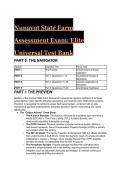
Nunavut State Farm
Assessment Exam: Elite
Universal Test Bank
PART 0: THE NAVIGATOR
Section Cognitive Tier Focus Area
PART I The Preview Critical Axioms & Exam
Calibration
PART II Tier 1: Questions 1–10 Foundational Syntax &
Application
PART II Tier 2: Questions 11–20 Complex Application &
Simulation
PART II Tier 3: Questions 21–30 Grandmaster Synthesis
PART I: THE PREVIEW
Mastery of the Nunavut State Farm Assessment requires the rigorous synthesis of territorial
jurisprudence, highly specific actuarial calculations, and nuanced client relationship protocols.
Precision in navigating the territory's unique fault-based system, combined with an elite
command of standard endorsements, translates directly to top-tier underwriting and claims
adjudication.
● The "Critical Axioms" Cheat Sheet:
○ The Nunavut Mandate: The statutory minimum for mandatory auto insurance is
strictly $200,000 in Third-Party Liability (TPL), Accident Benefits, and
Uninsured/Unidentified Automobile coverage.
○ The DCPD Vacuum: Nunavut operates a private insurance system utilizing a
fault-based framework; Direct Compensation Property Damage (DCPD) is entirely
non-existent within this territory.
○ The SEF 44 Shield: The Family Protection Endorsement (SEF 44) offsets shortfalls
from underinsured at-fault drivers. Under the Supreme Court of Canada precedent
established in Sabean v Portage, future Canada Pension Plan (CPP) disability
benefits are strictly non-deductible from the SEF 44 payout.
○ The Permafrost Variable: Property damage resulting from permafrost thaw
presents a unique systemic risk in the territory, requiring proactive structural
mitigation (such as adjustable steel pads and wedges) to maintain continuous
insurability against shifting foundations.
, ○ The UIM Offset Law: Underinsured Motorist (UIM) financial exposure is absolutely
capped by the following strict actuarial formula: (UIM Limit) - (Tortfeasor Payout) -
(Prior First-Party Advanced Payments).
Mandatory Territory Regulatory Framework Required Coverages Optional
Auto Minimums Enhancements
Nunavut Private / Fault-Based $200k TPL, Accident SEF 44, Collision,
Benefits, Uninsured Comprehensive, SEF
Auto 27
Northwest Territories Private / Fault-Based $200k TPL, Accident SEF 44, Collision,
Benefits, Uninsured Comprehensive, SEF
Auto 27
PART II: THE ELITE TEST BANK
Tier 1: Foundational Syntax & Application
Q1: An applicant in Iqaluit seeks the absolute minimum legal coverage required to operate a
private passenger vehicle in the territory. According to the Nunavut Insurance Act, which
configuration of coverages is the ONLY compliant option? A) Basic Autoplan including $200,000
in Basic Vehicle Damage and Inverse Liability Protection. B) $500,000 Third-Party Liability,
Accident Benefits, and Direct Compensation Property Damage (DCPD). C) $200,000
Third-Party Liability, Accident Benefits, and Uninsured/Unidentified Automobile coverage. D)
$200,000 Third-Party Liability, Comprehensive Insurance, and Collision coverage.
● The Answer: C ($200,000 Third-Party Liability, Accident Benefits, and
Uninsured/Unidentified Automobile coverage.)
● Distractor Analysis:
○ A is incorrect: Basic Autoplan represents the government-run mandatory insurance
system specific to British Columbia, which has absolutely no jurisdiction over the
private market in Nunavut.
○ B is incorrect: The $500,000 TPL threshold and mandatory DCPD are statutory
requirements for Nova Scotia. Nunavut strictly does not utilize the DCPD
framework.
○ D is incorrect: Comprehensive and Collision coverages are strictly optional physical
damage coverages, never legally mandated by territorial statutes for basic highway
operation.
The Mentor's Analysis: Statutory limits dictate the absolute floor of risk transfer in any
jurisdiction. When establishing a baseline policy in Nunavut, the immediate priority is satisfying
the territorial Insurance Act mandates before quoting optional physical damage coverages. By
utilizing the exact Third-Party Liability, Accident Benefits, and Uninsured Automobile triumvirate,
the underwriter bypasses the common trap of misapplying southern provincial mandates to
northern territories. This regulatory isolation prevents systemic quoting errors that could expose
an agency to severe compliance audits. Professional/Academic Intuition: Direct
Compensation Property Damage (DCPD) mechanisms are entirely absent within
Nunavut's hybrid tort/no-fault framework, forcing all property recovery into the traditional
tort arena.
Q2: A State Farm agent is analyzing the financial health of an agency targeted for acquisition.
The agency reports Current Assets of $150,000 and Current Liabilities of $100,000. Applying
standard financial benchmarking, what is the agency's Current Ratio, and what does it
, IMMEDIATELY indicate? A) 1.50; indicating a green light for strong short-term liquidity. B) 0.66;
indicating a red light and severe insolvency risk. C) 1.00; indicating perfect operational
equilibrium. D) $50,000; indicating the agency's net profit margin for the fiscal year.
● The Answer: A (1.50; indicating a green light for strong short-term liquidity.)
● Distractor Analysis:
○ B is incorrect: This output represents Liabilities divided by Assets ($100k / $150k),
which is the mathematical inverse of the correct Current Ratio formula.
○ C is incorrect: A ratio of 1.00 would require assets and liabilities to be perfectly
identical, which the provided balance sheet data explicitly refutes.
○ D is incorrect: The sum of $50,000 represents the Working Capital (Assets minus
Liabilities), which is an absolute dollar figure rather than a proportional liquidity ratio
utilized for standardized benchmarking.
The Mentor's Analysis: Financial solvency represents the bedrock of agency continuity and
operational resilience. When assessing the viability of an acquisition, the immediate priority is
isolating the Current Ratio, which divides current assets by current liabilities. By utilizing this
fundamental liquidity metric, the financial analyst bypasses the common trap of confusing
absolute working capital with proportional financial flexibility. High gross premiums mean nothing
if short-term obligations threaten to bankrupt the operating account before commissions clear.
Professional/Academic Intuition: The Current Ratio must safely exceed 1.0 to guarantee
short-term operational solvency and payroll continuity in a captive agency environment.
Q3: To improve client retention across a vast, geographically isolated territory like Nunavut, an
agent pivots their operations to the "Good Neighbor Connect" platform. What is the PRIMARY
operational mechanism of this proprietary tool? A) It operates as a telematics system tracking
driving behavior to lower monthly premiums. B) It allows the agent to conduct secure, virtual
face-to-face meetings with clients without requiring in-office travel. C) It automatically
aggregates local competitor rates to prove State Farm's pricing superiority. D) It functions as a
specialized social media network designed to deploy community grants.
● The Answer: B (It allows the agent to conduct secure, virtual face-to-face meetings with
clients without requiring in-office travel.)
● Distractor Analysis:
○ A is incorrect: Telematics and real-time behavioral tracking are exclusive functions
of the Drive Safe & Save program, not the Good Neighbor Connect portal.
○ C is incorrect: State Farm platforms do not inherently generate live competitor
quotes; they are deliberately designed to amplify proprietary value and relationship
building rather than commoditized price-matching.
○ D is incorrect: The Good Neighbor Citizenship Company Grants operate entirely
independently of the secure client communication platform.
The Mentor's Analysis: Client relationship management in modern, remote environments
requires frictionless, secure accessibility. When facing a geographically dispersed client base
spread across the Arctic, the immediate priority is maintaining the authentic "local agent"
presence through digital means. By utilizing the Good Neighbor Connect ecosystem, the agent
bypasses the common trap of losing market share to direct-to-consumer digital carriers who
offer operational speed but absolutely zero relationship capital. It is the human element,
delivered digitally, that secures long-term renewals. Professional/Academic Intuition:
High-retention digital strategy relies on proprietary tools that bridge geographical divides
while preserving secure, face-to-face consultative environments.
Q4: A Nunavut resident decides to store their vehicle for the winter and requests the immediate
removal of all mandatory car insurance coverages, leaving only "Comprehensive" coverage
Assessment Exam: Elite
Universal Test Bank
PART 0: THE NAVIGATOR
Section Cognitive Tier Focus Area
PART I The Preview Critical Axioms & Exam
Calibration
PART II Tier 1: Questions 1–10 Foundational Syntax &
Application
PART II Tier 2: Questions 11–20 Complex Application &
Simulation
PART II Tier 3: Questions 21–30 Grandmaster Synthesis
PART I: THE PREVIEW
Mastery of the Nunavut State Farm Assessment requires the rigorous synthesis of territorial
jurisprudence, highly specific actuarial calculations, and nuanced client relationship protocols.
Precision in navigating the territory's unique fault-based system, combined with an elite
command of standard endorsements, translates directly to top-tier underwriting and claims
adjudication.
● The "Critical Axioms" Cheat Sheet:
○ The Nunavut Mandate: The statutory minimum for mandatory auto insurance is
strictly $200,000 in Third-Party Liability (TPL), Accident Benefits, and
Uninsured/Unidentified Automobile coverage.
○ The DCPD Vacuum: Nunavut operates a private insurance system utilizing a
fault-based framework; Direct Compensation Property Damage (DCPD) is entirely
non-existent within this territory.
○ The SEF 44 Shield: The Family Protection Endorsement (SEF 44) offsets shortfalls
from underinsured at-fault drivers. Under the Supreme Court of Canada precedent
established in Sabean v Portage, future Canada Pension Plan (CPP) disability
benefits are strictly non-deductible from the SEF 44 payout.
○ The Permafrost Variable: Property damage resulting from permafrost thaw
presents a unique systemic risk in the territory, requiring proactive structural
mitigation (such as adjustable steel pads and wedges) to maintain continuous
insurability against shifting foundations.
, ○ The UIM Offset Law: Underinsured Motorist (UIM) financial exposure is absolutely
capped by the following strict actuarial formula: (UIM Limit) - (Tortfeasor Payout) -
(Prior First-Party Advanced Payments).
Mandatory Territory Regulatory Framework Required Coverages Optional
Auto Minimums Enhancements
Nunavut Private / Fault-Based $200k TPL, Accident SEF 44, Collision,
Benefits, Uninsured Comprehensive, SEF
Auto 27
Northwest Territories Private / Fault-Based $200k TPL, Accident SEF 44, Collision,
Benefits, Uninsured Comprehensive, SEF
Auto 27
PART II: THE ELITE TEST BANK
Tier 1: Foundational Syntax & Application
Q1: An applicant in Iqaluit seeks the absolute minimum legal coverage required to operate a
private passenger vehicle in the territory. According to the Nunavut Insurance Act, which
configuration of coverages is the ONLY compliant option? A) Basic Autoplan including $200,000
in Basic Vehicle Damage and Inverse Liability Protection. B) $500,000 Third-Party Liability,
Accident Benefits, and Direct Compensation Property Damage (DCPD). C) $200,000
Third-Party Liability, Accident Benefits, and Uninsured/Unidentified Automobile coverage. D)
$200,000 Third-Party Liability, Comprehensive Insurance, and Collision coverage.
● The Answer: C ($200,000 Third-Party Liability, Accident Benefits, and
Uninsured/Unidentified Automobile coverage.)
● Distractor Analysis:
○ A is incorrect: Basic Autoplan represents the government-run mandatory insurance
system specific to British Columbia, which has absolutely no jurisdiction over the
private market in Nunavut.
○ B is incorrect: The $500,000 TPL threshold and mandatory DCPD are statutory
requirements for Nova Scotia. Nunavut strictly does not utilize the DCPD
framework.
○ D is incorrect: Comprehensive and Collision coverages are strictly optional physical
damage coverages, never legally mandated by territorial statutes for basic highway
operation.
The Mentor's Analysis: Statutory limits dictate the absolute floor of risk transfer in any
jurisdiction. When establishing a baseline policy in Nunavut, the immediate priority is satisfying
the territorial Insurance Act mandates before quoting optional physical damage coverages. By
utilizing the exact Third-Party Liability, Accident Benefits, and Uninsured Automobile triumvirate,
the underwriter bypasses the common trap of misapplying southern provincial mandates to
northern territories. This regulatory isolation prevents systemic quoting errors that could expose
an agency to severe compliance audits. Professional/Academic Intuition: Direct
Compensation Property Damage (DCPD) mechanisms are entirely absent within
Nunavut's hybrid tort/no-fault framework, forcing all property recovery into the traditional
tort arena.
Q2: A State Farm agent is analyzing the financial health of an agency targeted for acquisition.
The agency reports Current Assets of $150,000 and Current Liabilities of $100,000. Applying
standard financial benchmarking, what is the agency's Current Ratio, and what does it
, IMMEDIATELY indicate? A) 1.50; indicating a green light for strong short-term liquidity. B) 0.66;
indicating a red light and severe insolvency risk. C) 1.00; indicating perfect operational
equilibrium. D) $50,000; indicating the agency's net profit margin for the fiscal year.
● The Answer: A (1.50; indicating a green light for strong short-term liquidity.)
● Distractor Analysis:
○ B is incorrect: This output represents Liabilities divided by Assets ($100k / $150k),
which is the mathematical inverse of the correct Current Ratio formula.
○ C is incorrect: A ratio of 1.00 would require assets and liabilities to be perfectly
identical, which the provided balance sheet data explicitly refutes.
○ D is incorrect: The sum of $50,000 represents the Working Capital (Assets minus
Liabilities), which is an absolute dollar figure rather than a proportional liquidity ratio
utilized for standardized benchmarking.
The Mentor's Analysis: Financial solvency represents the bedrock of agency continuity and
operational resilience. When assessing the viability of an acquisition, the immediate priority is
isolating the Current Ratio, which divides current assets by current liabilities. By utilizing this
fundamental liquidity metric, the financial analyst bypasses the common trap of confusing
absolute working capital with proportional financial flexibility. High gross premiums mean nothing
if short-term obligations threaten to bankrupt the operating account before commissions clear.
Professional/Academic Intuition: The Current Ratio must safely exceed 1.0 to guarantee
short-term operational solvency and payroll continuity in a captive agency environment.
Q3: To improve client retention across a vast, geographically isolated territory like Nunavut, an
agent pivots their operations to the "Good Neighbor Connect" platform. What is the PRIMARY
operational mechanism of this proprietary tool? A) It operates as a telematics system tracking
driving behavior to lower monthly premiums. B) It allows the agent to conduct secure, virtual
face-to-face meetings with clients without requiring in-office travel. C) It automatically
aggregates local competitor rates to prove State Farm's pricing superiority. D) It functions as a
specialized social media network designed to deploy community grants.
● The Answer: B (It allows the agent to conduct secure, virtual face-to-face meetings with
clients without requiring in-office travel.)
● Distractor Analysis:
○ A is incorrect: Telematics and real-time behavioral tracking are exclusive functions
of the Drive Safe & Save program, not the Good Neighbor Connect portal.
○ C is incorrect: State Farm platforms do not inherently generate live competitor
quotes; they are deliberately designed to amplify proprietary value and relationship
building rather than commoditized price-matching.
○ D is incorrect: The Good Neighbor Citizenship Company Grants operate entirely
independently of the secure client communication platform.
The Mentor's Analysis: Client relationship management in modern, remote environments
requires frictionless, secure accessibility. When facing a geographically dispersed client base
spread across the Arctic, the immediate priority is maintaining the authentic "local agent"
presence through digital means. By utilizing the Good Neighbor Connect ecosystem, the agent
bypasses the common trap of losing market share to direct-to-consumer digital carriers who
offer operational speed but absolutely zero relationship capital. It is the human element,
delivered digitally, that secures long-term renewals. Professional/Academic Intuition:
High-retention digital strategy relies on proprietary tools that bridge geographical divides
while preserving secure, face-to-face consultative environments.
Q4: A Nunavut resident decides to store their vehicle for the winter and requests the immediate
removal of all mandatory car insurance coverages, leaving only "Comprehensive" coverage


