

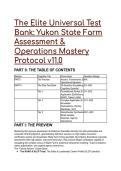
The Elite Universal Test
Bank: Yukon State Farm
Assessment &
Operations Mastery
Protocol v11.0
PART 0: THE TABLE OF CONTENTS
Section Cognitive Tier Focus Area Question Range
PART I The Preview Axioms, Frameworks, & N/A
Operational Baseline
PART II The Elite Test Bank 30-Question Escalating Q1–Q30
Cognitive Gauntlet
Tier 1 Foundational Syntax & Q1–Q10
Application (Definitions,
KSAO, Yukon Limits)
Tier 2 Complex Application & Q11–Q20
Simulation
(Calculations, 60-Day
Mandates, SJT)
Tier 3 Grandmaster Synthesis Q21–Q30
(Multi-variable
Disputes, Agency
Operations)
PART I: THE PREVIEW
Mastering this rigorous assessment architecture translates directly into elite prehospital and
corporate clinical judgment, guaranteeing definitive success on high-stakes insurance
certification exams and proprietary State Farm hiring gauntlets. By bridging theoretical corporate
frameworks with high-stakes, real-world execution, this protocol forges candidates capable of
navigating the complex nexus of State Farm’s predictive behavioral modeling, Yukon's statutory
claims adjudication, and captive agency economics.
The "Critical Axioms" Cheat Sheet:
● The KSAO & SLCP Triad: The Sales & Leadership Career Profile (SLCP) predicts
, agency success via distinct behavioral traits, heavily isolating attributes like Initiative,
Interpersonal Orientation, and Persuasiveness. The Knowledge, Skills, Abilities, and
Other Attributes (KSAO) assessment tests cognitive application via interactive Virtual Role
Play and Situational Judgment Tests (SJT).
● The Yukon Mandatory Minimums Doctrine: Yukon law enforces strict statutory limits
requiring all drivers to carry a minimum of $200,000 in Third-Party Liability and mandatory
Accident Benefits. Unlike jurisdictions such as Ontario where it has historically been
standard, Direct Compensation Property Damage (DCPD) remains strictly optional in
Yukon.
● The Section B Cap Metrics: Yukon Accident Benefits are rigidly capped. Medical
expenses are limited to $10,000 per person within a 2-year window. Disability income
pays 80% of gross wages but is aggressively capped at a maximum of $300 per week for
up to 104 weeks. Death benefits mandate $10,000 for the head of household and $2,000
per dependent.
● The 60/15 Fiduciary Timelines: Yukon insurers are bound by the Insurance Act Statutory
Conditions. Claims must be physically paid within 60 days of receiving a properly
executed Proof of Loss. If the claim enters a formal appraisal dispute, payment must be
rendered within 15 days of the appraisers' final award.
Mandatory vs. Optional Status Statutory Limit / Cap
Coverages in Yukon Auto
Insurance
Third-Party Liability Mandatory $200,000 Minimum
Accident Benefits (Section B) Mandatory $10,000 Maximum
- Medical
Accident Benefits (Section B) Mandatory 80% of gross, up to $300/week
- Disability
Uninsured Motorist Coverage Mandatory Included under Accident
Benefits
Direct Compensation Optional Selected by Insured
Property Damage (DCPD)
Collision and Comprehensive Optional Selected by Insured
PART II: THE ELITE TEST BANK
Q1: A Yukon resident applying for a standard automobile policy through a State Farm captive
agency questions the mandatory coverage requirements necessary to legally operate their
vehicle on public roadways. Based on Yukon statutory insurance frameworks, which
configuration of mandatory auto insurance is the MOST ACCURATE? A) Third-Party Liability
($500,000), Accident Benefits, and Direct Compensation Property Damage (DCPD). B)
Third-Party Liability ($200,000), Uninsured Motorist Coverage, and mandatory Direct
Compensation Property Damage (DCPD). C) Third-Party Liability ($200,000) and Accident
Benefits, which inherently include Uninsured Motorist coverage. D) Third-Party Liability
($1,000,000) under a Combined Single Limit (CSL), with optional Accident Benefits.
● The Answer: C (Third-Party Liability ($200,000) and Accident Benefits, which inherently
include Uninsured Motorist coverage.)
● Distractor Analysis:
○ A is incorrect: $500,000 is the mandatory minimum liability in Nova Scotia, not
Yukon, and DCPD is optional in the territory.
, ○ B is incorrect: While $200,000 is the correct baseline for Liability, DCPD is strictly
an optional coverage in Yukon, unlike in regions where it has operated as a
mandatory baseline.
○ D is incorrect: A $1,000,000 limit is a highly recommended industry standard for
superior protection, but it is not the statutory legal minimum. Furthermore, Accident
Benefits are mandatory, not optional.
The Mentor's Analysis: Understanding the baseline legal requirements of a jurisdiction is the
absolute foundation of lawful underwriting. When advising clients in Yukon, the immediate
priority is securing the $200,000 Liability and Accident Benefits floor. By utilizing Statutory
Minimums, you bypass the common trap of projecting one province's legacy laws onto a distinct
territory. Professional/Academic Intuition: Territorial boundaries dictate coverage
mandates; never apply southern provincial frameworks to northern statutory
requirements.
Q2: A State Farm claims adjuster receives a formally executed Proof of Loss for a
comprehensive vehicle claim in Whitehorse. Following the Yukon Insurance Act Statutory
Conditions, what is the ABSOLUTE MAXIMUM timeframe the insurer has to render payment for
this undisputed physical damage claim? A) 15 days following the initial notice of loss. B) 30
days following the receipt of the Proof of Loss. C) 60 days after the Proof of Loss has been
received. D) 90 days after the date the loss or damage occurred.
● The Answer: C (60 days after the Proof of Loss has been received.)
● Distractor Analysis:
○ A is incorrect: The 15-day timeline strictly applies to the payment window following
an appraisal award, not the baseline Proof of Loss payment timeline.
○ B is incorrect: The 30-day window is a standard timeline utilized for the initial
payment of loss of time benefits, but the ultimate physical damage payout cap is 60
days.
○ D is incorrect: The 90-day window represents the timeframe an insured is granted
to deliver the statutory declaration of the loss, not the insurer's payment execution
window.
The Mentor's Analysis: The fiduciary duty of an insurer is codified in strict temporal limits to
protect the consumer from administrative delay and financial ruin. When facing an undisputed
claim, the immediate priority is rendering payment within the 60-day window. By utilizing
Statutory Condition 6(1), you bypass the common trap of incurring bad-faith litigation due to
arbitrary payment delays. Professional/Academic Intuition: The 60-day clock begins the
precise moment the Proof of Loss is formally received, overriding all internal corporate
processing metrics.
Q3: During a State Farm KSAO Virtual Role Play, an agent is advising a client relocating from
Ontario to Yukon. The client assumes Direct Compensation Property Damage (DCPD) functions
identically in both jurisdictions. What is the FIRST correction the agent must communicate
regarding DCPD in Yukon? A) DCPD is strictly prohibited in Yukon due to the territory's pure
no-fault legal framework. B) DCPD is a mandatory minimum requirement in Yukon, but it only
covers 50% of property damage. C) DCPD is an optional supplementary coverage in Yukon,
unlike its historically standard status in Ontario. D) DCPD claims in Yukon are handled
exclusively by the territorial government's public insurance corporation.
● The Answer: C (DCPD is an optional supplementary coverage in Yukon, unlike its
historically standard status in Ontario.)
● Distractor Analysis:
○ A is incorrect: DCPD is not prohibited; Yukon operates a hybrid system with private
Bank: Yukon State Farm
Assessment &
Operations Mastery
Protocol v11.0
PART 0: THE TABLE OF CONTENTS
Section Cognitive Tier Focus Area Question Range
PART I The Preview Axioms, Frameworks, & N/A
Operational Baseline
PART II The Elite Test Bank 30-Question Escalating Q1–Q30
Cognitive Gauntlet
Tier 1 Foundational Syntax & Q1–Q10
Application (Definitions,
KSAO, Yukon Limits)
Tier 2 Complex Application & Q11–Q20
Simulation
(Calculations, 60-Day
Mandates, SJT)
Tier 3 Grandmaster Synthesis Q21–Q30
(Multi-variable
Disputes, Agency
Operations)
PART I: THE PREVIEW
Mastering this rigorous assessment architecture translates directly into elite prehospital and
corporate clinical judgment, guaranteeing definitive success on high-stakes insurance
certification exams and proprietary State Farm hiring gauntlets. By bridging theoretical corporate
frameworks with high-stakes, real-world execution, this protocol forges candidates capable of
navigating the complex nexus of State Farm’s predictive behavioral modeling, Yukon's statutory
claims adjudication, and captive agency economics.
The "Critical Axioms" Cheat Sheet:
● The KSAO & SLCP Triad: The Sales & Leadership Career Profile (SLCP) predicts
, agency success via distinct behavioral traits, heavily isolating attributes like Initiative,
Interpersonal Orientation, and Persuasiveness. The Knowledge, Skills, Abilities, and
Other Attributes (KSAO) assessment tests cognitive application via interactive Virtual Role
Play and Situational Judgment Tests (SJT).
● The Yukon Mandatory Minimums Doctrine: Yukon law enforces strict statutory limits
requiring all drivers to carry a minimum of $200,000 in Third-Party Liability and mandatory
Accident Benefits. Unlike jurisdictions such as Ontario where it has historically been
standard, Direct Compensation Property Damage (DCPD) remains strictly optional in
Yukon.
● The Section B Cap Metrics: Yukon Accident Benefits are rigidly capped. Medical
expenses are limited to $10,000 per person within a 2-year window. Disability income
pays 80% of gross wages but is aggressively capped at a maximum of $300 per week for
up to 104 weeks. Death benefits mandate $10,000 for the head of household and $2,000
per dependent.
● The 60/15 Fiduciary Timelines: Yukon insurers are bound by the Insurance Act Statutory
Conditions. Claims must be physically paid within 60 days of receiving a properly
executed Proof of Loss. If the claim enters a formal appraisal dispute, payment must be
rendered within 15 days of the appraisers' final award.
Mandatory vs. Optional Status Statutory Limit / Cap
Coverages in Yukon Auto
Insurance
Third-Party Liability Mandatory $200,000 Minimum
Accident Benefits (Section B) Mandatory $10,000 Maximum
- Medical
Accident Benefits (Section B) Mandatory 80% of gross, up to $300/week
- Disability
Uninsured Motorist Coverage Mandatory Included under Accident
Benefits
Direct Compensation Optional Selected by Insured
Property Damage (DCPD)
Collision and Comprehensive Optional Selected by Insured
PART II: THE ELITE TEST BANK
Q1: A Yukon resident applying for a standard automobile policy through a State Farm captive
agency questions the mandatory coverage requirements necessary to legally operate their
vehicle on public roadways. Based on Yukon statutory insurance frameworks, which
configuration of mandatory auto insurance is the MOST ACCURATE? A) Third-Party Liability
($500,000), Accident Benefits, and Direct Compensation Property Damage (DCPD). B)
Third-Party Liability ($200,000), Uninsured Motorist Coverage, and mandatory Direct
Compensation Property Damage (DCPD). C) Third-Party Liability ($200,000) and Accident
Benefits, which inherently include Uninsured Motorist coverage. D) Third-Party Liability
($1,000,000) under a Combined Single Limit (CSL), with optional Accident Benefits.
● The Answer: C (Third-Party Liability ($200,000) and Accident Benefits, which inherently
include Uninsured Motorist coverage.)
● Distractor Analysis:
○ A is incorrect: $500,000 is the mandatory minimum liability in Nova Scotia, not
Yukon, and DCPD is optional in the territory.
, ○ B is incorrect: While $200,000 is the correct baseline for Liability, DCPD is strictly
an optional coverage in Yukon, unlike in regions where it has operated as a
mandatory baseline.
○ D is incorrect: A $1,000,000 limit is a highly recommended industry standard for
superior protection, but it is not the statutory legal minimum. Furthermore, Accident
Benefits are mandatory, not optional.
The Mentor's Analysis: Understanding the baseline legal requirements of a jurisdiction is the
absolute foundation of lawful underwriting. When advising clients in Yukon, the immediate
priority is securing the $200,000 Liability and Accident Benefits floor. By utilizing Statutory
Minimums, you bypass the common trap of projecting one province's legacy laws onto a distinct
territory. Professional/Academic Intuition: Territorial boundaries dictate coverage
mandates; never apply southern provincial frameworks to northern statutory
requirements.
Q2: A State Farm claims adjuster receives a formally executed Proof of Loss for a
comprehensive vehicle claim in Whitehorse. Following the Yukon Insurance Act Statutory
Conditions, what is the ABSOLUTE MAXIMUM timeframe the insurer has to render payment for
this undisputed physical damage claim? A) 15 days following the initial notice of loss. B) 30
days following the receipt of the Proof of Loss. C) 60 days after the Proof of Loss has been
received. D) 90 days after the date the loss or damage occurred.
● The Answer: C (60 days after the Proof of Loss has been received.)
● Distractor Analysis:
○ A is incorrect: The 15-day timeline strictly applies to the payment window following
an appraisal award, not the baseline Proof of Loss payment timeline.
○ B is incorrect: The 30-day window is a standard timeline utilized for the initial
payment of loss of time benefits, but the ultimate physical damage payout cap is 60
days.
○ D is incorrect: The 90-day window represents the timeframe an insured is granted
to deliver the statutory declaration of the loss, not the insurer's payment execution
window.
The Mentor's Analysis: The fiduciary duty of an insurer is codified in strict temporal limits to
protect the consumer from administrative delay and financial ruin. When facing an undisputed
claim, the immediate priority is rendering payment within the 60-day window. By utilizing
Statutory Condition 6(1), you bypass the common trap of incurring bad-faith litigation due to
arbitrary payment delays. Professional/Academic Intuition: The 60-day clock begins the
precise moment the Proof of Loss is formally received, overriding all internal corporate
processing metrics.
Q3: During a State Farm KSAO Virtual Role Play, an agent is advising a client relocating from
Ontario to Yukon. The client assumes Direct Compensation Property Damage (DCPD) functions
identically in both jurisdictions. What is the FIRST correction the agent must communicate
regarding DCPD in Yukon? A) DCPD is strictly prohibited in Yukon due to the territory's pure
no-fault legal framework. B) DCPD is a mandatory minimum requirement in Yukon, but it only
covers 50% of property damage. C) DCPD is an optional supplementary coverage in Yukon,
unlike its historically standard status in Ontario. D) DCPD claims in Yukon are handled
exclusively by the territorial government's public insurance corporation.
● The Answer: C (DCPD is an optional supplementary coverage in Yukon, unlike its
historically standard status in Ontario.)
● Distractor Analysis:
○ A is incorrect: DCPD is not prohibited; Yukon operates a hybrid system with private


