

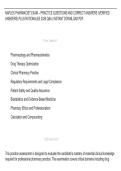
NAPLEX PHARMACIST EXAM – PRACTICE QUESTIONS AND CORRECT ANSWERS (VERIFIED
ANSWERS) PLUS RATIONALES 2026 Q&A | INSTANT DOWNLOAD PDF.
*Core Domains*
Pharmacology and Pharmacokinetics
Drug Therapy Optimization
Clinical Pharmacy Practice
Regulatory Requirements and Legal Compliance
Patient Safety and Quality Assurance
Biostatistics and Evidence-Based Medicine
Pharmacy Ethics and Professionalism
Calculation and Compounding
*Introduction*
This practice assessment is designed to evaluate the candidate's mastery of essential clinical knowledge
required for professional pharmacy practice. The examination covers critical domains including drug
,therapy management, regulatory compliance, and evidence-based decision-making. Through a rigorous
series of multiple-choice and scenario-based questions, candidates must demonstrate the ability to apply
pharmacological theory to real-world patient cases. The assessment emphasizes patient safety, accurate
calculations, and ethical considerations. By engaging with these diverse scenarios, professionals will
refine their critical thinking skills, ensuring they are prepared to provide safe, effective, and compliant
pharmaceutical care in various clinical settings.
SECTION ONE: QUESTIONS 1–100
1. A 65-year-old patient with heart failure is prescribed lisinopril. Which laboratory parameter must be
monitored closely during the initiation of this therapy?
A. Serum creatinine and potassium
B. Fasting blood glucose
C. Hemoglobin A1c
D. Thyroid stimulating hormone
🟢 A. Serum creatinine and potassium
🔴 RATIONALE: ACE inhibitors like lisinopril can cause elevations in serum potassium
(hyperkalemia) and may lead to a transient increase in serum creatinine, necessitating careful
monitoring of renal function and electrolyte balance.
2. Which of the following is the primary mechanism of action for warfarin?
A. Direct thrombin inhibition
B. Inhibition of Vitamin K epoxide reductase
C. Binding to antithrombin III
D. Inhibition of platelet aggregation
🟢 B. Inhibition of Vitamin K epoxide reductase
🔴 RATIONALE: Warfarin functions by inhibiting the enzyme Vitamin K epoxide reductase, which
prevents the recycling of Vitamin K and subsequently hinders the synthesis of clotting factors II, VII,
IX, and X.
,3. A patient presents with a prescription for amoxicillin 500mg TID. The patient reports a severe
anaphylactic reaction to penicillin in the past. What is the most appropriate action?
A. Dispense the medication with a warning label
B. Suggest a cephalosporin instead
C. Contact the prescriber to recommend an alternative antibiotic
D. Proceed with dispensing as it is a different class
🟢 C. Contact the prescriber to recommend an alternative antibiotic
🔴 RATIONALE: Due to the risk of cross-reactivity and the severity of the past reaction
(anaphylaxis), the pharmacist must intervene to prevent a potentially life-threatening event.
4. Which of the following insulins has the longest duration of action?
A. Insulin lispro
B. Insulin glargine
C. Regular insulin
D. NPH insulin
🟢 B. Insulin glargine
🔴 RATIONALE: Insulin glargine is a long-acting basal insulin that provides a relatively flat, peakless
concentration-time profile for up to 24 hours.
5. A patient is taking digoxin for atrial fibrillation. Which electrolyte imbalance increases the risk of
digoxin toxicity?
A. Hypercalcemia
B. Hypermagnesemia
C. Hypokalemia
D. Hyponatremia
🟢 C. Hypokalemia
🔴 RATIONALE: Digoxin binds to the same site on the Na+/K+-ATPase pump as potassium;
, therefore, low potassium levels allow more digoxin to bind, increasing its potency and the risk of
toxicity.
6. According to the Controlled Substances Act, which schedule of drugs has a high potential for abuse
but has an accepted medical use, with severe restrictions?
A. Schedule I
B. Schedule II
C. Schedule III
D. Schedule V
🟢 B. Schedule II
🔴 RATIONALE: Schedule II drugs are defined as having a high potential for abuse that may lead to
severe psychological or physical dependence, yet they are recognized as having accepted medical
utility under medical supervision.
7. Which of the following medications is a potent CYP3A4 inhibitor?
A. Rifampin
B. Carbamazepine
C. Ketoconazole
D. Phenytoin
🟢 C. Ketoconazole
🔴 RATIONALE: Ketoconazole is a well-known, potent inhibitor of the cytochrome P450 3A4
enzyme system, which frequently leads to significant drug-drug interactions.
8. A patient requires a conversion from IV morphine to oral morphine. If the IV dose is 10mg, what is
the equivalent oral dose?
A. 10mg
B. 20mg
C. 30mg
ANSWERS) PLUS RATIONALES 2026 Q&A | INSTANT DOWNLOAD PDF.
*Core Domains*
Pharmacology and Pharmacokinetics
Drug Therapy Optimization
Clinical Pharmacy Practice
Regulatory Requirements and Legal Compliance
Patient Safety and Quality Assurance
Biostatistics and Evidence-Based Medicine
Pharmacy Ethics and Professionalism
Calculation and Compounding
*Introduction*
This practice assessment is designed to evaluate the candidate's mastery of essential clinical knowledge
required for professional pharmacy practice. The examination covers critical domains including drug
,therapy management, regulatory compliance, and evidence-based decision-making. Through a rigorous
series of multiple-choice and scenario-based questions, candidates must demonstrate the ability to apply
pharmacological theory to real-world patient cases. The assessment emphasizes patient safety, accurate
calculations, and ethical considerations. By engaging with these diverse scenarios, professionals will
refine their critical thinking skills, ensuring they are prepared to provide safe, effective, and compliant
pharmaceutical care in various clinical settings.
SECTION ONE: QUESTIONS 1–100
1. A 65-year-old patient with heart failure is prescribed lisinopril. Which laboratory parameter must be
monitored closely during the initiation of this therapy?
A. Serum creatinine and potassium
B. Fasting blood glucose
C. Hemoglobin A1c
D. Thyroid stimulating hormone
🟢 A. Serum creatinine and potassium
🔴 RATIONALE: ACE inhibitors like lisinopril can cause elevations in serum potassium
(hyperkalemia) and may lead to a transient increase in serum creatinine, necessitating careful
monitoring of renal function and electrolyte balance.
2. Which of the following is the primary mechanism of action for warfarin?
A. Direct thrombin inhibition
B. Inhibition of Vitamin K epoxide reductase
C. Binding to antithrombin III
D. Inhibition of platelet aggregation
🟢 B. Inhibition of Vitamin K epoxide reductase
🔴 RATIONALE: Warfarin functions by inhibiting the enzyme Vitamin K epoxide reductase, which
prevents the recycling of Vitamin K and subsequently hinders the synthesis of clotting factors II, VII,
IX, and X.
,3. A patient presents with a prescription for amoxicillin 500mg TID. The patient reports a severe
anaphylactic reaction to penicillin in the past. What is the most appropriate action?
A. Dispense the medication with a warning label
B. Suggest a cephalosporin instead
C. Contact the prescriber to recommend an alternative antibiotic
D. Proceed with dispensing as it is a different class
🟢 C. Contact the prescriber to recommend an alternative antibiotic
🔴 RATIONALE: Due to the risk of cross-reactivity and the severity of the past reaction
(anaphylaxis), the pharmacist must intervene to prevent a potentially life-threatening event.
4. Which of the following insulins has the longest duration of action?
A. Insulin lispro
B. Insulin glargine
C. Regular insulin
D. NPH insulin
🟢 B. Insulin glargine
🔴 RATIONALE: Insulin glargine is a long-acting basal insulin that provides a relatively flat, peakless
concentration-time profile for up to 24 hours.
5. A patient is taking digoxin for atrial fibrillation. Which electrolyte imbalance increases the risk of
digoxin toxicity?
A. Hypercalcemia
B. Hypermagnesemia
C. Hypokalemia
D. Hyponatremia
🟢 C. Hypokalemia
🔴 RATIONALE: Digoxin binds to the same site on the Na+/K+-ATPase pump as potassium;
, therefore, low potassium levels allow more digoxin to bind, increasing its potency and the risk of
toxicity.
6. According to the Controlled Substances Act, which schedule of drugs has a high potential for abuse
but has an accepted medical use, with severe restrictions?
A. Schedule I
B. Schedule II
C. Schedule III
D. Schedule V
🟢 B. Schedule II
🔴 RATIONALE: Schedule II drugs are defined as having a high potential for abuse that may lead to
severe psychological or physical dependence, yet they are recognized as having accepted medical
utility under medical supervision.
7. Which of the following medications is a potent CYP3A4 inhibitor?
A. Rifampin
B. Carbamazepine
C. Ketoconazole
D. Phenytoin
🟢 C. Ketoconazole
🔴 RATIONALE: Ketoconazole is a well-known, potent inhibitor of the cytochrome P450 3A4
enzyme system, which frequently leads to significant drug-drug interactions.
8. A patient requires a conversion from IV morphine to oral morphine. If the IV dose is 10mg, what is
the equivalent oral dose?
A. 10mg
B. 20mg
C. 30mg


