

Biology 105 NCSU
Study online at https://quizlet.com/_euewdv
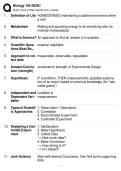
1. Definition of Life HOMEOSTASIS (maintaining a stable environment within
a cell)
2. Metabolism Making and spending energy to do everything else (to
maintain homeostasis)
3. What is Science? An approach to find an answer to a question
4. Scientific Ques- material, falsifiable
tions Must Be...
5. Approach to col- measurable, observable, repeatable
lect data
6. Answer/Conclu- restrained to strength of Experimental Design
sion (strength)
7. Hypothesis IF (condition), THEN (measurement); possible explana-
tion of an event, based on previous knowledge (An "edu-
cated guess")
8. Independent and condition &
Dependent Vari- measurement
ables
9. Types of Scientif- 1. Observation / Description
ic Approaches 2. Correlation
3. Noncontrolled Experiment
4. Controlled Experiment
10. Designing a Con- 1. AskQuestion
trolled Experi- 2. Make Hypothesis
ment 3. Collect Data
--> How much data?
4. Make Conclusion
--> How strong is it?
--> Is it biased?
11. Junk Science Start with desired Conclusion, then find some supporting
data
, Biology 105 NCSU
Study online at https://quizlet.com/_euewdv
12. PseudoScience • Question NOT material, falsifiable
• Approach NOT measurable, observable, repeatable
• Exciting & sensational
13. Correlations causation
does not equal
_________
14. Fact one piece of empirical data; falsifiable
15. Law narrow, but strong prediction of events under specific
conditions (often a mathematical formula)
16. Scientific Theory broad & strongest explanation supported by a large body
of scientific research, with minimal influence of human
bias.
17. Accept vs. Be- You either ACCEPT or DO NOT ACCEPT that data lead
lieve to a specific conclusion; You do NOT believe in anything
in science
18. Supported vs. You either SUPPORT or REFUTE a hypothesis; Nothing
Proven or True is ever 100% (never "proven" or "true"), but
99% is very strong
19. Permian Extinc- ~250 mya; 95% of all marine species; 70% of land verte-
tion (The Great brates; 80% of insects
Dying)
20. Cretaceous Ex- ~65 mya; Dinosaurs
tinction
21. Holocene extinc- current extinction; ~100,000 species extinct/year;
tion megafauna (~10,000 ya); Amphibians; Plants
22. Classification Domain, Kingdom, Phylum, Class, Order, Family, Genus,
List Species
23. Scientific Names Genus + species = Scientific Name (Italicized)
, Biology 105 NCSU
Study online at https://quizlet.com/_euewdv
24. Grouping one species = one name; organize similar groups into
Species categories
25. Species Defini- A group of organisms capable of breeding in nature, and
tion producing viable offspring
26. Problems with •Only breeding organisms (by sexual means)
Species Defini- •No definition of range for "in nature"
tion •What is a "variety"/"breed" vs. "species"
•Range of characteristics/genetics
27. Scientific Names • Not precise (can refer to many species)
vs. Common • Different common names used in different places; Differ-
Names ent languages
• Common names can refer to different species
• Some species have no common names
28. Why Latin? • Dead language (meaning doesn't change)
• Shorter than detailed description • Used everywhere
• Used forever
29. Three Basic Cell Bacteria (prokaryote), Archaea (prokaryote), Eukaryota
Structures (eukaryote)
30. Domains Bacteria, Archaea, Eukaryota
31. Importance of • Food
Plants • Oxygen
• Ecosystems
--> Base of food chain
--> Hold soil; add nitrogen
• Human Society
-->Agriculture
-->Paper/Books
• Furniture & Clothing
• Medicine
32. First Plants Mosses (500mya); Ferns (300mya); Conifers (200mya);
Flowering Plants (100mya)
, Biology 105 NCSU
Study online at https://quizlet.com/_euewdv
33. Mosses • Most primitive plant
• NO vascular system, roots (cannot grow tall)
• Swimming sperm (need water to reproduce)
34. Vascular Tissue Height=compete for sunlight
35. Ferns • Ferns prominent 300 mya
• Vascular system*
- Allows for tall growth
• Leaves with cuticle & stomata
- Keeps water from evaporating
• Swimming sperm (no pollen)
36. Pollen= sperm
37. Gymnosperms • "Age of Cycads" (200 mya)
(conifers, • Vascular system; Leaves with cuticle & stomata
ginkgo) • Reproduction using pollen & seeds (no fruit)
38. Angiosperms • Widespread ~100 mya
(flowering • Vascular system; Leaves with cuticle & stomata
plants) • Reproduction using pollen & seed
- Symbiotic Dispersal: Flowers & Fruit
39. Flower vs Fruit Flowers= more efficient pollination
Seeds enclosed in Fruit (increased range because this
way uses animals for distraction)
40. Fruit vs Veg- Fruit=anything that grows from the ovary of a flower
etable (contains seeds); Vegetable=anything that grows from the
vegetative part of the plant (not a fruit)
41. All About Plant - Domain Eukaryota
Cells - Kingdom Plantae
- Photosynthesis (chloroplast)
- Lack of movement (cell wall, vacuoles & chemicals)
42. Creatures in the Jellyfish (cnidaria), Worms (3 phyla: flatworms, round-
Kingdom Ani- worms, segmented worms), Molluscs, Arthropods, Echin-
malia oderms, Chordates,
Study online at https://quizlet.com/_euewdv
1. Definition of Life HOMEOSTASIS (maintaining a stable environment within
a cell)
2. Metabolism Making and spending energy to do everything else (to
maintain homeostasis)
3. What is Science? An approach to find an answer to a question
4. Scientific Ques- material, falsifiable
tions Must Be...
5. Approach to col- measurable, observable, repeatable
lect data
6. Answer/Conclu- restrained to strength of Experimental Design
sion (strength)
7. Hypothesis IF (condition), THEN (measurement); possible explana-
tion of an event, based on previous knowledge (An "edu-
cated guess")
8. Independent and condition &
Dependent Vari- measurement
ables
9. Types of Scientif- 1. Observation / Description
ic Approaches 2. Correlation
3. Noncontrolled Experiment
4. Controlled Experiment
10. Designing a Con- 1. AskQuestion
trolled Experi- 2. Make Hypothesis
ment 3. Collect Data
--> How much data?
4. Make Conclusion
--> How strong is it?
--> Is it biased?
11. Junk Science Start with desired Conclusion, then find some supporting
data
, Biology 105 NCSU
Study online at https://quizlet.com/_euewdv
12. PseudoScience • Question NOT material, falsifiable
• Approach NOT measurable, observable, repeatable
• Exciting & sensational
13. Correlations causation
does not equal
_________
14. Fact one piece of empirical data; falsifiable
15. Law narrow, but strong prediction of events under specific
conditions (often a mathematical formula)
16. Scientific Theory broad & strongest explanation supported by a large body
of scientific research, with minimal influence of human
bias.
17. Accept vs. Be- You either ACCEPT or DO NOT ACCEPT that data lead
lieve to a specific conclusion; You do NOT believe in anything
in science
18. Supported vs. You either SUPPORT or REFUTE a hypothesis; Nothing
Proven or True is ever 100% (never "proven" or "true"), but
99% is very strong
19. Permian Extinc- ~250 mya; 95% of all marine species; 70% of land verte-
tion (The Great brates; 80% of insects
Dying)
20. Cretaceous Ex- ~65 mya; Dinosaurs
tinction
21. Holocene extinc- current extinction; ~100,000 species extinct/year;
tion megafauna (~10,000 ya); Amphibians; Plants
22. Classification Domain, Kingdom, Phylum, Class, Order, Family, Genus,
List Species
23. Scientific Names Genus + species = Scientific Name (Italicized)
, Biology 105 NCSU
Study online at https://quizlet.com/_euewdv
24. Grouping one species = one name; organize similar groups into
Species categories
25. Species Defini- A group of organisms capable of breeding in nature, and
tion producing viable offspring
26. Problems with •Only breeding organisms (by sexual means)
Species Defini- •No definition of range for "in nature"
tion •What is a "variety"/"breed" vs. "species"
•Range of characteristics/genetics
27. Scientific Names • Not precise (can refer to many species)
vs. Common • Different common names used in different places; Differ-
Names ent languages
• Common names can refer to different species
• Some species have no common names
28. Why Latin? • Dead language (meaning doesn't change)
• Shorter than detailed description • Used everywhere
• Used forever
29. Three Basic Cell Bacteria (prokaryote), Archaea (prokaryote), Eukaryota
Structures (eukaryote)
30. Domains Bacteria, Archaea, Eukaryota
31. Importance of • Food
Plants • Oxygen
• Ecosystems
--> Base of food chain
--> Hold soil; add nitrogen
• Human Society
-->Agriculture
-->Paper/Books
• Furniture & Clothing
• Medicine
32. First Plants Mosses (500mya); Ferns (300mya); Conifers (200mya);
Flowering Plants (100mya)
, Biology 105 NCSU
Study online at https://quizlet.com/_euewdv
33. Mosses • Most primitive plant
• NO vascular system, roots (cannot grow tall)
• Swimming sperm (need water to reproduce)
34. Vascular Tissue Height=compete for sunlight
35. Ferns • Ferns prominent 300 mya
• Vascular system*
- Allows for tall growth
• Leaves with cuticle & stomata
- Keeps water from evaporating
• Swimming sperm (no pollen)
36. Pollen= sperm
37. Gymnosperms • "Age of Cycads" (200 mya)
(conifers, • Vascular system; Leaves with cuticle & stomata
ginkgo) • Reproduction using pollen & seeds (no fruit)
38. Angiosperms • Widespread ~100 mya
(flowering • Vascular system; Leaves with cuticle & stomata
plants) • Reproduction using pollen & seed
- Symbiotic Dispersal: Flowers & Fruit
39. Flower vs Fruit Flowers= more efficient pollination
Seeds enclosed in Fruit (increased range because this
way uses animals for distraction)
40. Fruit vs Veg- Fruit=anything that grows from the ovary of a flower
etable (contains seeds); Vegetable=anything that grows from the
vegetative part of the plant (not a fruit)
41. All About Plant - Domain Eukaryota
Cells - Kingdom Plantae
- Photosynthesis (chloroplast)
- Lack of movement (cell wall, vacuoles & chemicals)
42. Creatures in the Jellyfish (cnidaria), Worms (3 phyla: flatworms, round-
Kingdom Ani- worms, segmented worms), Molluscs, Arthropods, Echin-
malia oderms, Chordates,


