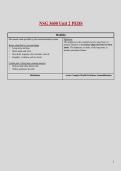
NSG 3600 Unit 2 PEDS
Mobility
Movement made possible by the musculoskeletal system Epiphysis
The epiphysis is the rounded end of a long bone, its
Bones-classified by size and shape primary function is to connect adjacent bones to form
• Long-arms and legs joints. The diaphysis, or shaft, of the long bone, is
• Short-ankle and wrist another prominent feature.
• Flat-skull, scapulae, ribs, sternum, clavicle
• Irregular- vertebrae, pelvis, facial
Central part of long bone contains marrow
• Red-red and white blood cells
• Yellow-produces fat cells
Definitions Acute Complex Health Problems: Immobilization
1
,Joints Physiological effects
Where two or more bones connect, allow for movement, – Decreased muscle strength
structural and functional – Bone demineralization
– Decreased metabolic rate
Fibrous – Altered distribution of blood volume
Held together by connective tissue (skull sutures) – Increased risk for developing venous stasis
– Psychological Effects
Cartilaginous – Physical interference with activity
attach bone by cartilage (ribs, spine) • Frustration and helplessness
• Sluggish intellectual and psychomotor
Synovial spaces responses
filled with fluid (wrist, elbow, hip, knee) – Effects on family
– Disrupt family function
Hinge-convex surface fits in concave surface (knee, elbow
Pivot Nursing management
Allows for rotation (radius and ulna) – Activities to increase strength
– Prevent skin breakdown – Nutrition
Compound • High protein
Multiple joints (skull and vertebral column) • High caloric
Ball and socket-allows for radial movement (hips, shoulders) Age-appropriate distractions
1 yr-24 months
Ligaments fibrous • Toy, play hammer
bands linking bones or cartilage together, provide stability, Toddler
blood supply very small, lack elasticity • Large Crayons
Adolescent
Striated skeletal • Give them Homework to occupy their time
attaches to tendons, create movement, contract voluntarily
Smooth Found
in the wall of the hollow organs except the heart Involuntary
contraction
Epiphyseal Injuries Clubfoot-Genetic disorder causing deformity of the
foot
2
, • Weakest point of long bones is the cartilage growth Causes
plate (epiphyseal plate) • Postural-benign form-usually resolves with
• Frequent site of damage during trauma stretches and casting
• May affect future bone growth • Idiopathic-true congenital clubfoot with varied
• Treatment may include open reduction and internal severity
fixation to prevent growth disturbances • Neurogenic-usually seen with spina bifida
• Syndromic-associated with other anomalies
Signs & Symptoms
• Foot is plantar-flexed with an inverted heel (turned
sharply inward)
• Adducted forefoot
• Is rigid and cannot be moved into a neutral position
• Has smaller calf muscle on affected leg
Legg-Calve Perthes Congenital Clubfoot
Idiopathic: An interrupted blood supply to the femoral head Talipes equinovarus is the most frequently
which results in necrosis occurring type of clubfoot (»95%) of all cases.
Risk Factors: Age 3-12 and male Diagnosis-
• Visualization
Signs & Symptoms • Prenatal ultrasound or newborn screening
• Hip/knee soreness or stiffness
• Pain that increases with movement and decreases with Collaborative Care
rest Medical
• Painful limp • abduction and dorsiflexion casting
• Quadriceps muscle atrophy • Browne splint-used after the last casting-worn 23
• Joint dysfunction hours/day
• Limited ROM Surgical
• tenotomy for severe cases
Diagnosis
Radiograph, MRI, Bone Scan Nursing care
• Provide cast care, neurovascular assessments,
Collaborative Care Medical/surgical passive ROM
• Periods of hospitalization with non-weight bearing. • Manage pain
Later increased weight bearing with a brace worn for 24 • Educate family on need for compliance with bracing
years. Montreal abduction plaster cast for a year or more • Parent teaching
(which allows weight bearing). The Toronto brace can • Manage Pain
replace casting allowing for full knee flexion while • Regular neurovascular checks
maintaining hip placement. • Extremity elevated
• Femoral osteotomy with spica cast-surgical. Nonweight • Observe the extremity for edema, change in color,
bearing warm/cold
• Movement
Treatment goal: • Keeping Doctor’s appointments for weekly serial
• keep head of femur in acetabulum casting
• Need for regular nurse visits and PT for ROM activities • Double diapering to keep cast clean
until weight bearing • Cast care-No baths
Home Nursing • Keep cast clean
• Assessment/history • Reposition every 2 hours
• Assess support systems
3
Mobility
Movement made possible by the musculoskeletal system Epiphysis
The epiphysis is the rounded end of a long bone, its
Bones-classified by size and shape primary function is to connect adjacent bones to form
• Long-arms and legs joints. The diaphysis, or shaft, of the long bone, is
• Short-ankle and wrist another prominent feature.
• Flat-skull, scapulae, ribs, sternum, clavicle
• Irregular- vertebrae, pelvis, facial
Central part of long bone contains marrow
• Red-red and white blood cells
• Yellow-produces fat cells
Definitions Acute Complex Health Problems: Immobilization
1
,Joints Physiological effects
Where two or more bones connect, allow for movement, – Decreased muscle strength
structural and functional – Bone demineralization
– Decreased metabolic rate
Fibrous – Altered distribution of blood volume
Held together by connective tissue (skull sutures) – Increased risk for developing venous stasis
– Psychological Effects
Cartilaginous – Physical interference with activity
attach bone by cartilage (ribs, spine) • Frustration and helplessness
• Sluggish intellectual and psychomotor
Synovial spaces responses
filled with fluid (wrist, elbow, hip, knee) – Effects on family
– Disrupt family function
Hinge-convex surface fits in concave surface (knee, elbow
Pivot Nursing management
Allows for rotation (radius and ulna) – Activities to increase strength
– Prevent skin breakdown – Nutrition
Compound • High protein
Multiple joints (skull and vertebral column) • High caloric
Ball and socket-allows for radial movement (hips, shoulders) Age-appropriate distractions
1 yr-24 months
Ligaments fibrous • Toy, play hammer
bands linking bones or cartilage together, provide stability, Toddler
blood supply very small, lack elasticity • Large Crayons
Adolescent
Striated skeletal • Give them Homework to occupy their time
attaches to tendons, create movement, contract voluntarily
Smooth Found
in the wall of the hollow organs except the heart Involuntary
contraction
Epiphyseal Injuries Clubfoot-Genetic disorder causing deformity of the
foot
2
, • Weakest point of long bones is the cartilage growth Causes
plate (epiphyseal plate) • Postural-benign form-usually resolves with
• Frequent site of damage during trauma stretches and casting
• May affect future bone growth • Idiopathic-true congenital clubfoot with varied
• Treatment may include open reduction and internal severity
fixation to prevent growth disturbances • Neurogenic-usually seen with spina bifida
• Syndromic-associated with other anomalies
Signs & Symptoms
• Foot is plantar-flexed with an inverted heel (turned
sharply inward)
• Adducted forefoot
• Is rigid and cannot be moved into a neutral position
• Has smaller calf muscle on affected leg
Legg-Calve Perthes Congenital Clubfoot
Idiopathic: An interrupted blood supply to the femoral head Talipes equinovarus is the most frequently
which results in necrosis occurring type of clubfoot (»95%) of all cases.
Risk Factors: Age 3-12 and male Diagnosis-
• Visualization
Signs & Symptoms • Prenatal ultrasound or newborn screening
• Hip/knee soreness or stiffness
• Pain that increases with movement and decreases with Collaborative Care
rest Medical
• Painful limp • abduction and dorsiflexion casting
• Quadriceps muscle atrophy • Browne splint-used after the last casting-worn 23
• Joint dysfunction hours/day
• Limited ROM Surgical
• tenotomy for severe cases
Diagnosis
Radiograph, MRI, Bone Scan Nursing care
• Provide cast care, neurovascular assessments,
Collaborative Care Medical/surgical passive ROM
• Periods of hospitalization with non-weight bearing. • Manage pain
Later increased weight bearing with a brace worn for 24 • Educate family on need for compliance with bracing
years. Montreal abduction plaster cast for a year or more • Parent teaching
(which allows weight bearing). The Toronto brace can • Manage Pain
replace casting allowing for full knee flexion while • Regular neurovascular checks
maintaining hip placement. • Extremity elevated
• Femoral osteotomy with spica cast-surgical. Nonweight • Observe the extremity for edema, change in color,
bearing warm/cold
• Movement
Treatment goal: • Keeping Doctor’s appointments for weekly serial
• keep head of femur in acetabulum casting
• Need for regular nurse visits and PT for ROM activities • Double diapering to keep cast clean
until weight bearing • Cast care-No baths
Home Nursing • Keep cast clean
• Assessment/history • Reposition every 2 hours
• Assess support systems
3