

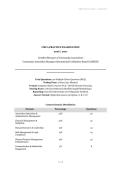
CMCA Practice Exam — 2026/2027
CMCA PRACTICE EXAMINATION
Certified Manager of Community Associations
Community Association Managers International Certification Board (CAMICB)
━━━━━━━━━━━━━━━━━━━━━━━━━━━━━━━━━━━━━━━━━━━━━━
━━━━━━━━━━━━━━
Total Questions: 160 Multiple-Choice Questions (MCQ)
Testing Time: 4 Hours (240 Minutes)
Format: Computer-Based | Pearson VUE / OnVUE Remote Proctoring
Passing Score: Criterion-Referenced (Modified Angoff Methodology)
Reporting: Pass/Fail with Domain-Level Diagnostic Feedback
Answer Format: Single-Best-Answer (4 Options: A, B, C, D)
Content Domain Distribution
Domain Percentage Questions
Association Operations & 25% 40
Administrative Management
Financial Management & 20% 32
Budgeting
Human Resources & Leadership 15% 24
Risk Management & Legal 15% 24
Compliance
Physical Property Management 15% 24
& Maintenance
Communication & Stakeholder 5% 8
Engagement
Page 1
, CMCA Practice Exam — 2026/2027
Governance & Strategic 5% 8
Planning
TOTAL 100% 160
EXAM INSTRUCTIONS
• This CMCA Practice Examination consists of 160 multiple-choice questions designed to assess your
competency across the seven core domains of community association management as defined by the
CAMICB CMCA Examination Content Outline for 2026/2027.
• Each question has four answer options (A, B, C, D). Select the single best answer for each question.
There is no penalty for guessing, so you should answer every question even if you are uncertain.
• The correct answer for each question is displayed in bold purple text (#BC13FE) immediately below
the question options. A detailed rationale written in italic font with a lavender background (#F5EDF9)
follows each question, explaining why the correct answer is best and why the other options are
incorrect.
• The total testing time for the official CMCA examination is 4 hours (240 minutes). For realistic
practice, try to complete all 160 questions within this time frame. Pace yourself at approximately 1.5
minutes per question.
• This practice exam is aligned with the CMCA Examination Blueprint: Association Operations (25%),
Financial Management (20%), Human Resources (15%), Risk Management (15%), Physical Property
Management (15%), Communication (5%), and Governance (5%).
• Questions include standard MCQ items, scenario-based application vignettes, governing document
interpretation items, financial calculation scenarios, risk prioritization questions, and ethical decision-
making cases reflecting the item types used on the actual CMCA examination.
• After completing the exam, review the rationales for all questions — especially those you answered
incorrectly — to identify knowledge gaps and focus your continued study on weaker domains.
Page 2
, CMCA Practice Exam — 2026/2027
Association Operations & Administrative Management (Q1–Q40 | 25%)
──────────────────────────────────────────────────────────────────
1. A community association manager receives a request from an owner to review the
board's executive session minutes from three months ago. According to governing
document interpretation and state law best practices, which action is most appropriate?
A. Deny the request entirely because executive session minutes are permanently confidential
B. Provide the minutes after redacting legally privileged and personnel-related
information
C. Provide the unredacted minutes since all owners have a right to access all records
D. Refer the owner to the association's attorney for all record requests
Rationale: Executive session minutes typically contain sensitive personnel, legal, or
contractual matters. While owners generally have the right to access association records, the
association must redact legally privileged information and confidential personnel details
before disclosure. Complete denial (A) is overly restrictive, providing unredacted minutes (C)
may violate confidentiality obligations, and referring to counsel (D) unnecessarily escalates a
routine administrative request.
2. An owner requests to install a satellite dish on the common area roof. The CC&Rs state
that no alterations to common areas are permitted without board approval. The bylaws
state the board may grant variances for exterior modifications. The rules and regulations
prohibit all rooftop installations. Which governing document takes precedence in
determining the outcome?
A. The rules and regulations, because they are the most recently adopted document
B. The CC&Rs, because they hold the highest priority in the hierarchy of governing
documents
C. The bylaws, because they specifically address the board's variance authority
D. Federal telecommunications law, which always supersedes all governing documents
Rationale: The hierarchy of governing documents follows a clear order: recorded covenants
(CC&Rs) supersede bylaws, which supersede rules and regulations. Since the CC&Rs prohibit
alterations to common areas without board approval, they establish the controlling standard.
While bylaws may grant variance authority, they cannot override CC&R restrictions. Rules
and regulations occupy the lowest tier and cannot contradict higher documents. Option (D) is
incorrect because while the FCC Over-the-Air Reception Device Rule preempts some
restrictions, it does not grant an absolute right to install equipment on common area property
the owner does not own or control.
3. A board of directors wants to amend the CC&Rs to increase the annual assessment cap
from 5% to 10%. The current CC&Rs require a two-thirds vote of all owners for any
amendment. State statute, however, permits assessment cap changes with a majority vote
of those present at a duly called meeting. Which threshold must the association follow?
A. The state statute threshold, because state law always supersedes private covenants
B. The CC&R threshold, because the association agreed to the higher standard and it is more
protective of owner rights
C. The lower threshold, because it is easier to achieve and still legally compliant
D. Either threshold, at the board's discretion
Page 3
, CMCA Practice Exam — 2026/2027
Rationale: When a conflict exists between state statute and governing documents, state law
prevails as the superior legal authority. The association cannot enforce a procedural
requirement that contradicts state statute, even if the governing document provision is more
restrictive. Option (B) is incorrect because private covenants cannot override statutory
mandates. Option (C) reflects improper reasoning by prioritizing convenience over legal
compliance. Option (D) is incorrect because the board does not have discretion to choose which
legal standard to follow when statute directly governs.
4. The CC&Rs of a 200-unit condominium state that 'no unit owner shall keep pets in the
unit without prior written approval of the board.' The board adopted a rule stating 'no dogs
over 25 pounds are permitted.' An owner with a 30-pound dog that was approved by the
previous board five years ago receives a violation notice. What is the most defensible
position for the association?
A. Enforce the rule against the owner because the current rule is clear and unambiguous
B. Grandfather the owner's existing approval since it was granted before the new rule
was adopted
C. Require the owner to reapply under the current rule and then deny the application
D. Rescind the rule entirely because it conflicts with the CC&Rs
Rationale: When a rule is adopted that changes existing rights previously granted in
compliance with governing documents, the principle of grandfathering applies to protect
vested rights. The owner obtained valid approval under the prior standard and should be
allowed to continue until the pet is no longer in the unit. Option (A) fails to account for the
prior approval's validity. Option (C) would be an improper retroactive application of the new
rule. Option (D) is incorrect because the board has authority to adopt reasonable rules
implementing the CC&R provision regarding pet approval.
5. A community association's bylaws require that board meetings be held 'monthly.' Due to
scheduling conflicts, the board has not met in seven weeks. An owner demands that the
board meet immediately, citing the bylaw requirement. Which statement best describes the
board's obligation?
A. The board has no obligation because 'monthly' is commonly interpreted to mean approximately
once per calendar month
B. The board should convene a meeting promptly to comply with the bylaw
requirement and avoid potential breach of fiduciary duty claims
C. The board may wait until the next regularly scheduled meeting since no emergency exists
D. The owner has standing to force a board meeting through a court petition regardless of the
board's rationale
Rationale: Bylaws are binding on the board, and a requirement to meet monthly should be
followed as written. While courts generally allow some flexibility, a seven-week gap exceeds
reasonable interpretation of 'monthly.' Failing to meet as required could expose board
members to claims of breach of fiduciary duty. Option (A) stretches the definition
unreasonably. Option (C) disregards the governing document mandate. Option (D) overstates
the owner's remedy; while an owner may seek judicial intervention, it is not automatic and
typically requires showing harm or exhaustion of internal remedies.
6. An association's CC&Rs contain a provision stating, 'No offensive activity shall be carried
on in any unit.' An owner operates a home-based consulting business and a neighbor files a
complaint claiming the business is 'offensive.' The board must interpret this covenant.
According to CAI best practices and legal standards, how should the board approach this
ambiguous provision?
A. Apply the board's personal interpretation of 'offensive' to decide the complaint
Page 4
CMCA PRACTICE EXAMINATION
Certified Manager of Community Associations
Community Association Managers International Certification Board (CAMICB)
━━━━━━━━━━━━━━━━━━━━━━━━━━━━━━━━━━━━━━━━━━━━━━
━━━━━━━━━━━━━━
Total Questions: 160 Multiple-Choice Questions (MCQ)
Testing Time: 4 Hours (240 Minutes)
Format: Computer-Based | Pearson VUE / OnVUE Remote Proctoring
Passing Score: Criterion-Referenced (Modified Angoff Methodology)
Reporting: Pass/Fail with Domain-Level Diagnostic Feedback
Answer Format: Single-Best-Answer (4 Options: A, B, C, D)
Content Domain Distribution
Domain Percentage Questions
Association Operations & 25% 40
Administrative Management
Financial Management & 20% 32
Budgeting
Human Resources & Leadership 15% 24
Risk Management & Legal 15% 24
Compliance
Physical Property Management 15% 24
& Maintenance
Communication & Stakeholder 5% 8
Engagement
Page 1
, CMCA Practice Exam — 2026/2027
Governance & Strategic 5% 8
Planning
TOTAL 100% 160
EXAM INSTRUCTIONS
• This CMCA Practice Examination consists of 160 multiple-choice questions designed to assess your
competency across the seven core domains of community association management as defined by the
CAMICB CMCA Examination Content Outline for 2026/2027.
• Each question has four answer options (A, B, C, D). Select the single best answer for each question.
There is no penalty for guessing, so you should answer every question even if you are uncertain.
• The correct answer for each question is displayed in bold purple text (#BC13FE) immediately below
the question options. A detailed rationale written in italic font with a lavender background (#F5EDF9)
follows each question, explaining why the correct answer is best and why the other options are
incorrect.
• The total testing time for the official CMCA examination is 4 hours (240 minutes). For realistic
practice, try to complete all 160 questions within this time frame. Pace yourself at approximately 1.5
minutes per question.
• This practice exam is aligned with the CMCA Examination Blueprint: Association Operations (25%),
Financial Management (20%), Human Resources (15%), Risk Management (15%), Physical Property
Management (15%), Communication (5%), and Governance (5%).
• Questions include standard MCQ items, scenario-based application vignettes, governing document
interpretation items, financial calculation scenarios, risk prioritization questions, and ethical decision-
making cases reflecting the item types used on the actual CMCA examination.
• After completing the exam, review the rationales for all questions — especially those you answered
incorrectly — to identify knowledge gaps and focus your continued study on weaker domains.
Page 2
, CMCA Practice Exam — 2026/2027
Association Operations & Administrative Management (Q1–Q40 | 25%)
──────────────────────────────────────────────────────────────────
1. A community association manager receives a request from an owner to review the
board's executive session minutes from three months ago. According to governing
document interpretation and state law best practices, which action is most appropriate?
A. Deny the request entirely because executive session minutes are permanently confidential
B. Provide the minutes after redacting legally privileged and personnel-related
information
C. Provide the unredacted minutes since all owners have a right to access all records
D. Refer the owner to the association's attorney for all record requests
Rationale: Executive session minutes typically contain sensitive personnel, legal, or
contractual matters. While owners generally have the right to access association records, the
association must redact legally privileged information and confidential personnel details
before disclosure. Complete denial (A) is overly restrictive, providing unredacted minutes (C)
may violate confidentiality obligations, and referring to counsel (D) unnecessarily escalates a
routine administrative request.
2. An owner requests to install a satellite dish on the common area roof. The CC&Rs state
that no alterations to common areas are permitted without board approval. The bylaws
state the board may grant variances for exterior modifications. The rules and regulations
prohibit all rooftop installations. Which governing document takes precedence in
determining the outcome?
A. The rules and regulations, because they are the most recently adopted document
B. The CC&Rs, because they hold the highest priority in the hierarchy of governing
documents
C. The bylaws, because they specifically address the board's variance authority
D. Federal telecommunications law, which always supersedes all governing documents
Rationale: The hierarchy of governing documents follows a clear order: recorded covenants
(CC&Rs) supersede bylaws, which supersede rules and regulations. Since the CC&Rs prohibit
alterations to common areas without board approval, they establish the controlling standard.
While bylaws may grant variance authority, they cannot override CC&R restrictions. Rules
and regulations occupy the lowest tier and cannot contradict higher documents. Option (D) is
incorrect because while the FCC Over-the-Air Reception Device Rule preempts some
restrictions, it does not grant an absolute right to install equipment on common area property
the owner does not own or control.
3. A board of directors wants to amend the CC&Rs to increase the annual assessment cap
from 5% to 10%. The current CC&Rs require a two-thirds vote of all owners for any
amendment. State statute, however, permits assessment cap changes with a majority vote
of those present at a duly called meeting. Which threshold must the association follow?
A. The state statute threshold, because state law always supersedes private covenants
B. The CC&R threshold, because the association agreed to the higher standard and it is more
protective of owner rights
C. The lower threshold, because it is easier to achieve and still legally compliant
D. Either threshold, at the board's discretion
Page 3
, CMCA Practice Exam — 2026/2027
Rationale: When a conflict exists between state statute and governing documents, state law
prevails as the superior legal authority. The association cannot enforce a procedural
requirement that contradicts state statute, even if the governing document provision is more
restrictive. Option (B) is incorrect because private covenants cannot override statutory
mandates. Option (C) reflects improper reasoning by prioritizing convenience over legal
compliance. Option (D) is incorrect because the board does not have discretion to choose which
legal standard to follow when statute directly governs.
4. The CC&Rs of a 200-unit condominium state that 'no unit owner shall keep pets in the
unit without prior written approval of the board.' The board adopted a rule stating 'no dogs
over 25 pounds are permitted.' An owner with a 30-pound dog that was approved by the
previous board five years ago receives a violation notice. What is the most defensible
position for the association?
A. Enforce the rule against the owner because the current rule is clear and unambiguous
B. Grandfather the owner's existing approval since it was granted before the new rule
was adopted
C. Require the owner to reapply under the current rule and then deny the application
D. Rescind the rule entirely because it conflicts with the CC&Rs
Rationale: When a rule is adopted that changes existing rights previously granted in
compliance with governing documents, the principle of grandfathering applies to protect
vested rights. The owner obtained valid approval under the prior standard and should be
allowed to continue until the pet is no longer in the unit. Option (A) fails to account for the
prior approval's validity. Option (C) would be an improper retroactive application of the new
rule. Option (D) is incorrect because the board has authority to adopt reasonable rules
implementing the CC&R provision regarding pet approval.
5. A community association's bylaws require that board meetings be held 'monthly.' Due to
scheduling conflicts, the board has not met in seven weeks. An owner demands that the
board meet immediately, citing the bylaw requirement. Which statement best describes the
board's obligation?
A. The board has no obligation because 'monthly' is commonly interpreted to mean approximately
once per calendar month
B. The board should convene a meeting promptly to comply with the bylaw
requirement and avoid potential breach of fiduciary duty claims
C. The board may wait until the next regularly scheduled meeting since no emergency exists
D. The owner has standing to force a board meeting through a court petition regardless of the
board's rationale
Rationale: Bylaws are binding on the board, and a requirement to meet monthly should be
followed as written. While courts generally allow some flexibility, a seven-week gap exceeds
reasonable interpretation of 'monthly.' Failing to meet as required could expose board
members to claims of breach of fiduciary duty. Option (A) stretches the definition
unreasonably. Option (C) disregards the governing document mandate. Option (D) overstates
the owner's remedy; while an owner may seek judicial intervention, it is not automatic and
typically requires showing harm or exhaustion of internal remedies.
6. An association's CC&Rs contain a provision stating, 'No offensive activity shall be carried
on in any unit.' An owner operates a home-based consulting business and a neighbor files a
complaint claiming the business is 'offensive.' The board must interpret this covenant.
According to CAI best practices and legal standards, how should the board approach this
ambiguous provision?
A. Apply the board's personal interpretation of 'offensive' to decide the complaint
Page 4


