

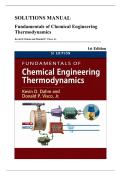
SOLUTIONS MANUAL
Fundamentals of Chemical Engineering
Thermodynamics
ST
Kevin D. Dahm and Donald P. Visco, Jr.
──────────────────────────────────────────────────
UV
1st Edition
IA
?_
AP
PR
OV
ED
? ?
, TABLE OF CONTENTS
Solution Manual: Fundamentals of Chemical Engineering Thermodynamics, 1st
Edition
ST
By Kevin D. Dahm and Donald P. Visco
UV
Chapter Title
Chapter 1 Introduction
Chapter 2 The Physical Properties of Pure Compounds
IA
Chapter 3 Material and Energy Balances
Chapter 4 Entropy
?_
Chapter 5 Thermodynamic Processes and Cycles
Chapter 6 Thermodynamic Models of Real, Pure Compounds
AP
Chapter 7 Equations of State
Chapter 8 Modeling Phase Equilibrium for Pure Compounds
PR
Chapter 9 An Introduction to Mixtures
Chapter 10 Vapor-Liquid Equilibrium
OV
Chapter 11 Theories and Models for Vapor–Liquid Equilibrium of Mixtures: Modified
Raoult’s Law Approaches
Chapter 12 Theories and Models for Vapor–Liquid Equilibrium of Mixtures: Using
ED
Equations of State
Chapter 13 Liquid-Liquid, Vapor-Liquid-Liquid, and Solid-Liquid Equilibrium
Chapter 14 Fundamentals of Chemical Reaction Equilibrium
??
Chapter 15 Synthesis of Thermodynamic Principles
1
, Chapter 1: Introduction
ST
1-16) The value g = 9.81 m/s2 is specific to the force of gravity on the surface of the
earth. The universal formula for the force of gravitational attraction is:
UV
�1�2
�= G
�2
Where m1 and m2 are the masses of the two objects, r is the distance between the
centers of the two objects, and G is the universal gravitation constant,
G = 6.674 × 10⁻¹¹ N(m/kg)2.
IA
A) Research the diameters and masses of the Earth and Jupiter.
B) Demonstrate that F = m(9.81 m/s2) is a valid relationship on the surface of the
?_
earth.
C) Determine the force of gravity acting on a 1000 kg satellite that is 2000 miles
above the surface of the Earth.
D) One of the authors of this book has a mass of 200 lbm. If he was on the surface
AP
of Jupiter, what gravitational force in lbf would be acting on him?
Solution:
A) Measurements obtained from different sources will vary slightly.
PR
DEarth~ 12,742 km DJupiter~ 142,000 km
Massearth= 5.97 × 1024 kg Massjupiter= 1.90 × 1027 kg
OV
B) Massearth= 5.97 × 1024 kg RadiusEarth= 6.371 × 10⁶ meters
� � Nm2 (5.97×1024kg) kg m
( )
�= G 1 2
� = mobject (6.674 × 10⁻¹¹ ) ( sec2
)
�2 kg2 (6.37×10⁶ m)2 (1 N)
ED
m
F = m(9. 81 )
sec2
C) 2000 miles = 3218.68 km = 3218680 m
??
2
� = 1000kg (6.674 × 10⁻¹¹ Nm (5.97×1024kg)
) (6371000�+3218680� )2 = 4348 N
kg2
1
, Chapter 1: Introduction
D) RadiusJupiter= 66854000 m MassJupiter= 1.898 × 1027 kg 200lbm = 90.7 kg
Nm2 (1.90 × 1027kg) ( kg m )
sec2
ST
−11
� = 90.7 kg (6.674 × 10 ) ( ) = 2281 N
kg2 (7.10 × 10⁷ m)2 (1 N)
UV
1-17) A gas at T=300 K and P=1 bar is contained in a rigid, rectangular vessel that is 2
meters long, 1 meter wide and 1 meter deep. How much force does the gas exert on
the walls of the container?
Solution:
IA
1 Bar = 100,000 Pa
AreaSurface = (2 × W × H) + (2 × W × L) + (2 × H × L)
?_
Force = Pressure × Area
N
( 2)
Force = (100000Pa)(2 × 1m × 1m + 2 × 1m × 2m + 2 × 1m × 2m) ( m )
AP
Pa
Force = 1 × 10⁶N
PR
1-18) A car weighs 3000 lbm, and is travelling 60 mph when it has to make an emergency
stop. The car comes to a stop 5 seconds after the brakes are applied.
A) Assuming the rate of deceleration is constant, what force is required?
OV
B) Assuming the rate of deceleration is constant, how much distance is covered
before the car comes to a stop?
Solution:
5280ft ft
A) Force = mass × acceleration 60mph ( 1hr
)( ) = 88
ED
3600sec 1mile sec
velocityfinal − velocityinitial
Acceleration =
time
??
ft
88 sec − 0
a=
5 sec
ft
a = 17.6
sec2
2
Fundamentals of Chemical Engineering
Thermodynamics
ST
Kevin D. Dahm and Donald P. Visco, Jr.
──────────────────────────────────────────────────
UV
1st Edition
IA
?_
AP
PR
OV
ED
? ?
, TABLE OF CONTENTS
Solution Manual: Fundamentals of Chemical Engineering Thermodynamics, 1st
Edition
ST
By Kevin D. Dahm and Donald P. Visco
UV
Chapter Title
Chapter 1 Introduction
Chapter 2 The Physical Properties of Pure Compounds
IA
Chapter 3 Material and Energy Balances
Chapter 4 Entropy
?_
Chapter 5 Thermodynamic Processes and Cycles
Chapter 6 Thermodynamic Models of Real, Pure Compounds
AP
Chapter 7 Equations of State
Chapter 8 Modeling Phase Equilibrium for Pure Compounds
PR
Chapter 9 An Introduction to Mixtures
Chapter 10 Vapor-Liquid Equilibrium
OV
Chapter 11 Theories and Models for Vapor–Liquid Equilibrium of Mixtures: Modified
Raoult’s Law Approaches
Chapter 12 Theories and Models for Vapor–Liquid Equilibrium of Mixtures: Using
ED
Equations of State
Chapter 13 Liquid-Liquid, Vapor-Liquid-Liquid, and Solid-Liquid Equilibrium
Chapter 14 Fundamentals of Chemical Reaction Equilibrium
??
Chapter 15 Synthesis of Thermodynamic Principles
1
, Chapter 1: Introduction
ST
1-16) The value g = 9.81 m/s2 is specific to the force of gravity on the surface of the
earth. The universal formula for the force of gravitational attraction is:
UV
�1�2
�= G
�2
Where m1 and m2 are the masses of the two objects, r is the distance between the
centers of the two objects, and G is the universal gravitation constant,
G = 6.674 × 10⁻¹¹ N(m/kg)2.
IA
A) Research the diameters and masses of the Earth and Jupiter.
B) Demonstrate that F = m(9.81 m/s2) is a valid relationship on the surface of the
?_
earth.
C) Determine the force of gravity acting on a 1000 kg satellite that is 2000 miles
above the surface of the Earth.
D) One of the authors of this book has a mass of 200 lbm. If he was on the surface
AP
of Jupiter, what gravitational force in lbf would be acting on him?
Solution:
A) Measurements obtained from different sources will vary slightly.
PR
DEarth~ 12,742 km DJupiter~ 142,000 km
Massearth= 5.97 × 1024 kg Massjupiter= 1.90 × 1027 kg
OV
B) Massearth= 5.97 × 1024 kg RadiusEarth= 6.371 × 10⁶ meters
� � Nm2 (5.97×1024kg) kg m
( )
�= G 1 2
� = mobject (6.674 × 10⁻¹¹ ) ( sec2
)
�2 kg2 (6.37×10⁶ m)2 (1 N)
ED
m
F = m(9. 81 )
sec2
C) 2000 miles = 3218.68 km = 3218680 m
??
2
� = 1000kg (6.674 × 10⁻¹¹ Nm (5.97×1024kg)
) (6371000�+3218680� )2 = 4348 N
kg2
1
, Chapter 1: Introduction
D) RadiusJupiter= 66854000 m MassJupiter= 1.898 × 1027 kg 200lbm = 90.7 kg
Nm2 (1.90 × 1027kg) ( kg m )
sec2
ST
−11
� = 90.7 kg (6.674 × 10 ) ( ) = 2281 N
kg2 (7.10 × 10⁷ m)2 (1 N)
UV
1-17) A gas at T=300 K and P=1 bar is contained in a rigid, rectangular vessel that is 2
meters long, 1 meter wide and 1 meter deep. How much force does the gas exert on
the walls of the container?
Solution:
IA
1 Bar = 100,000 Pa
AreaSurface = (2 × W × H) + (2 × W × L) + (2 × H × L)
?_
Force = Pressure × Area
N
( 2)
Force = (100000Pa)(2 × 1m × 1m + 2 × 1m × 2m + 2 × 1m × 2m) ( m )
AP
Pa
Force = 1 × 10⁶N
PR
1-18) A car weighs 3000 lbm, and is travelling 60 mph when it has to make an emergency
stop. The car comes to a stop 5 seconds after the brakes are applied.
A) Assuming the rate of deceleration is constant, what force is required?
OV
B) Assuming the rate of deceleration is constant, how much distance is covered
before the car comes to a stop?
Solution:
5280ft ft
A) Force = mass × acceleration 60mph ( 1hr
)( ) = 88
ED
3600sec 1mile sec
velocityfinal − velocityinitial
Acceleration =
time
??
ft
88 sec − 0
a=
5 sec
ft
a = 17.6
sec2
2


