

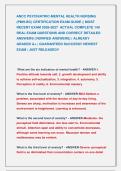
ANCC PSYCHIATRIC-MENTAL HEALTH NURSING
(PMH-BC) CERTIFICATION EXAM GUIDE || MOST
RECENT EXAM 2026-2027 ACTUAL COMPLETE 140
REAL EXAM QUESTIONS AND CORRECT DETAILED
ANSWERS (VERIFIED ANSWERS) | ALREADY
GRADED A+ | GUARANTEED SUCCESS!! NEWEST
EXAM | JUST RELEASED!!
What are the six indicators of mental health? - ANSWER-1.
Positive attitude towards self, 2. growth development and ability
to achieve self-actualization, 3. integration, 4. autonomy, 5.
Perception of reality, 6. Environmental mastery
What is the first level of anxiety? - ANSWER-Mild-Seldom a
problem, associated with the tension of day-to-day living.
Senses are sharp, motivation is increases and awareness of the
environment is heightened. Learning is enhanced.
What is the second level of anxiety? - ANSWER-Moderate- the
perceptual field diminishes. Are less alert to. Environmental
stimuli. Attention span and ability to concentrate decreases,
although some learning can occur. Muscular tension and
restlessness may be evident.
What is the third level of anxiety? - ANSWER-Severe- perceptual
field is so diminished that concentration centers on one detail
,only or on many extraneous details.very limited attention span.
All behavior is aimed at relieving anxiety
What is the fourth level of anxiety? - ANSWER-Panic- most
intense state. Individual is unable to focus on one detail.
Misperceptions of the environment are common, there may be
loss of contact with reality. Behavior may be characterized by
wild and desperate actions or by extreme withdrawal. Human
function and communication with other are ineffective.
Prolonged panic anxiety can lead to physical and emotional
exhaustion can be life threatening.
What are the coping mechanisms when dealing with mild
anxiety? - ANSWER-Eating, drinking, sleeping, physical
exercise, smoking, crying, laughing, talking to someone
What is the coping mechanism when dealing with mild to
moderate anxiety? - ANSWER-Compensation, denial,
displacement, identification (attempt to increase self-worth),
intellectualization (attempt to avoid actual emotions),
introspection (the belief and values of another are internalized
and symbolically become part of themselves)
At the mild level of and anxiety what happens in the following -
perceptual field, ability to learn, physical characteristics,
emotional/behavioral characteristics? - ANSWER-PF heightened
perception, increases awareness, increase alertness, ATL-
learning is enhances, PC- restlessness irritability, EBC -rarely
expressed as distressful, motivation increases
, At the moderate level of and anxiety what happens in the
following - perceptual field, ability to learn, physical
characteristics, emotional/behavioral characteristics? -
ANSWER-PF- reduction in perceptual field, reduced alertness to
environmental events, ATL- learning still occurs but not at
optimal level, decreased attention span and ability to
concentrate, PC- restlessness, increase heart rate and
respiration, perspiration, muscle tension, increased speech rate
volume, pitch. EC- relationship problem person wants to fix
problem
At the severe level of and anxiety what happens in the following
- perceptual field, ability to learn, physical characteristics,
emotional/behavioral characteristics? - ANSWER-PF- reduction
in alertness, perception, may become fixated on something,
ATL- very limited attention span, unable to concentrate or
problem solve learning cannot occur, PC- headache, dizziness,
nausea, trembling, insomnia, palpitations, tachycardia,
diarrhea, EC- feeling of dread, loathing, horror, total focus on
self and intense desire to relive anxiety
At the panic level of and anxiety what happens in the following -
perceptual field, ability to learn, physical characteristics,
emotional/behavioral characteristics? - ANSWER-PF- unable to
focus on even one detail, misperceptions blows things out of
proportion, ATL- learning cannot occur, unable to concentrate
or follow directions, PC- dilated pupils, labored breathing,
severe trembling, sleeplessness, palpitations, muscular in
(PMH-BC) CERTIFICATION EXAM GUIDE || MOST
RECENT EXAM 2026-2027 ACTUAL COMPLETE 140
REAL EXAM QUESTIONS AND CORRECT DETAILED
ANSWERS (VERIFIED ANSWERS) | ALREADY
GRADED A+ | GUARANTEED SUCCESS!! NEWEST
EXAM | JUST RELEASED!!
What are the six indicators of mental health? - ANSWER-1.
Positive attitude towards self, 2. growth development and ability
to achieve self-actualization, 3. integration, 4. autonomy, 5.
Perception of reality, 6. Environmental mastery
What is the first level of anxiety? - ANSWER-Mild-Seldom a
problem, associated with the tension of day-to-day living.
Senses are sharp, motivation is increases and awareness of the
environment is heightened. Learning is enhanced.
What is the second level of anxiety? - ANSWER-Moderate- the
perceptual field diminishes. Are less alert to. Environmental
stimuli. Attention span and ability to concentrate decreases,
although some learning can occur. Muscular tension and
restlessness may be evident.
What is the third level of anxiety? - ANSWER-Severe- perceptual
field is so diminished that concentration centers on one detail
,only or on many extraneous details.very limited attention span.
All behavior is aimed at relieving anxiety
What is the fourth level of anxiety? - ANSWER-Panic- most
intense state. Individual is unable to focus on one detail.
Misperceptions of the environment are common, there may be
loss of contact with reality. Behavior may be characterized by
wild and desperate actions or by extreme withdrawal. Human
function and communication with other are ineffective.
Prolonged panic anxiety can lead to physical and emotional
exhaustion can be life threatening.
What are the coping mechanisms when dealing with mild
anxiety? - ANSWER-Eating, drinking, sleeping, physical
exercise, smoking, crying, laughing, talking to someone
What is the coping mechanism when dealing with mild to
moderate anxiety? - ANSWER-Compensation, denial,
displacement, identification (attempt to increase self-worth),
intellectualization (attempt to avoid actual emotions),
introspection (the belief and values of another are internalized
and symbolically become part of themselves)
At the mild level of and anxiety what happens in the following -
perceptual field, ability to learn, physical characteristics,
emotional/behavioral characteristics? - ANSWER-PF heightened
perception, increases awareness, increase alertness, ATL-
learning is enhances, PC- restlessness irritability, EBC -rarely
expressed as distressful, motivation increases
, At the moderate level of and anxiety what happens in the
following - perceptual field, ability to learn, physical
characteristics, emotional/behavioral characteristics? -
ANSWER-PF- reduction in perceptual field, reduced alertness to
environmental events, ATL- learning still occurs but not at
optimal level, decreased attention span and ability to
concentrate, PC- restlessness, increase heart rate and
respiration, perspiration, muscle tension, increased speech rate
volume, pitch. EC- relationship problem person wants to fix
problem
At the severe level of and anxiety what happens in the following
- perceptual field, ability to learn, physical characteristics,
emotional/behavioral characteristics? - ANSWER-PF- reduction
in alertness, perception, may become fixated on something,
ATL- very limited attention span, unable to concentrate or
problem solve learning cannot occur, PC- headache, dizziness,
nausea, trembling, insomnia, palpitations, tachycardia,
diarrhea, EC- feeling of dread, loathing, horror, total focus on
self and intense desire to relive anxiety
At the panic level of and anxiety what happens in the following -
perceptual field, ability to learn, physical characteristics,
emotional/behavioral characteristics? - ANSWER-PF- unable to
focus on even one detail, misperceptions blows things out of
proportion, ATL- learning cannot occur, unable to concentrate
or follow directions, PC- dilated pupils, labored breathing,
severe trembling, sleeplessness, palpitations, muscular in


