Genen en ziekte
Celcyclus
- G0 fase: rustfase
- G1 fase: voorbereidingen voor DNA synthese
- S fase
- M fase (mitosefase: moedercel deelt in 2 identieke dochtercellen)
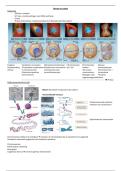
Celgroei Verdwijnen nucleolus Afbraak kernmembraan Chromosomen Chromsomen Nieuwe
Voorbereiding Chromatine condenseert Kinetochoor microtubuli op 1 lijn breken kernmembraan
mitose in chromosomen Centrosoom naar Op niveau Chromosomen >
Mitotische spindles verschillende pool centromeren chromatine
Centrosomen Bewegen naar Nucleoli
tegenovergestelde kant
------------------------------------------------------------------------------------------------------------------------ ➔ M fase
Opbouw genetische code
Waar? Genetisch materiaal in de celkern
Verschillende niveaus
Ondersteunende eiwitten:
histonen en nucleosoom
Spiralisatie tot chromatide
Chromosomen tijdens de metafase→ bestaan uit chromatiden die in spiraalvorm is opgerold
Genetisch materiaal opgekruld rond histonen (eiwitten)
Chromosomen
Enkel tijdens celdeling
Karyogram
G (giemsa stain) of R (reverse giemsa stain) bands
, ➔ complementair
A + T en C + G
1951 Watson en Crick: specifieke organisatie van DNA
Dubbele keten in helixstructuur
• Antiparallel (tegenovergestelde richting)
• Complementariteit (purine tegenover pyrimidine)
- A=T
- GC
• Waterstofbruggen als verbindingen tussen de basen
Genetische code: voor de verschillende eiwitten, enzymes...
Belangrijk te weten hoe genetische code is opgebouwd
, Kopiëren genetische code
Celgroei
Cytoplasmatische
deling
Voorbereiding DNA
Duplicatie DNA synthese
‘zuster’chromatiden
Groeifactoren
Omzetten van genetische code
HELICASE: enzyme die dubbele helixstructuur
uit elkaar haalt
POLYMERASE: DNA dupliceren
TRANSCRIPTIE
Complementair (basenparing)
Enkelstrengig
mRNA
U (uracil) ipv T (thymine)
Celcyclus
- G0 fase: rustfase
- G1 fase: voorbereidingen voor DNA synthese
- S fase
- M fase (mitosefase: moedercel deelt in 2 identieke dochtercellen)
Celgroei Verdwijnen nucleolus Afbraak kernmembraan Chromosomen Chromsomen Nieuwe
Voorbereiding Chromatine condenseert Kinetochoor microtubuli op 1 lijn breken kernmembraan
mitose in chromosomen Centrosoom naar Op niveau Chromosomen >
Mitotische spindles verschillende pool centromeren chromatine
Centrosomen Bewegen naar Nucleoli
tegenovergestelde kant
------------------------------------------------------------------------------------------------------------------------ ➔ M fase
Opbouw genetische code
Waar? Genetisch materiaal in de celkern
Verschillende niveaus
Ondersteunende eiwitten:
histonen en nucleosoom
Spiralisatie tot chromatide
Chromosomen tijdens de metafase→ bestaan uit chromatiden die in spiraalvorm is opgerold
Genetisch materiaal opgekruld rond histonen (eiwitten)
Chromosomen
Enkel tijdens celdeling
Karyogram
G (giemsa stain) of R (reverse giemsa stain) bands
, ➔ complementair
A + T en C + G
1951 Watson en Crick: specifieke organisatie van DNA
Dubbele keten in helixstructuur
• Antiparallel (tegenovergestelde richting)
• Complementariteit (purine tegenover pyrimidine)
- A=T
- GC
• Waterstofbruggen als verbindingen tussen de basen
Genetische code: voor de verschillende eiwitten, enzymes...
Belangrijk te weten hoe genetische code is opgebouwd
, Kopiëren genetische code
Celgroei
Cytoplasmatische
deling
Voorbereiding DNA
Duplicatie DNA synthese
‘zuster’chromatiden
Groeifactoren
Omzetten van genetische code
HELICASE: enzyme die dubbele helixstructuur
uit elkaar haalt
POLYMERASE: DNA dupliceren
TRANSCRIPTIE
Complementair (basenparing)
Enkelstrengig
mRNA
U (uracil) ipv T (thymine)