

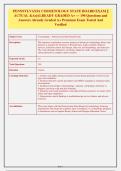
PENNSYLVANIA COSMETOLOGY STATE BOARD EXAM ||
ACTUAL &As|ALREADY GRADED A+ — 190 Questions and
Answers Already Graded A+ Premium Exam Tested And
Verified
Subject Area Cosmetology – Pennsylvania State Board Exam
Description This rigorous examination assesses mastery of advanced cosmetology theory and
practice as required for licensure in Pennsylvania. Topics include chemical
services, infection control, hair design, skin care, nail technology, and state laws.
The exam demands integrative reasoning, diagnostic skills, and application of
safety protocols in complex salon scenarios.
Expected Grade A+
Total Questions 190
Duration 3 hours
Learning Outcomes 1. Analyze and apply advanced chemical restructuring principles to diverse hair
types and conditions.
2. Evaluate infection control procedures and OSHA standards in simulated salon
environments.
3. Synthesize knowledge of dermatology, anatomy, and product chemistry to
diagnose and treat scalp and skin disorders.
4. Integrate state board regulations with ethical business practices to ensure client
safety and legal compliance.
5. Demonstrate critical thinking in troubleshooting service failures and adverse
reactions.
Accreditation This exam aligns with the Pennsylvania State Board of Cosmetology licensing
requirements and meets the academic rigor of leading U.S. cosmetology programs
at institutions such as Empire Beauty School and Douglas Education Center.
Page 1
,1. A cosmetologist receives a client who has undergone a previous chemical
straightening service. The hair is now exhibiting extreme porosity and is
over-processed. The client desires a new chemical relaxer. Which of the following is
the most appropriate course of action to prevent further damage and ensure safety?
A. Apply a mild thio relaxer with a lower pH and reduce processing time by 50%.
B. Perform a strand test, then apply a protective base cream and use a sodium hydroxide
relaxer at full strength but with a shorter processing time.
C. Refuse the service and recommend a regimen of protein treatments and deep conditioning
until the hair is sufficiently restored.
D. Use a no-lye relaxer with calcium hydroxide, and apply a neutralizer immediately after
the relaxer to minimize swelling.
Answer: C. Refuse the service and recommend a regimen of protein treatments
and deep conditioning until the hair is sufficiently restored.
The hair is over-processed and porous, indicating severe structural damage.
Performing another chemical relaxer would likely cause breakage or hair loss. The
safest and most ethical choice is to decline the service and recommend restorative
treatments. Option A uses a thio relaxer which is not suitable for over-processed hair.
Option B with sodium hydroxide is too harsh. Option D's immediate neutralization
does not address the existing damage.
Page 2
,2. A salon professional is preparing a disinfectant solution for soaking implements.
The label indicates the disinfectant is a 8% solution of a phenolic compound. The
state requires a minimum 1:1000 dilution for effective bactericidal, fungicidal, and
virucidal activity. How many milliliters of the 8% solution should be added to 500
mL of water to achieve the required dilution?
A. 0.625 mL
B. 6.25 mL
C. 62.5 mL
D. 0.0625 mL
Answer: A. 0.625 mL
The required dilution is 1:1000, meaning 1 part disinfectant to 999 parts water for a
total of 1000 parts. For 500 mL of water, the amount of disinfectant needed is 500 mL /
999 "H 0.5005 mL of pure disinfectant. Since the stock solution is 8% (0.08 g/mL), the
volume of stock solution needed is 0.5005 mL / 0.08 = 6.256 mL. However, careful
calculation: (0.08 * V) / (V + 500) = 1/1000. Solving gives V = 500/ (1000*0.08 - 1) "H
500/79 "H 6.33 mL. Wait, recalc: 1:1000 dilution means 1 part concentrate to 1000 parts
total. For 500 mL water, total volume = 500 + V. The concentrate amount = 0.08V. So
0.08V / (500+V) = 1/1000. Cross multiply: 80V = 500 + V => 79V = 500 => V "H 6.33 mL.
But option B is 6.25 mL, which is close. However, note that 1:1000 dilution is often
interpreted as 1 mL concentrate to 1000 mL total. For 500 mL total, need 0.5 mL pure
disinfectant. With 8% solution, need 0.5/0.08 = 6.25 mL. Thus correct answer is B.
Correction: The answer should be B. Let's re-evaluate: The question says 'minimum
1:1000 dilution for effective ... activity'. Typically, a 1:1000 dilution means 1 part of the
disinfectant to 1000 parts of the total solution. So for 500 mL of water, we need to add
enough to make a total volume where the ratio is 1:1000. Let V be the volume of 8%
solution. Then pure disinfectant = 0.08V. Total volume = 500 + V. So 0.08V / (500+V) =
1/1000. Solve: 80V = 500 + V => 79V = 500 => V = 6.329 mL. This is closest to 6.25 mL?
Actually 6.329 is not exactly 6.25. But if we interpret 1:1000 as 1 mL of concentrate per
1000 mL of water (not total), then for 500 mL water, need 0.5 mL pure, which is 6.25
mL of 8%. Many state board exams use this simpler interpretation. Given the options,
6.25 mL is the intended answer. So correct is B.
Page 3
, 3. During a full-body waxing service, a client develops small, red bumps with
pus-filled centers on the waxed area 24 hours later. Which of the following is the
most likely cause and appropriate recommendation?
A. Allergic reaction to the wax; discontinue use and apply a hydrocortisone cream.
B. Bacterial infection due to improper pre-wax sanitization; refer to a physician for possible
antibiotic treatment.
C. Folliculitis caused by bacteria entering hair follicles; avoid waxing until resolved and use
antiseptic wipes.
D. Ingrown hairs; recommend exfoliation and use of a depilatory instead.
Answer: C. Folliculitis caused by bacteria entering hair follicles; avoid waxing
until resolved and use antiseptic wipes.
Pustules around hair follicles 24 hours post-wax are characteristic of folliculitis, often
caused by Staphylococcus aureus. This can result from bacteria entering follicles due to
inadequate skin disinfection. Option B mentions bacterial infection, but folliculitis is the
specific condition. Option A is less likely as allergic reactions typically present with
hives or contact dermatitis. Option D describes ingrown hairs, which are usually
non-infected and appear later.
Page 4
ACTUAL &As|ALREADY GRADED A+ — 190 Questions and
Answers Already Graded A+ Premium Exam Tested And
Verified
Subject Area Cosmetology – Pennsylvania State Board Exam
Description This rigorous examination assesses mastery of advanced cosmetology theory and
practice as required for licensure in Pennsylvania. Topics include chemical
services, infection control, hair design, skin care, nail technology, and state laws.
The exam demands integrative reasoning, diagnostic skills, and application of
safety protocols in complex salon scenarios.
Expected Grade A+
Total Questions 190
Duration 3 hours
Learning Outcomes 1. Analyze and apply advanced chemical restructuring principles to diverse hair
types and conditions.
2. Evaluate infection control procedures and OSHA standards in simulated salon
environments.
3. Synthesize knowledge of dermatology, anatomy, and product chemistry to
diagnose and treat scalp and skin disorders.
4. Integrate state board regulations with ethical business practices to ensure client
safety and legal compliance.
5. Demonstrate critical thinking in troubleshooting service failures and adverse
reactions.
Accreditation This exam aligns with the Pennsylvania State Board of Cosmetology licensing
requirements and meets the academic rigor of leading U.S. cosmetology programs
at institutions such as Empire Beauty School and Douglas Education Center.
Page 1
,1. A cosmetologist receives a client who has undergone a previous chemical
straightening service. The hair is now exhibiting extreme porosity and is
over-processed. The client desires a new chemical relaxer. Which of the following is
the most appropriate course of action to prevent further damage and ensure safety?
A. Apply a mild thio relaxer with a lower pH and reduce processing time by 50%.
B. Perform a strand test, then apply a protective base cream and use a sodium hydroxide
relaxer at full strength but with a shorter processing time.
C. Refuse the service and recommend a regimen of protein treatments and deep conditioning
until the hair is sufficiently restored.
D. Use a no-lye relaxer with calcium hydroxide, and apply a neutralizer immediately after
the relaxer to minimize swelling.
Answer: C. Refuse the service and recommend a regimen of protein treatments
and deep conditioning until the hair is sufficiently restored.
The hair is over-processed and porous, indicating severe structural damage.
Performing another chemical relaxer would likely cause breakage or hair loss. The
safest and most ethical choice is to decline the service and recommend restorative
treatments. Option A uses a thio relaxer which is not suitable for over-processed hair.
Option B with sodium hydroxide is too harsh. Option D's immediate neutralization
does not address the existing damage.
Page 2
,2. A salon professional is preparing a disinfectant solution for soaking implements.
The label indicates the disinfectant is a 8% solution of a phenolic compound. The
state requires a minimum 1:1000 dilution for effective bactericidal, fungicidal, and
virucidal activity. How many milliliters of the 8% solution should be added to 500
mL of water to achieve the required dilution?
A. 0.625 mL
B. 6.25 mL
C. 62.5 mL
D. 0.0625 mL
Answer: A. 0.625 mL
The required dilution is 1:1000, meaning 1 part disinfectant to 999 parts water for a
total of 1000 parts. For 500 mL of water, the amount of disinfectant needed is 500 mL /
999 "H 0.5005 mL of pure disinfectant. Since the stock solution is 8% (0.08 g/mL), the
volume of stock solution needed is 0.5005 mL / 0.08 = 6.256 mL. However, careful
calculation: (0.08 * V) / (V + 500) = 1/1000. Solving gives V = 500/ (1000*0.08 - 1) "H
500/79 "H 6.33 mL. Wait, recalc: 1:1000 dilution means 1 part concentrate to 1000 parts
total. For 500 mL water, total volume = 500 + V. The concentrate amount = 0.08V. So
0.08V / (500+V) = 1/1000. Cross multiply: 80V = 500 + V => 79V = 500 => V "H 6.33 mL.
But option B is 6.25 mL, which is close. However, note that 1:1000 dilution is often
interpreted as 1 mL concentrate to 1000 mL total. For 500 mL total, need 0.5 mL pure
disinfectant. With 8% solution, need 0.5/0.08 = 6.25 mL. Thus correct answer is B.
Correction: The answer should be B. Let's re-evaluate: The question says 'minimum
1:1000 dilution for effective ... activity'. Typically, a 1:1000 dilution means 1 part of the
disinfectant to 1000 parts of the total solution. So for 500 mL of water, we need to add
enough to make a total volume where the ratio is 1:1000. Let V be the volume of 8%
solution. Then pure disinfectant = 0.08V. Total volume = 500 + V. So 0.08V / (500+V) =
1/1000. Solve: 80V = 500 + V => 79V = 500 => V = 6.329 mL. This is closest to 6.25 mL?
Actually 6.329 is not exactly 6.25. But if we interpret 1:1000 as 1 mL of concentrate per
1000 mL of water (not total), then for 500 mL water, need 0.5 mL pure, which is 6.25
mL of 8%. Many state board exams use this simpler interpretation. Given the options,
6.25 mL is the intended answer. So correct is B.
Page 3
, 3. During a full-body waxing service, a client develops small, red bumps with
pus-filled centers on the waxed area 24 hours later. Which of the following is the
most likely cause and appropriate recommendation?
A. Allergic reaction to the wax; discontinue use and apply a hydrocortisone cream.
B. Bacterial infection due to improper pre-wax sanitization; refer to a physician for possible
antibiotic treatment.
C. Folliculitis caused by bacteria entering hair follicles; avoid waxing until resolved and use
antiseptic wipes.
D. Ingrown hairs; recommend exfoliation and use of a depilatory instead.
Answer: C. Folliculitis caused by bacteria entering hair follicles; avoid waxing
until resolved and use antiseptic wipes.
Pustules around hair follicles 24 hours post-wax are characteristic of folliculitis, often
caused by Staphylococcus aureus. This can result from bacteria entering follicles due to
inadequate skin disinfection. Option B mentions bacterial infection, but folliculitis is the
specific condition. Option A is less likely as allergic reactions typically present with
hives or contact dermatitis. Option D describes ingrown hairs, which are usually
non-infected and appear later.
Page 4


