

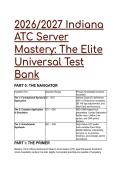
2026/2027 Indiana
ATC Server
Mastery: The Elite
Universal Test
Bank
PART 0: THE NAVIGATOR
Cognitive Tier Question Range Primary Knowledge Domains
Assessed
Tier 1: Foundational Syntax & Q1 – Q10 Indiana Code (IC) definitions,
Application HEA 1275 Bouncer mandates,
SB 146 age adjustments, and
Hard Deck service hours.
Tier 2: Complex Application Q11 – Q20 HEA 1086 Happy Hour
& Simulation parameters, Limited Separation
facility rules, Lifeline Law
syntax, and OWI permit
barriers.
Tier 3: Grandmaster Q21 – Q30 High-stakes ATC audits,
Synthesis multi-variable Dram Shop
liability defense, intersecting
carryout vs. on-premise
timelines, and complex permit
revocations.
PART I: THE PRIMER
Mastery of the Indiana Alcohol and Tobacco Commission (ATC) legal framework transforms
novice hospitality workers into elite, legally invulnerable practitioners capable of navigating
,severe disciplinary minefields. This test bank bridges the gap between abstract legislative
code—including the sweeping 2024, 2025, and 2026 updates—and high-stakes operational
reality, ensuring absolute compliance under the scrutiny of the Indiana State Excise Police.
The "Critical Axioms" Cheat Sheet:
● The Bouncer Mandate (HEA 1275): As of July 1, 2025, any employee responsible for
verifying age or identification at the door (bouncers/security) MUST possess an ATC
Employee Permit and complete certified server training.
● The Happy Hour Parameters (HEA 1086): Discounted drinks are permitted but strictly
capped at 4 hours per day and 15 hours per week. Happy Hours are absolutely forbidden
between 9:00 PM and 3:00 AM.
● The 40/26 Verification Protocol: Indiana law mandates ID checks for anyone appearing
under 40 for carryout sales. For on-premise consumption, the Excise Police standard
recommendation is checking anyone appearing under 26.
● The Minor Service Adjustment (SB 146): As of 2024, an 18-year-old with a Restricted
Permit may ring up carryout alcohol and serve (but not pour/mix) in a family dining area,
provided a 21-year-old certified supervisor is present.
● The Dram Shop "Actual Knowledge" Standard: Third-party liability requires the plaintiff
to prove the server had actual knowledge of the patron's visible intoxication and that the
intoxication proximately caused the injury.
PART II: THE ELITE TEST BANK
Tier 1: Foundational Syntax & Application
Q1: An establishment hires a 19-year-old to work as a server in the family dining room.
According to Indiana ATC regulations, what is the maximum timeframe this employee has to
complete a certified alcohol server training program and obtain an Employee Permit? A)
Immediately prior to their first shift on the floor B) Within 30 days of their official date of hire C)
Prior to applying for the permit, which must be obtained within 120 days of hire D) Within 180
days, provided they are supervised by a 21-year-old manager
● The Answer: C (Prior to applying for the permit, which must be obtained within 120 days
of hire)
● Distractor Analysis:
○ A is incorrect: While highly recommended from a liability standpoint, the law
provides a grace period for new hires to complete the bureaucratic process.
○ B is incorrect: 30 days is a common legacy misconception adopted from standard
corporate probationary periods, not Indiana law.
○ D is incorrect: The statutory limit is strictly 120 days under IC regulations,
regardless of the age or qualification of the supervising manager.
The Mentor's Analysis: The ATC grants a grace period for onboarding, but the training itself is
a hard prerequisite for the permit application. When managing new personnel, the immediate
priority is tracking the 120-day deadline to prevent a lapse into unpermitted service. By utilizing
a 120-Day hard-stop, you bypass the common trap of assuming ongoing grace periods.
Professional/Academic Intuition: Training precedes the application; the application must
conclude before day 120.
Q2: A customer approaches a liquor store register on a Tuesday to purchase a case of beer for
carryout. The cashier, a 19-year-old employee, believes the customer looks 35 years old. Based
, on Indiana Excise Police enforcement standards, which action is the MOST APPROPRIATE? A)
Complete the sale without an ID check, as the customer looks over 21. B) Demand an ID,
because the law requires ID checks for all carryout customers appearing under 40. C) Refuse
the sale because the cashier is under 21 and cannot legally ring up alcohol in a liquor store. D)
Demand an ID, because the law requires ID checks for all customers appearing under 26.
● The Answer: C (Refuse the sale because the cashier is under 21 and cannot legally ring
up alcohol in a liquor store.)
● Distractor Analysis:
○ A is incorrect: The cashier cannot legally operate the register for this transaction in
this specific venue, regardless of the customer's age.
○ B is incorrect: While the "under 40" rule is technically true for carryout , the
fundamental venue restriction supersedes it.
○ D is incorrect: The "under 26" rule is an Excise Police recommendation for
on-premise consumption, not carryout.
The Mentor's Analysis: Venue syntax dictates minor employment capabilities. While SB 146
allows 18-year-olds to ring up alcohol in grocery or drug stores, package liquor stores mandate
that all employees and clerks be at least 21 years old. By verifying the Venue Class, you bypass
the trap of misapplying general age rules. Professional/Academic Intuition: In a package
liquor store, the minimum working age is an absolute 21.
Q3: On August 15, 2025, a nightclub manager hires a new bouncer to verify IDs at the main
entrance. The bouncer does not pour, serve, or transport alcohol. Under House Enrolled Act
1275, what is the legal requirement for this bouncer? A) The bouncer requires no permits, as
they do not physically handle alcoholic beverages. B) The bouncer must obtain a specialized
Security Endorsement from the Excise Police. C) The bouncer must complete an approved
Alcohol Server Training course and obtain an ATC Employee Permit. D) The bouncer must hold
a permit only if the establishment operates under a Type 209 license.
● The Answer: C (The bouncer must complete an approved Alcohol Server Training course
and obtain an ATC Employee Permit.)
● Distractor Analysis:
○ A is incorrect: HEA 1275 legally reclassified door security and bouncers as "alcohol
servers" subject to the exact same licensing requirements.
○ B is incorrect: There is no distinct "Security Endorsement" in Indiana; they require
the standard Employee Permit.
○ D is incorrect: This mandate applies to all establishments utilizing door staff for age
verification, regardless of their specific permit classification.
The Mentor's Analysis: The legislative intent of HEA 1275 was to close the loophole where
untrained staff were evaluating complex, fraudulent IDs. When staffing an entrance, the priority
is verifying that door personnel hold identical credentials to bartenders. By utilizing the
Expanded Server Definition, you bypass the novice error of exempting non-pouring staff.
Professional/Academic Intuition: If you check the ID, you hold the permit.
Q4: A bartender in downtown Indianapolis is working a shift on a Sunday morning. A patron
orders a Bloody Mary at 9:00 AM. Based on Indiana legal service hours, what is the MOST
ACCURATE response? A) The bartender must refuse service, as Sunday sales do not begin
until 12:00 PM. B) The bartender may serve the drink, as Sunday on-premise service is legal
beginning at 7:00 AM. C) The bartender may serve the drink only if the patron also orders a hot
meal from the kitchen. D) The bartender must refuse service, as Sunday on-premise service is
prohibited entirely.
● The Answer: B (The bartender may serve the drink, as Sunday on-premise service is
ATC Server
Mastery: The Elite
Universal Test
Bank
PART 0: THE NAVIGATOR
Cognitive Tier Question Range Primary Knowledge Domains
Assessed
Tier 1: Foundational Syntax & Q1 – Q10 Indiana Code (IC) definitions,
Application HEA 1275 Bouncer mandates,
SB 146 age adjustments, and
Hard Deck service hours.
Tier 2: Complex Application Q11 – Q20 HEA 1086 Happy Hour
& Simulation parameters, Limited Separation
facility rules, Lifeline Law
syntax, and OWI permit
barriers.
Tier 3: Grandmaster Q21 – Q30 High-stakes ATC audits,
Synthesis multi-variable Dram Shop
liability defense, intersecting
carryout vs. on-premise
timelines, and complex permit
revocations.
PART I: THE PRIMER
Mastery of the Indiana Alcohol and Tobacco Commission (ATC) legal framework transforms
novice hospitality workers into elite, legally invulnerable practitioners capable of navigating
,severe disciplinary minefields. This test bank bridges the gap between abstract legislative
code—including the sweeping 2024, 2025, and 2026 updates—and high-stakes operational
reality, ensuring absolute compliance under the scrutiny of the Indiana State Excise Police.
The "Critical Axioms" Cheat Sheet:
● The Bouncer Mandate (HEA 1275): As of July 1, 2025, any employee responsible for
verifying age or identification at the door (bouncers/security) MUST possess an ATC
Employee Permit and complete certified server training.
● The Happy Hour Parameters (HEA 1086): Discounted drinks are permitted but strictly
capped at 4 hours per day and 15 hours per week. Happy Hours are absolutely forbidden
between 9:00 PM and 3:00 AM.
● The 40/26 Verification Protocol: Indiana law mandates ID checks for anyone appearing
under 40 for carryout sales. For on-premise consumption, the Excise Police standard
recommendation is checking anyone appearing under 26.
● The Minor Service Adjustment (SB 146): As of 2024, an 18-year-old with a Restricted
Permit may ring up carryout alcohol and serve (but not pour/mix) in a family dining area,
provided a 21-year-old certified supervisor is present.
● The Dram Shop "Actual Knowledge" Standard: Third-party liability requires the plaintiff
to prove the server had actual knowledge of the patron's visible intoxication and that the
intoxication proximately caused the injury.
PART II: THE ELITE TEST BANK
Tier 1: Foundational Syntax & Application
Q1: An establishment hires a 19-year-old to work as a server in the family dining room.
According to Indiana ATC regulations, what is the maximum timeframe this employee has to
complete a certified alcohol server training program and obtain an Employee Permit? A)
Immediately prior to their first shift on the floor B) Within 30 days of their official date of hire C)
Prior to applying for the permit, which must be obtained within 120 days of hire D) Within 180
days, provided they are supervised by a 21-year-old manager
● The Answer: C (Prior to applying for the permit, which must be obtained within 120 days
of hire)
● Distractor Analysis:
○ A is incorrect: While highly recommended from a liability standpoint, the law
provides a grace period for new hires to complete the bureaucratic process.
○ B is incorrect: 30 days is a common legacy misconception adopted from standard
corporate probationary periods, not Indiana law.
○ D is incorrect: The statutory limit is strictly 120 days under IC regulations,
regardless of the age or qualification of the supervising manager.
The Mentor's Analysis: The ATC grants a grace period for onboarding, but the training itself is
a hard prerequisite for the permit application. When managing new personnel, the immediate
priority is tracking the 120-day deadline to prevent a lapse into unpermitted service. By utilizing
a 120-Day hard-stop, you bypass the common trap of assuming ongoing grace periods.
Professional/Academic Intuition: Training precedes the application; the application must
conclude before day 120.
Q2: A customer approaches a liquor store register on a Tuesday to purchase a case of beer for
carryout. The cashier, a 19-year-old employee, believes the customer looks 35 years old. Based
, on Indiana Excise Police enforcement standards, which action is the MOST APPROPRIATE? A)
Complete the sale without an ID check, as the customer looks over 21. B) Demand an ID,
because the law requires ID checks for all carryout customers appearing under 40. C) Refuse
the sale because the cashier is under 21 and cannot legally ring up alcohol in a liquor store. D)
Demand an ID, because the law requires ID checks for all customers appearing under 26.
● The Answer: C (Refuse the sale because the cashier is under 21 and cannot legally ring
up alcohol in a liquor store.)
● Distractor Analysis:
○ A is incorrect: The cashier cannot legally operate the register for this transaction in
this specific venue, regardless of the customer's age.
○ B is incorrect: While the "under 40" rule is technically true for carryout , the
fundamental venue restriction supersedes it.
○ D is incorrect: The "under 26" rule is an Excise Police recommendation for
on-premise consumption, not carryout.
The Mentor's Analysis: Venue syntax dictates minor employment capabilities. While SB 146
allows 18-year-olds to ring up alcohol in grocery or drug stores, package liquor stores mandate
that all employees and clerks be at least 21 years old. By verifying the Venue Class, you bypass
the trap of misapplying general age rules. Professional/Academic Intuition: In a package
liquor store, the minimum working age is an absolute 21.
Q3: On August 15, 2025, a nightclub manager hires a new bouncer to verify IDs at the main
entrance. The bouncer does not pour, serve, or transport alcohol. Under House Enrolled Act
1275, what is the legal requirement for this bouncer? A) The bouncer requires no permits, as
they do not physically handle alcoholic beverages. B) The bouncer must obtain a specialized
Security Endorsement from the Excise Police. C) The bouncer must complete an approved
Alcohol Server Training course and obtain an ATC Employee Permit. D) The bouncer must hold
a permit only if the establishment operates under a Type 209 license.
● The Answer: C (The bouncer must complete an approved Alcohol Server Training course
and obtain an ATC Employee Permit.)
● Distractor Analysis:
○ A is incorrect: HEA 1275 legally reclassified door security and bouncers as "alcohol
servers" subject to the exact same licensing requirements.
○ B is incorrect: There is no distinct "Security Endorsement" in Indiana; they require
the standard Employee Permit.
○ D is incorrect: This mandate applies to all establishments utilizing door staff for age
verification, regardless of their specific permit classification.
The Mentor's Analysis: The legislative intent of HEA 1275 was to close the loophole where
untrained staff were evaluating complex, fraudulent IDs. When staffing an entrance, the priority
is verifying that door personnel hold identical credentials to bartenders. By utilizing the
Expanded Server Definition, you bypass the novice error of exempting non-pouring staff.
Professional/Academic Intuition: If you check the ID, you hold the permit.
Q4: A bartender in downtown Indianapolis is working a shift on a Sunday morning. A patron
orders a Bloody Mary at 9:00 AM. Based on Indiana legal service hours, what is the MOST
ACCURATE response? A) The bartender must refuse service, as Sunday sales do not begin
until 12:00 PM. B) The bartender may serve the drink, as Sunday on-premise service is legal
beginning at 7:00 AM. C) The bartender may serve the drink only if the patron also orders a hot
meal from the kitchen. D) The bartender must refuse service, as Sunday on-premise service is
prohibited entirely.
● The Answer: B (The bartender may serve the drink, as Sunday on-premise service is


