

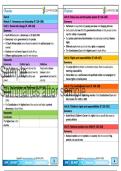
Sample
Summaries after sample
, U7: National symbols since 1994 U1: Democratic change
• National flag - symbolises the coming together of • Democracy means government by the people -
diverse elements in society and moving forward ensures that everyone has an equal say when
together in unity. decisions are made.
U6: Children's rights and • A national anthem is an official song that represents • Every citizen (18+) can choose their political leaders
responsibilities a country and is performed on special occasions. through elections.
• Non-discrimination, free expression, • The coat of arms serves as the official badge of the • Elections are held every 5 years in South Africa.
religious freedom, protection from nation. • A political party consists of a group of people who
abuse and exploitation, family love, share the same ideas about how a country should
basic needs, education and recreation. be run.
•
U5: The Constitutional Court • .
U2: The Constitution and Parliament
Sample • The Constitutional Court has the final say on all
matters relating to the Constitution.
• It consists of 11 judges – the Chief Justice of South
M7:
Democracy
and citizenship
• The Constitution is the supreme law of the country.
• Establishes rules for when elections should take
place.
Africa, the Deputy Chief Justice and 9 other judges.
Summaries after sample U4: Rights and responsibilities
• Prevents any individual or government body from
holding too much power.
• Outlines human rights within a Bill of Rights.
• Creates independent courts and commissions to
• Every right has a matching responsibility. safeguard citizens' rights and monitor government
• Fulfil your responsibilities to protect your rights. performance.
• It protects democracy - prevents future
U3: Rules, laws and the justice system governments from passing laws that contradict it.
• Laws make it possible for people to live together safely, peacefully, and ensure that citizens respect
each other's rights and duties. Bicameral Parliament:
• Civil (or public) law - focuses on settling disputes and arguments between individual people or
organisations. • The National Assembly - members are directly
• Criminal law - deals with actions and crimes that cause serious harm to individuals or groups. elected by the voters.
• Hierarchy of South African Courts – Constitutional Court -> Supreme Court of Appeal -> high courts -> • The National Council of Provinces - members
magistrates’ court -> small claims courts -> equality courts -> traditional courts -> community courts. are elected by the provinces to represent them
at the national government level.
GR6 SS-HIST T3-M7 Mind Map Study&Master Copyright © www.summariessa.co.za (DO NOT COPY)
Summaries after sample
, U7: National symbols since 1994 U1: Democratic change
• National flag - symbolises the coming together of • Democracy means government by the people -
diverse elements in society and moving forward ensures that everyone has an equal say when
together in unity. decisions are made.
U6: Children's rights and • A national anthem is an official song that represents • Every citizen (18+) can choose their political leaders
responsibilities a country and is performed on special occasions. through elections.
• Non-discrimination, free expression, • The coat of arms serves as the official badge of the • Elections are held every 5 years in South Africa.
religious freedom, protection from nation. • A political party consists of a group of people who
abuse and exploitation, family love, share the same ideas about how a country should
basic needs, education and recreation. be run.
•
U5: The Constitutional Court • .
U2: The Constitution and Parliament
Sample • The Constitutional Court has the final say on all
matters relating to the Constitution.
• It consists of 11 judges – the Chief Justice of South
M7:
Democracy
and citizenship
• The Constitution is the supreme law of the country.
• Establishes rules for when elections should take
place.
Africa, the Deputy Chief Justice and 9 other judges.
Summaries after sample U4: Rights and responsibilities
• Prevents any individual or government body from
holding too much power.
• Outlines human rights within a Bill of Rights.
• Creates independent courts and commissions to
• Every right has a matching responsibility. safeguard citizens' rights and monitor government
• Fulfil your responsibilities to protect your rights. performance.
• It protects democracy - prevents future
U3: Rules, laws and the justice system governments from passing laws that contradict it.
• Laws make it possible for people to live together safely, peacefully, and ensure that citizens respect
each other's rights and duties. Bicameral Parliament:
• Civil (or public) law - focuses on settling disputes and arguments between individual people or
organisations. • The National Assembly - members are directly
• Criminal law - deals with actions and crimes that cause serious harm to individuals or groups. elected by the voters.
• Hierarchy of South African Courts – Constitutional Court -> Supreme Court of Appeal -> high courts -> • The National Council of Provinces - members
magistrates’ court -> small claims courts -> equality courts -> traditional courts -> community courts. are elected by the provinces to represent them
at the national government level.
GR6 SS-HIST T3-M7 Mind Map Study&Master Copyright © www.summariessa.co.za (DO NOT COPY)


