

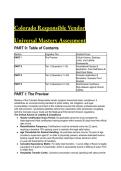
Colorado Responsible Vendor
Universal Mastery Assessment
PART 0: Table of Contents
Section Cognitive Tier Content Focus
PART I The Preview Critical Axioms, Statutory
Limits, and Liability
Frameworks
PART II Tier 1 (Questions 1–10) Foundational Syntax &
Application: Core Definitions &
Hard Deck Rules
PART II Tier 2 (Questions 11–20) Complex Application &
Simulation: Scenario Pivot
Analysis
PART II Tier 3 (Questions 21–30) Grandmaster Synthesis:
High-Stakes Legal & Clinical
Liability
PART I: The Preview
Mastery of the Colorado Responsible Vendor program transcends basic compliance; it
establishes an uncompromising standard of public safety, risk mitigation, and legal
invulnerability. Complete command of this material ensures that industry professionals operate
with elite precision, neutralizing liabilities before they materialize while seamlessly navigating
both the Colorado Liquor Code and the Marijuana Enforcement Division regulations.
The Critical Axioms of Liability & Compliance
● Vendor Certification Grace Period: All applicable personnel must complete the
state-approved initial certification training program within exactly 90 days from their official
date of hire.
● Recertification Frequency: Certifications must be renewed every two (2) years,
requiring a baseline 70% passing score to maintain the legal safe harbor.
● Age Thresholds for Alcohol Handling: On-premises servers may be 18 years of age
provided a supervisor aged 21 or older is physically present, whereas dedicated taverns
lacking regular food service and off-premises retail liquor stores demand a strict
21-year-old threshold for all handlers.
● Cannabis Equivalency Matrix: For daily retail transfers, 1 ounce (28g) of flower is legally
equivalent to 8 grams of concentrate, which is equivalently bound to 800mg of active THC
in edible form.
● Hospitality Transfer Limits: Licensed consumption venues operating with sales permits
, are restricted to transferring 1 ounce of flower, 8 grams of concentrate, or 100mg of
edibles (demarcated in 10mg single servings) per patron per day.
● Identification Confiscation Mandate: Fraudulent instruments of identification may be
confiscated by the licensee but must be surrendered directly to state or local law
enforcement officers within exactly 72 hours.
PART II: THE ELITE TEST BANK
Tier 1: Foundational Syntax & Application
Q1: A newly hired general manager at a Colorado Retail Liquor Store is auditing the
establishment's operational calendar for the upcoming winter season. Based on recent statutory
updates under the Colorado Liquor Code, which operational decision regarding holiday sales is
the MOST ACCURATE? A) The establishment must strictly prohibit the sale of alcohol in sealed
containers on Christmas Day to comply with state blue laws. B) The establishment may sell
alcohol on Christmas Day only if the local licensing authority grants an exemption or a special
event permit. C) The establishment is legally permitted to conduct the sale of alcohol in sealed
containers on Christmas Day without special exemptions. D) The establishment may remain
open on Christmas Day but is legally restricted to selling only fermented malt beverages
containing no more than 3.2% alcohol by weight.
● The Answer: C (The establishment is legally permitted to conduct the sale of alcohol in
sealed containers on Christmas Day without special exemptions.)
● Distractor Analysis:
○ A is incorrect: The assertion that an off-premises retailer must close relies on an
outdated institutional memory that precedes Senate Bill 24-231. Historically, the
state mandated strict closures on Christmas Day, but this legislative update
definitively removed the prohibition, reflecting a modernized approach to holiday
commerce. By adhering to the old rule, a manager artificially constricts operational
revenue based on obsolete parameters rather than active statutory truth.
○ B is incorrect: The modern legal framework establishes Christmas Day sales as a
baseline right for licensed off-premises retailers, removing the bureaucratic hurdle
of seeking localized exemptions or special event permits.
○ D is incorrect: The distinction restricting sales to 3.2% beer was completely phased
out of Colorado law in previous legislative sessions, rendering the concept of a
3.2% holiday exemption an analytical trap rooted in legacy regulations.
The Mentor's Analysis: Legislative frameworks frequently evolve to reflect market realities,
and an elite practitioner must never rely on outdated industry folklore. By understanding the
immediate impact of Senate Bill 24-231, the professional avoids unnecessary revenue loss
while maintaining absolute statutory compliance. Professional/Academic Intuition: Always
execute operational strategies based on the most current legislative session updates,
deliberately discarding legacy statutes that no longer hold legal weight.
Q2: A patron approaches the sales counter of a licensed Retail Marijuana Store seeking to
purchase a combination of concentrated products and flower. According to the Marijuana
Enforcement Division equivalency rules, how much Regulated Marijuana Concentrate is legally
deemed equivalent to one ounce (28 grams) of retail marijuana flower? A) 2 grams B) 4 grams
C) 8 grams D) 10 grams
● The Answer: C (8 grams)
, ● Distractor Analysis:
○ A is incorrect: Utilizing 2 grams represents a historic limitation applied to earlier,
more restrictive hospitality models prior to the sweeping 2024 regulatory updates,
not the standard retail equivalency matrix.
○ B is incorrect: The 4-gram threshold represents a common analytical error by
novices attempting to arbitrarily fractionalize the limit without utilizing the proper
mathematical conversion dictated by the state.
○ D is incorrect: The 10-gram metric exceeds the strict mathematical boundary
established by the state, which dictates that exactly 8 grams of concentrate
perfectly equals 1 ounce of flower for the purposes of daily transfer limits.
Transferring 10 grams would inherently bypass the legal maximum, triggering
severe administrative penalties.
The Mentor's Analysis: Purchase equivalencies form the absolute hard deck of cannabis
compliance; violating them instantly transitions a legal retail sale into an unlawful distribution
event. Utilizing the formalized equivalency matrix ensures that combination sales never
inadvertently breach the statutory daily cap. Professional/Academic Intuition: The
mathematical reality of cannabis retail dictates that one ounce of flower equals eight
grams of concentrate equals 800 milligrams of edible THC; these metrics are absolute
and inflexible.
Q3: Under the Responsible Alcohol Beverage Vendor program outlined in Regulation 47-605,
what is the maximum allowable timeframe for a newly hired employee involved in the sale and
service of alcohol to successfully complete the state-approved initial certification training
program? A) Prior to their first active shift on the retail floor. B) Within 30 days of their official
date of hire. C) Within 90 days of their official date of hire. D) Within 180 days of their official
date of hire.
● The Answer: C (Within 90 days of their official date of hire.)
● Distractor Analysis:
○ A is incorrect: While highly vigilant managers may choose to enforce pre-shift
training internally as a risk mitigation strategy, the state explicitly recognizes the
logistical burden on operators and formally grants a specific grace period.
○ B is incorrect: The 30-day window is a plausible distractor because it aligns with
many municipal reporting deadlines, but it arbitrarily shortens the legally allotted
statutory timeframe for training completion.
○ D is incorrect: Operating a full 180 days without certification is technically incorrect
and operationally dangerous, as extending the window beyond 90 days immediately
revokes the establishment's Responsible Vendor safe harbor protections, leaving
the license fully exposed to maximum penalties in the event of an infraction.
The Mentor's Analysis: The statutory grace period is designed to facilitate operational flexibility
during onboarding, not to encourage administrative complacency. While the state permits up to
90 days, Elite managers prioritize immediate educational intervention to secure mitigating
protections against administrative liabilities from the earliest possible moment.
Professional/Academic Intuition: Statutory grace periods define the absolute legal limit,
but operational excellence demands achieving full compliance well before the deadline
expires.
Q4: A twenty-two-year-old patron from out-of-state presents a vertically oriented driver's license
to the door staff at a Denver tavern. The identification document contains a valid photograph, a
clear date of birth, and is completely unexpired. Based purely on the text of the Colorado Liquor
Code, which immediate action is the MOST ACCURATE? A) The staff must refuse entry
Universal Mastery Assessment
PART 0: Table of Contents
Section Cognitive Tier Content Focus
PART I The Preview Critical Axioms, Statutory
Limits, and Liability
Frameworks
PART II Tier 1 (Questions 1–10) Foundational Syntax &
Application: Core Definitions &
Hard Deck Rules
PART II Tier 2 (Questions 11–20) Complex Application &
Simulation: Scenario Pivot
Analysis
PART II Tier 3 (Questions 21–30) Grandmaster Synthesis:
High-Stakes Legal & Clinical
Liability
PART I: The Preview
Mastery of the Colorado Responsible Vendor program transcends basic compliance; it
establishes an uncompromising standard of public safety, risk mitigation, and legal
invulnerability. Complete command of this material ensures that industry professionals operate
with elite precision, neutralizing liabilities before they materialize while seamlessly navigating
both the Colorado Liquor Code and the Marijuana Enforcement Division regulations.
The Critical Axioms of Liability & Compliance
● Vendor Certification Grace Period: All applicable personnel must complete the
state-approved initial certification training program within exactly 90 days from their official
date of hire.
● Recertification Frequency: Certifications must be renewed every two (2) years,
requiring a baseline 70% passing score to maintain the legal safe harbor.
● Age Thresholds for Alcohol Handling: On-premises servers may be 18 years of age
provided a supervisor aged 21 or older is physically present, whereas dedicated taverns
lacking regular food service and off-premises retail liquor stores demand a strict
21-year-old threshold for all handlers.
● Cannabis Equivalency Matrix: For daily retail transfers, 1 ounce (28g) of flower is legally
equivalent to 8 grams of concentrate, which is equivalently bound to 800mg of active THC
in edible form.
● Hospitality Transfer Limits: Licensed consumption venues operating with sales permits
, are restricted to transferring 1 ounce of flower, 8 grams of concentrate, or 100mg of
edibles (demarcated in 10mg single servings) per patron per day.
● Identification Confiscation Mandate: Fraudulent instruments of identification may be
confiscated by the licensee but must be surrendered directly to state or local law
enforcement officers within exactly 72 hours.
PART II: THE ELITE TEST BANK
Tier 1: Foundational Syntax & Application
Q1: A newly hired general manager at a Colorado Retail Liquor Store is auditing the
establishment's operational calendar for the upcoming winter season. Based on recent statutory
updates under the Colorado Liquor Code, which operational decision regarding holiday sales is
the MOST ACCURATE? A) The establishment must strictly prohibit the sale of alcohol in sealed
containers on Christmas Day to comply with state blue laws. B) The establishment may sell
alcohol on Christmas Day only if the local licensing authority grants an exemption or a special
event permit. C) The establishment is legally permitted to conduct the sale of alcohol in sealed
containers on Christmas Day without special exemptions. D) The establishment may remain
open on Christmas Day but is legally restricted to selling only fermented malt beverages
containing no more than 3.2% alcohol by weight.
● The Answer: C (The establishment is legally permitted to conduct the sale of alcohol in
sealed containers on Christmas Day without special exemptions.)
● Distractor Analysis:
○ A is incorrect: The assertion that an off-premises retailer must close relies on an
outdated institutional memory that precedes Senate Bill 24-231. Historically, the
state mandated strict closures on Christmas Day, but this legislative update
definitively removed the prohibition, reflecting a modernized approach to holiday
commerce. By adhering to the old rule, a manager artificially constricts operational
revenue based on obsolete parameters rather than active statutory truth.
○ B is incorrect: The modern legal framework establishes Christmas Day sales as a
baseline right for licensed off-premises retailers, removing the bureaucratic hurdle
of seeking localized exemptions or special event permits.
○ D is incorrect: The distinction restricting sales to 3.2% beer was completely phased
out of Colorado law in previous legislative sessions, rendering the concept of a
3.2% holiday exemption an analytical trap rooted in legacy regulations.
The Mentor's Analysis: Legislative frameworks frequently evolve to reflect market realities,
and an elite practitioner must never rely on outdated industry folklore. By understanding the
immediate impact of Senate Bill 24-231, the professional avoids unnecessary revenue loss
while maintaining absolute statutory compliance. Professional/Academic Intuition: Always
execute operational strategies based on the most current legislative session updates,
deliberately discarding legacy statutes that no longer hold legal weight.
Q2: A patron approaches the sales counter of a licensed Retail Marijuana Store seeking to
purchase a combination of concentrated products and flower. According to the Marijuana
Enforcement Division equivalency rules, how much Regulated Marijuana Concentrate is legally
deemed equivalent to one ounce (28 grams) of retail marijuana flower? A) 2 grams B) 4 grams
C) 8 grams D) 10 grams
● The Answer: C (8 grams)
, ● Distractor Analysis:
○ A is incorrect: Utilizing 2 grams represents a historic limitation applied to earlier,
more restrictive hospitality models prior to the sweeping 2024 regulatory updates,
not the standard retail equivalency matrix.
○ B is incorrect: The 4-gram threshold represents a common analytical error by
novices attempting to arbitrarily fractionalize the limit without utilizing the proper
mathematical conversion dictated by the state.
○ D is incorrect: The 10-gram metric exceeds the strict mathematical boundary
established by the state, which dictates that exactly 8 grams of concentrate
perfectly equals 1 ounce of flower for the purposes of daily transfer limits.
Transferring 10 grams would inherently bypass the legal maximum, triggering
severe administrative penalties.
The Mentor's Analysis: Purchase equivalencies form the absolute hard deck of cannabis
compliance; violating them instantly transitions a legal retail sale into an unlawful distribution
event. Utilizing the formalized equivalency matrix ensures that combination sales never
inadvertently breach the statutory daily cap. Professional/Academic Intuition: The
mathematical reality of cannabis retail dictates that one ounce of flower equals eight
grams of concentrate equals 800 milligrams of edible THC; these metrics are absolute
and inflexible.
Q3: Under the Responsible Alcohol Beverage Vendor program outlined in Regulation 47-605,
what is the maximum allowable timeframe for a newly hired employee involved in the sale and
service of alcohol to successfully complete the state-approved initial certification training
program? A) Prior to their first active shift on the retail floor. B) Within 30 days of their official
date of hire. C) Within 90 days of their official date of hire. D) Within 180 days of their official
date of hire.
● The Answer: C (Within 90 days of their official date of hire.)
● Distractor Analysis:
○ A is incorrect: While highly vigilant managers may choose to enforce pre-shift
training internally as a risk mitigation strategy, the state explicitly recognizes the
logistical burden on operators and formally grants a specific grace period.
○ B is incorrect: The 30-day window is a plausible distractor because it aligns with
many municipal reporting deadlines, but it arbitrarily shortens the legally allotted
statutory timeframe for training completion.
○ D is incorrect: Operating a full 180 days without certification is technically incorrect
and operationally dangerous, as extending the window beyond 90 days immediately
revokes the establishment's Responsible Vendor safe harbor protections, leaving
the license fully exposed to maximum penalties in the event of an infraction.
The Mentor's Analysis: The statutory grace period is designed to facilitate operational flexibility
during onboarding, not to encourage administrative complacency. While the state permits up to
90 days, Elite managers prioritize immediate educational intervention to secure mitigating
protections against administrative liabilities from the earliest possible moment.
Professional/Academic Intuition: Statutory grace periods define the absolute legal limit,
but operational excellence demands achieving full compliance well before the deadline
expires.
Q4: A twenty-two-year-old patron from out-of-state presents a vertically oriented driver's license
to the door staff at a Denver tavern. The identification document contains a valid photograph, a
clear date of birth, and is completely unexpired. Based purely on the text of the Colorado Liquor
Code, which immediate action is the MOST ACCURATE? A) The staff must refuse entry


