EXAM 2 PRACTICE Qs.,WELL EXPLAINED WITH CORRECT ANSWERS 100% GRADED A.
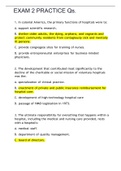
1. In colonial America, the primary functions of hospitals were to: A. support scientific research. B. shelter older adults, the dying, orphans, and vagrants and protect community residents from contagiously sick and mentally ill persons. C. provide congregate sites for training of nurses. D. provide entrepreneurial enterprises for business-minded physicians. 2. The development that contributed most significantly to the decline of the charitable or social mission of voluntary hospitals was the: A. specialization of clinical practice. B. enactment of private and public insurance reimbursement for hospital care. C. development of high-technology hospital care D. passage of HMO legislation in 1973. 3. The ultimate responsibility for everything that happens within a hospital, including the medical and nursing care provided, rests with a hospital's: A. medical staff. B. department of quality management. C. board of directors. D. chief executive officer. 4. A major obligation of doctors when obtaining informed consent for a medical procedure is to: A. shield the patient from information about negative side effects which may be upsetting. B. ensure that family members agree with the patient’s decision. C. ensure that the patient understands the risks and benefits of the procedure. D. protect themselves from malpractice claims. 5. Through discharge planning, hospitals help assure that safe and appropriate post-hospital accommodations are arranged for each patient. Medicare patients may appeal what they believe to be a premature or inappropriate discharge by petitioning which of the following organizations? A. hospital board of directors B. hospital medical staff C. Medicare quality improvement organization (QIO) D. American Hospital Association 6. Until the mid-1980s, hospitals were reimbursed for whatever they charged on a “retrospective” basis. Now they are paid a certain amount for each patient’s care on a “prospective” basis. The amount they are paid is based on: A. empirical data B. diagnosis related groups (DRGs) C. Costs of resources used D. prospective patient categories (PPCs) 7. Hospitals in the future health care system will: A. expand as hubs of more technologically sophisticated health care systems. B. no longer be the axis of health care delivery but will retain core roles as sites of sophisticated care, professional teaching and clinical research. C. surrender their charitable missions to embrace profit-making principles. D. emphasize competition with community physicians. 8. Which of the following terms refers to a health care system that includes several service components with each addressing one or more dimensions of a population’s health care needs? A. Vertically integrated B. Laterally integrated C. Parallel structured D. Horizontally integrated 9. For many years, the standard for assessing hospital quality of care was peer review using physician audits of selected patient records to judge “the degree of conformity with preset standards.” All of the following were reasons for the ineffectiveness of these audits EXCEPT A. Reviewers used implicit standards to make qualitative judgments. B. Hospital administrators influenced how reviewers were selected. C. No rational basis existed for chart selection to permit extrapolation of sample findings to the larger patient population. D. When deficiencies were identified, reviewers were reluctant to pass judgment on their colleagues. 10. In its landmark report on hospital errors, “To Err is Human,” the Institute of Medicine emphasized that errors in care most typically originate from which one of the following sources? A. Distracted, fatigued physicians B. Inadequate nurse training C. Medical equipment failures D. Deficiencies in the systems of care 11. “Hospitals can no longer live in a four-walls, brick and mortar world.” This statement refers to which encompassing principle of health care reform? A. Primary doctors will be the system leaders, not specialists. B. Almost every American will have health insurance coverage. C. The focus will be on population health status with community- based care delivered in multiple provider sites. D. Measures of hospital quality will become more transparent and available to the public. 12. A major trend is hospital corporate organization over the past few years as hospitals strategically prepared for system reforms has included: A. Mergers and consolidations into larger systems of care. B. Downsizing of nursing and related support personnel. C. Closures of ambulatory clinics. D. Publicly disclosing fees and charges to improve competitive market position. 13. Hospital value-based purchasing now required by the ACA for over 3,000 Medicare participating hospitals is a program that may be best described as using A. Hospital fines and penalties for readmissions with the same diagnosis within 30 days of discharge. B. Consolidated Medicare payments based on a complete “episode of care” rather than piecemeal payments for individual services. C. Incentive payments for achievements and improvements in clinical care and patient satisfaction. D. Organizations composed of multiple providers which are paid incentives for enabling Medicare patients to avoid hospitalization. CHAPTER 5 Ambulatory Care 1. The primary organizational mode of medical care in the United States, in terms of volume of services delivered, is: A. hospital ambulatory clinics B. private practice physicians’ offices C. community-based clinics run by voluntary agencies D. government-operated health clinics. 2. Which of the following is not a principle of a patient-centered medical home practice? A. providing for all of a patient’s health care needs or appropriately arranging care with other qualified professionals. B. The personal physician leads a team of individuals in the practice who take responsibility for the ongoing care of patients. C. Care is coordinated and integrated across all elements of the delivery system (subspecialty, hospital, home, nursing home), facilitated by electronic record registries D. Appointment systems adhere to strictly enforced, advance scheduling. 3. In today’s hospitals, outpatient clinics frequently provide: A. care for those without private physicians. B. primary-care services organized similarly to private physician offices. C. teaching sites for medical residents. D. all of the above. 4. A significant advance in the provision of hospital emergency department services occurred with the introduction of: A. volunteer assistants. B. board-certified emergency medicine physicians. C. MRI diagnostic equipment. D. electronic health records. 5. The predominant services of local public health departments today are: A. specialty services for high-risk pregnant women B. school-based pediatric medical care C. chronic disease screening D. child and adult immunizations 6. “Urgent Care” is best described as care A. provided on a walk-in, extended hour basis for acute illness and injury that is either beyond the scope of or availability of a primary care practice or retail clinic. B. providing a service alternative to crowded emergency departments. C. that does not require the services of a physician. D. for fast treatment of easy-to-diagnose conditions. 7. The primary owners of community-based ambulatory surgical centers are A. hospital corporations. B. shareholders of publicly-traded companies. C. physicians. D. physician specialty societies. 8. In addition to providing primary and preventive care, federally qualified community health centers also: A. provide leadership for housing renewal in inner-cities. B. offer a broad array of high-tech, medical specialty services C. help patients link with other supportive programs and services such as welfare, Medicaid, the Women, Infants and Children supplemental nutrition program (WIC) and the Child Health Insurance Program. D. advocate politically for health insurance for low-income individuals. 9. The technological and clinical advances that allow many surgical procedures to be safely performed on an ambulatory basis had what corollary effect on hospitals? A. New joint-business relationships with physicians rapidly developed B. Physicians became competitors with hospitals for the same lines of business C. Hospitals sold their ambulatory services to physician groups D. Hospital outpatient service volume and revenues increased CHAPTER 6 Medical Education and the Changing Practice of Medicine 1. In colonial America, the primary modes of medical education included the following EXCEPT: A. student apprenticeship with European trained physicians B. applied folklore using herbal remedies C. on-the-job experience in one of the few existing hospitals 2. Medical societies were first established for the primary purpose of: A. overseeing the construction of new medical schools B. promoting medical school affiliations with hospitals C. improving the quality of medical education and practice D. establishing national standards for granting the MD degree 3. In 1905, the American Medical Association, with support from the Carnegie Foundation, commissioned a study of U.S. medical schools in response to decades of concern about the quality of medical education and training. The resulting Flexner Report is considered a benchmark in the history of medical education. Which of the following was NOT a result of the Flexner Report? A. The closure of all medical schools that did not meet established quality criteria. B. Licensing legislation and new requirements pertaining to training lengths and quality standards in laboratories and other training facilities. C. Contributions of large sums of charitable dollars from foundations and wealthy individuals in order to improve medical schools. 4. In 1965, the federal government recognized the contributions of medical-school/teaching-hospital research and training activities in advancing the sophistication and effectiveness of medical care with the passage of: A. Regional Medical Program legislation B. Medicare and Medicaid legislation C. The Health Systems Agency legislation D. The Health Professions Education Assistance Act 5. Academic Health Centers may be best described as: A. complexes of medical schools and teaching hospitals on the same campus B. major research facilities that are affiliated with a teaching hospital and a medical school C. complexes of medical schools and other health professional schools -- such as nursing, pharmacy, dentistry, and allied health -- affiliated with each other and with teaching hospitals and other research and clinical facilities D. major hospitals that attract complex medical cases that provide valuable teaching experience for medical students 6. In order to provide direct patient care, physicians are required to A. pass a national licensing examination immediately following medical school graduation. B. complete a 3-7 year accredited residency program and pass a medical board exam of she state in which they will practice. C. serve under an appointed mentor in their specialty field for a designated period of time. D. participate in approved collaborative training programs with allied health professionals. 7. Which of the following organizations is responsible for approving the content of post-medical school residency training? A. American Medical Association B. Association of Academic Health Centers C. Accreditation Council for Graduate Medical Education D. American Board of Medical Specialties 8. The U.S. imbalance between specialty physicians and primary care physicians has its origins in many factors. Which of the following does not contribute to physicians’ attraction to specialty medicine over primary care? A. Academic health center socialization processes that shape skills, values and attitudes B. Higher government tuition subsidies for specialty training C. Significant income differentials between specialists and primary physicians D. Easier life-work balance management issues for specialists 9. Physician employment by hospitals continues on a pathway of steady growth. One reason why physicians are leaving private practice for hospital employment is A. hospitals offer significantly higher earning potential than private practice. B. the desire to be more involved in teaching medical residents. C. increasingly complex health insurance and information technology demands of private practice. D. a desire for “corporate identity” associated with hospitals. 10. Health care reforms will change the emphasis in medical practice from treating illness in individual patients to maintaining wellness in community populations. This shift poses major challenges to the medical education process because: A. medical school education and training has historically focused on curing illness, not preventing it. B. the health care delivery system is largely operated as an “complaint-response” system. C. community health and preventive medicine has historically been assigned low priority in medical school curricula. D. all of the above.
Document information
- Uploaded on
- May 25, 2021
- Number of pages
- 13
- Written in
- 2020/2021
- Type
- Exam (elaborations)
- Contains
- Questions & answers