

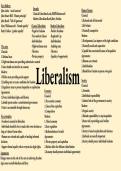
Key thinkers:
Strands: Human Nature:
John Locke - ‘social contract’
Classical Liberalism:Locke,Mill,Wollstonecraft Classical:
John Stuart Mill - ‘Harms principle’
Modern Liberalism:Rawls,Betty Freidan 1.Rational and self interested
John Rawls -’Veil of ignorance’
Mary Wollstonecraft - ‘formal equality’ Classical Liberalism: Modern Liberalism: 2.Self-reliant
Betty Freidan - ‘gender equality’ -Negative freedoms -Positive freedoms 3.Naturally competitive
-Free-markets/Laissez -Regulated Cap Modern:
-Individualism -Individualism 1.Developmental, can improve with right conditions
The state: -Nightwatchman state -Enabling state 2.Naturally social and cooperative
Classical: -Tolerance -Tolerance 3.Capable but constrained because of inequalities
1.Minimal state -Private property -Equality of oppurtunity Agreements:
2.Nightwatchman state providing authoritative control 1.Humans are rational
Liberalism
3.State should not interfere in economy 2.Individualism
Modern: 3.Should have freedom to pursue own goals
1.Welfare state providing social support
2.Enabling state to create conditions for freedom Society:
3.Regulatory state to prevent inequality or exploitation Classical:
Agreements: Economy: 1.Atomistic
1.Protect individual rights and liberties Classical: 2.Individual responsibility
2.should operate under a constitutional government 1.Free-market economy 3.Limited role of the government in society
3.State is accountable through democracy 2.Laissez-faire capitalism Modern:
3.Competition 1.Organic soceity
Key principles: Modern: 2.Mutual responsibility to stop inequalities
-Freedom is essential to liberalism 1. Mixed economy 3.States role in providing social welfare
-Individuals should be free to make their own decisions as 2.State regulation Agreements:
long as it doesn’t harm others. 3.Redistrubution of wealth 1.Society is based on pluralism and tolerance
-Humans are rational and capable of making informed Agreements: 2.Indivuals are morally important
decisions 1.Private property and capitalism 3.Society should protect individual freedoms
-Support formal equality where everyone has legal rights. 2.Markets allow for efficient redistribution
Arguments: 3.Economy should promote individual oppurtunity
Disagree most on the role of the state in achieving freedom
Agree most on individualism and libery
, Society:
The state:
1.Agree view socialist as individualist
1.Agree on state as necessary to achieve freedom
Thinkers:Stuart mill and locke
Thinkers: John locke v Mary
Argument: essential to progress and flourish
Argument:social contract, to achieve formal equality
2.Disagree on extent of state intervention
2.Disagree on society as a collective
Thinkers:Classical v modern
Thinkers: Classical v modern
Arguments: Night watchman v Enabling
Arguments: Atomism v collectivism
3.Disagree on rights given by state
Thinkers:Modern v liberal
3.disagree on equality of opportunity
Arguments: Positive v classical
Thinkers:classical v modern
Arguments: Equality of rights v Equality of outcome
Essay Plans
through welfare investment
Economy:
1.Agreements that markets are necessary for
competition and growth
Thinkers:Mill v Rawls
Argument:promote efficiency v economic freedom
2.Disagree on type of economy Human Nature:
Thinkers:Modern v classic 1.Agree on humans are naturally cooperative
Arguments:Laissez faire v regulated capitalism Thinkers:John Rawls v John locke
Argument:Veil of ignorance, before the state
3.Redistribution of wealth
Thinkers:Rawls v Locke 2. Disagree nature of humans
Arguments:Tax is theft Thinkers:John rawls v John stuart mill
Argument:Veil of ignorance v Harms principle
3. The role of the state in Humans lives
Argument:Enabling v night watchman state
Strands:Modern v Classic
, Human Nature:
Key thinkers: Key principles: Traditional:
Thomas Hobbes- ‘nasty,brutal and short’ without authority 1.Paternalism-power exerted from above 1.Imperfect and flawed
Edmund Burke- ‘Society is organic, authority is natural’ 2.Tradition-wisdom from past generations 2.Need authority
Michael Oakeshott- ‘Politics should be pragmatic’ 3.Human Imperfection- humans are flawed 3.Sceptical of radical ideas
Ayn Rand- ‘Objectivism’ One-nation:
4.Organic society-state is more important
Robert Nozick- ‘ Night watchman state’ 1.Imperfect but can be supported
5.Pragmatism-flexible approach to society 2.Need guidance from the elite
Traditional Conservatism: 3.Cooperation is important for stability
-Society is organic Strands:
New Right:
- Preserve Authority,tradition,hierarchy Traditional Conservatism:Hobbes,Burke
1.Humans are capable of improvement
-Inequality is natural and necessary One-Nation Conservatism:Oakeshott 2.Value opportunity for self-interest
Conservatism
-respect for institutions New Right:Rand,Nozick 3.Take responsibility for their success
Disagreements:
One nation Conservatism:
1.pessimistic v optimistic
-Accepts hierarchy 2.guided support v self-improvement
-Paternalism 3.tradition v progress
-Limited state Economy: State: Society:
-Social cohesion Traditional: Traditional: Traditional:
-Reform to maintain stability 1.Private property and Capitalism 1.Strong but limited 1.Organic
2.Limited change 2.To maintain order 2.Traditional
New Right Conservatism: 3.little intervention 3.Natural
3.To maintain hierarchy, not equality
-Capitalism and free markets One-nation: One-nation: One-nation:
-Equality of outcome 1.State intervention with Capitalism 1.Paternal 1.United
-Promotes welfare to get out of poverty 2.Redistribution to reduce inequalities 2.supports welfare and social reform 2.Supports reducing class division
-Government plays an active role 3.To prevent class conflict 3.maintain social cohesion 3.Accepts hierarchy but wants fairness
New Right: New Right: New Right:
Agreements: 1.Free markets and globalisation 1.Enabling 1.Meritocracy
A commitment to maintaining order 2.Equality of outcome 2.Supports welfare investment 2.Social mobility
3.public-private partnerships 3.Use partnerships with private sector 3.open to modernisation and diversity
and stability
Disagreements: Disagreements: Disagreements:
Disagreements: 1.Minimal v Active role 1.Hierarchy v meritocracy
1.Minimal change v active state
The role of the state in the economy 2.Degree of welfare intervention 2.Welfare cohesion v opportunity cohesion
2.Welfare v Redistribution of wealth
3.Pro-globalisation v Tradition 3.Partnership v traditional 3.change v cautious
Strands: Human Nature:
John Locke - ‘social contract’
Classical Liberalism:Locke,Mill,Wollstonecraft Classical:
John Stuart Mill - ‘Harms principle’
Modern Liberalism:Rawls,Betty Freidan 1.Rational and self interested
John Rawls -’Veil of ignorance’
Mary Wollstonecraft - ‘formal equality’ Classical Liberalism: Modern Liberalism: 2.Self-reliant
Betty Freidan - ‘gender equality’ -Negative freedoms -Positive freedoms 3.Naturally competitive
-Free-markets/Laissez -Regulated Cap Modern:
-Individualism -Individualism 1.Developmental, can improve with right conditions
The state: -Nightwatchman state -Enabling state 2.Naturally social and cooperative
Classical: -Tolerance -Tolerance 3.Capable but constrained because of inequalities
1.Minimal state -Private property -Equality of oppurtunity Agreements:
2.Nightwatchman state providing authoritative control 1.Humans are rational
Liberalism
3.State should not interfere in economy 2.Individualism
Modern: 3.Should have freedom to pursue own goals
1.Welfare state providing social support
2.Enabling state to create conditions for freedom Society:
3.Regulatory state to prevent inequality or exploitation Classical:
Agreements: Economy: 1.Atomistic
1.Protect individual rights and liberties Classical: 2.Individual responsibility
2.should operate under a constitutional government 1.Free-market economy 3.Limited role of the government in society
3.State is accountable through democracy 2.Laissez-faire capitalism Modern:
3.Competition 1.Organic soceity
Key principles: Modern: 2.Mutual responsibility to stop inequalities
-Freedom is essential to liberalism 1. Mixed economy 3.States role in providing social welfare
-Individuals should be free to make their own decisions as 2.State regulation Agreements:
long as it doesn’t harm others. 3.Redistrubution of wealth 1.Society is based on pluralism and tolerance
-Humans are rational and capable of making informed Agreements: 2.Indivuals are morally important
decisions 1.Private property and capitalism 3.Society should protect individual freedoms
-Support formal equality where everyone has legal rights. 2.Markets allow for efficient redistribution
Arguments: 3.Economy should promote individual oppurtunity
Disagree most on the role of the state in achieving freedom
Agree most on individualism and libery
, Society:
The state:
1.Agree view socialist as individualist
1.Agree on state as necessary to achieve freedom
Thinkers:Stuart mill and locke
Thinkers: John locke v Mary
Argument: essential to progress and flourish
Argument:social contract, to achieve formal equality
2.Disagree on extent of state intervention
2.Disagree on society as a collective
Thinkers:Classical v modern
Thinkers: Classical v modern
Arguments: Night watchman v Enabling
Arguments: Atomism v collectivism
3.Disagree on rights given by state
Thinkers:Modern v liberal
3.disagree on equality of opportunity
Arguments: Positive v classical
Thinkers:classical v modern
Arguments: Equality of rights v Equality of outcome
Essay Plans
through welfare investment
Economy:
1.Agreements that markets are necessary for
competition and growth
Thinkers:Mill v Rawls
Argument:promote efficiency v economic freedom
2.Disagree on type of economy Human Nature:
Thinkers:Modern v classic 1.Agree on humans are naturally cooperative
Arguments:Laissez faire v regulated capitalism Thinkers:John Rawls v John locke
Argument:Veil of ignorance, before the state
3.Redistribution of wealth
Thinkers:Rawls v Locke 2. Disagree nature of humans
Arguments:Tax is theft Thinkers:John rawls v John stuart mill
Argument:Veil of ignorance v Harms principle
3. The role of the state in Humans lives
Argument:Enabling v night watchman state
Strands:Modern v Classic
, Human Nature:
Key thinkers: Key principles: Traditional:
Thomas Hobbes- ‘nasty,brutal and short’ without authority 1.Paternalism-power exerted from above 1.Imperfect and flawed
Edmund Burke- ‘Society is organic, authority is natural’ 2.Tradition-wisdom from past generations 2.Need authority
Michael Oakeshott- ‘Politics should be pragmatic’ 3.Human Imperfection- humans are flawed 3.Sceptical of radical ideas
Ayn Rand- ‘Objectivism’ One-nation:
4.Organic society-state is more important
Robert Nozick- ‘ Night watchman state’ 1.Imperfect but can be supported
5.Pragmatism-flexible approach to society 2.Need guidance from the elite
Traditional Conservatism: 3.Cooperation is important for stability
-Society is organic Strands:
New Right:
- Preserve Authority,tradition,hierarchy Traditional Conservatism:Hobbes,Burke
1.Humans are capable of improvement
-Inequality is natural and necessary One-Nation Conservatism:Oakeshott 2.Value opportunity for self-interest
Conservatism
-respect for institutions New Right:Rand,Nozick 3.Take responsibility for their success
Disagreements:
One nation Conservatism:
1.pessimistic v optimistic
-Accepts hierarchy 2.guided support v self-improvement
-Paternalism 3.tradition v progress
-Limited state Economy: State: Society:
-Social cohesion Traditional: Traditional: Traditional:
-Reform to maintain stability 1.Private property and Capitalism 1.Strong but limited 1.Organic
2.Limited change 2.To maintain order 2.Traditional
New Right Conservatism: 3.little intervention 3.Natural
3.To maintain hierarchy, not equality
-Capitalism and free markets One-nation: One-nation: One-nation:
-Equality of outcome 1.State intervention with Capitalism 1.Paternal 1.United
-Promotes welfare to get out of poverty 2.Redistribution to reduce inequalities 2.supports welfare and social reform 2.Supports reducing class division
-Government plays an active role 3.To prevent class conflict 3.maintain social cohesion 3.Accepts hierarchy but wants fairness
New Right: New Right: New Right:
Agreements: 1.Free markets and globalisation 1.Enabling 1.Meritocracy
A commitment to maintaining order 2.Equality of outcome 2.Supports welfare investment 2.Social mobility
3.public-private partnerships 3.Use partnerships with private sector 3.open to modernisation and diversity
and stability
Disagreements: Disagreements: Disagreements:
Disagreements: 1.Minimal v Active role 1.Hierarchy v meritocracy
1.Minimal change v active state
The role of the state in the economy 2.Degree of welfare intervention 2.Welfare cohesion v opportunity cohesion
2.Welfare v Redistribution of wealth
3.Pro-globalisation v Tradition 3.Partnership v traditional 3.change v cautious


