

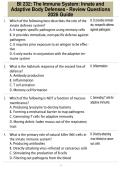
BI 232: The Immune System: Innate and
Adaptive Body Defenses - Review Questions
2026 Guide
1. Which of the following best describes the role of the B. It provides immedi-
innate defense system? ate, nonspecific defense
A. It targets specific pathogens using memory cells against pathogens
B. It provides immediate, nonspecific defense against
pathogens
C. It requires prior exposure to an antigen to be effec-
tive
D. It only works in conjunction with the adaptive im-
mune system
2. What is the hallmark response of the second line of B. Inflammation
defense?
A. Antibody production
B. Inflammation
C. T cell activation
D. Memory cell formation
3. Which of the following is NOT a function of mucous C. Generating T cells for
membranes? adaptive immunity
A. Producing lysozyme to destroy bacteria
B. Forming a mechanical barrier to trap pathogens
C. Generating T cells for adaptive immunity
D. Moving debris-laden mucus out of the respiratory
tract
4. What is the primary role of natural killer (NK) cells in B. Directly attacking
the innate immune system? virus-infected or cancer-
A. Producing antibodies ous cells
B. Directly attacking virus-infected or cancerous cells
C. Stimulating the production of B cells
D. Filtering out pathogens from the blood
, BI 232: The Immune System: Innate and
Adaptive Body Defenses - Review Questions
2026 Guide
5. How do mucous membranes contribute to innate im- Mucous membranes act as
munity? physical barriers that trap
pathogens in mucus. They
also contain antimicrobial
enzymes like lysozyme and
have cilia that move debris
and microbes out of the
body, helping to prevent
infections.
6. The first line of defense against pathogens includes skin; mucous
and membranes.
7. is an antimicrobial enzyme found in saliva, tears, Lysozyme
and respiratory mucus that destroys bacteria.
8. The acidity of the skin, vaginal secretions, and stomach acid mantle
secretions is collectively known as the , which
inhibits bacterial growth.
9. When surface barriers are breached, the body relies on inflammation
, phagocytes, and antimicrobial proteins as part
of its second line of defense.
10. Why is the immune system considered a functional The immune system is
system rather than an organ system? considered a functional
system because it con-
sists of a diverse net-
work of molecules and im-
mune cells, rather than a
distinct anatomical organ.
It includes lymphoid tis-
, sues, circulating immune
cells, and chemical de-
fenses that work together
to protect the body from
pathogens.
11. Explain how neutrophils differ from macrophages in Neutrophils are the most
terms of their function and lifespan in the immune abundant white blood
response. cells and become phago-
cytic when encounter-
ing pathogens. Howev-
er, they are short-lived
and self-destruct af-
ter fighting an infec-
tion. Macrophages, de-
rived from monocytes, are
more durable and can
survive to kill multiple
pathogens over time.
12. What are the benefits of inflammation in the immune Inflammation helps pre-
response? List at least two. vent the spread of harmful
agents to surrounding tis-
sues and alerts the adap-
tive immune system to the
presence of an infection. It
also assists in disposing of
cell debris and pathogens,
setting the stage for tissue
repair.
Adaptive Body Defenses - Review Questions
2026 Guide
1. Which of the following best describes the role of the B. It provides immedi-
innate defense system? ate, nonspecific defense
A. It targets specific pathogens using memory cells against pathogens
B. It provides immediate, nonspecific defense against
pathogens
C. It requires prior exposure to an antigen to be effec-
tive
D. It only works in conjunction with the adaptive im-
mune system
2. What is the hallmark response of the second line of B. Inflammation
defense?
A. Antibody production
B. Inflammation
C. T cell activation
D. Memory cell formation
3. Which of the following is NOT a function of mucous C. Generating T cells for
membranes? adaptive immunity
A. Producing lysozyme to destroy bacteria
B. Forming a mechanical barrier to trap pathogens
C. Generating T cells for adaptive immunity
D. Moving debris-laden mucus out of the respiratory
tract
4. What is the primary role of natural killer (NK) cells in B. Directly attacking
the innate immune system? virus-infected or cancer-
A. Producing antibodies ous cells
B. Directly attacking virus-infected or cancerous cells
C. Stimulating the production of B cells
D. Filtering out pathogens from the blood
, BI 232: The Immune System: Innate and
Adaptive Body Defenses - Review Questions
2026 Guide
5. How do mucous membranes contribute to innate im- Mucous membranes act as
munity? physical barriers that trap
pathogens in mucus. They
also contain antimicrobial
enzymes like lysozyme and
have cilia that move debris
and microbes out of the
body, helping to prevent
infections.
6. The first line of defense against pathogens includes skin; mucous
and membranes.
7. is an antimicrobial enzyme found in saliva, tears, Lysozyme
and respiratory mucus that destroys bacteria.
8. The acidity of the skin, vaginal secretions, and stomach acid mantle
secretions is collectively known as the , which
inhibits bacterial growth.
9. When surface barriers are breached, the body relies on inflammation
, phagocytes, and antimicrobial proteins as part
of its second line of defense.
10. Why is the immune system considered a functional The immune system is
system rather than an organ system? considered a functional
system because it con-
sists of a diverse net-
work of molecules and im-
mune cells, rather than a
distinct anatomical organ.
It includes lymphoid tis-
, sues, circulating immune
cells, and chemical de-
fenses that work together
to protect the body from
pathogens.
11. Explain how neutrophils differ from macrophages in Neutrophils are the most
terms of their function and lifespan in the immune abundant white blood
response. cells and become phago-
cytic when encounter-
ing pathogens. Howev-
er, they are short-lived
and self-destruct af-
ter fighting an infec-
tion. Macrophages, de-
rived from monocytes, are
more durable and can
survive to kill multiple
pathogens over time.
12. What are the benefits of inflammation in the immune Inflammation helps pre-
response? List at least two. vent the spread of harmful
agents to surrounding tis-
sues and alerts the adap-
tive immune system to the
presence of an infection. It
also assists in disposing of
cell debris and pathogens,
setting the stage for tissue
repair.


