

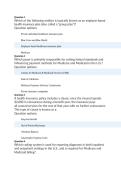
Question 1
Which of the following entities is typically known as an employer-based
health insurance plan (also called a “group plan”)?
Question options:
Private individual healthcare insurance plan
Blue Cross and Blue Shield
Employer-based healthcare insurance plan
Medicare
Question 2
Which payer is primarily responsible for setting federal standards and
influencing payment methods for Medicare and Medicaid in the U.S.?
Question options:
Centers for Medicare & Medicaid Services (CMS)
State of California
Medicare Payment Advisory Commission
Private insurance companies
Question 3
A health insurance policy includes a clause: once the insured spends
$2,000 in coinsurance during a benefit year, the insurance pays
all covered services for the rest of that year with no further coinsurance.
This type of clause is known as a:
Question options:
Stop-loss benefit
Out-of-Pocket Maximum
Premium Balance
Catastrophic Expense Limit
Question 4
Which coding system is used for reporting diagnoses in both inpatient
and outpatient settings in the U.S., and is required for Medicare and
Medicaid billing?
, Question options:
ICD-10-CM
HCPCS Level II
CPT
ICD-10-PCS
Question 5
What is the industry term for the document submitted by a provider to
an insurance payer to request payment for services rendered?
Question options:
Allowance
Charge
Claim
Explanation of Benefits
Question 6
Which of the following is not a characteristic of commercial (private)
health insurance?
Question options:
Coverage often negotiated between employer groups and insurance carriers
Plans often have deductibles, copayments, coinsurance amounts
Costs typically regulated by federal law exactly as Medicare/Medicaid are
Private insurance premiums paid partly (or wholly) by individuals or employers
Question 7
What term best describes the cost-sharing amount a patient pays each
time they receive a service, such as seeing a specialist?
Question options:
Deductible
Coinsurance
Copayment
Which of the following entities is typically known as an employer-based
health insurance plan (also called a “group plan”)?
Question options:
Private individual healthcare insurance plan
Blue Cross and Blue Shield
Employer-based healthcare insurance plan
Medicare
Question 2
Which payer is primarily responsible for setting federal standards and
influencing payment methods for Medicare and Medicaid in the U.S.?
Question options:
Centers for Medicare & Medicaid Services (CMS)
State of California
Medicare Payment Advisory Commission
Private insurance companies
Question 3
A health insurance policy includes a clause: once the insured spends
$2,000 in coinsurance during a benefit year, the insurance pays
all covered services for the rest of that year with no further coinsurance.
This type of clause is known as a:
Question options:
Stop-loss benefit
Out-of-Pocket Maximum
Premium Balance
Catastrophic Expense Limit
Question 4
Which coding system is used for reporting diagnoses in both inpatient
and outpatient settings in the U.S., and is required for Medicare and
Medicaid billing?
, Question options:
ICD-10-CM
HCPCS Level II
CPT
ICD-10-PCS
Question 5
What is the industry term for the document submitted by a provider to
an insurance payer to request payment for services rendered?
Question options:
Allowance
Charge
Claim
Explanation of Benefits
Question 6
Which of the following is not a characteristic of commercial (private)
health insurance?
Question options:
Coverage often negotiated between employer groups and insurance carriers
Plans often have deductibles, copayments, coinsurance amounts
Costs typically regulated by federal law exactly as Medicare/Medicaid are
Private insurance premiums paid partly (or wholly) by individuals or employers
Question 7
What term best describes the cost-sharing amount a patient pays each
time they receive a service, such as seeing a specialist?
Question options:
Deductible
Coinsurance
Copayment


