Nursing 4710 Infant
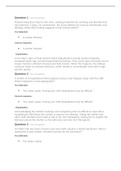
NURSING 4710 INFANT Question 1 See full question Parents bring their infant to the clinic, seeking treatment for vomiting and diarrhea that has lasted for 2 days. On assessment, the nurse detects dry mucous membranes and lethargy. What other finding suggests a fluid volume deficit? You Selected: A sunken fontanel Correct response: A sunken fontanel Explanation: In an infant, signs of fluid volume deficit (dehydration) include sunken fontanels, increased pulse rate, and decreased blood pressure. They occur when the body can no longer maintain sufficient intravascular fluid volume. When this happens, the kidneys conserve water to minimize fluid loss, which results in concentrated urine with a high specific gravity. Question 2 See full question A mother of a hospitalized infant appears anxious and displays anger with the staff. Which response is most appropriate? You Selected: "You seem upset. Having your child hospitalized must be difficult." Correct response: "You seem upset. Having your child hospitalized must be difficult." Explanation: Acknowledging the mother's feelings and recognizing that it's difficult to cope with a hospitalized child allows the mother to express her feelings. Telling the mother that other staff members don't want to talk to her isn't therapeutic. Asking her to explain her behavior places the mother on the defensive and also isn't therapeutic. Question 3 See full question An infant who has been in foster care since birth requires a blood transfusion. Who is authorized to give written, informed consent for the procedure? You Selected: The foster mother Correct response: The foster mother Explanation: When children are minors and aren't emancipated, their parents or designated legal guardians are responsible for providing consent for medical procedures. Therefore, the foster mother is authorized to give consent for the blood transfusion. The social worker, the nurse, and the nurse manager have no legal rights to give consent in this scenario. Question 4 See full question The most appropriate toys to give to a 5-month-old infant are: You Selected: soft, washable toys. Correct response: soft, washable toys. Explanation: Soft, washable toys are appropriate for infants, who tend to place everything in their mouths. These toys are not harmful. Plastic toys cannot be manipulated by a child of this age, and the child would put the car in the mouth, which may not be safe due to small parts that may be swallowed or aspirated. Games and puzzles are too advanced for a 5-month-old, and the child could put the pieces in the mouth and swallow them. Some stuffed animals have eyes that can be swallowed or aspirated. Question 5 See full question Which serum electrolytes findings should the nurse expect to find in an infant with persistent vomiting? You Selected: K + , 3.2; Cl- , 92; Na+ , 120 Correct response: K + , 3.2; Cl- , 92; Na+ , 120 Explanation: Chloride and sodium function together to maintain fluid and electrolyte balance. With vomiting, sodium chloride and water are lost in gastric fluid. As dehydration occurs, potassium moves into the extracellular fluid. For these reasons, persistent vomiting can lead to hypokalemia, hypochloremia, and hyponatremia. .....Continued.....
Document information
- Uploaded on
- May 21, 2021
- Number of pages
- 45
- Written in
- 2020/2021
- Type
- Exam (elaborations)
- Contains
- Questions & answers