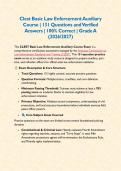
Clest Basic Law Enforcement Auxiliary
Course | 131 Questions and Verified
Answers | 100% Correct | Grade A
(2026/2027)
This CLEST Basic Law Enforcement Auxiliary Course Exam is a
comprehensive certification assessment managed by the Arkansas Commission on
Law Enforcement Standards and Training (CLEST). This 131-question practice
exam serves as an academic study resource designed to prepare auxiliary, part-
time, and refresher officers for official state law enforcement validation.
Exam Description & Core Structure
• Total Questions: 131 highly curated, accurate practice questions.
• Question Formats: Multiple-choice, true/false, and core definition
matchmaking.
• Minimum Passing Threshold: Trainees must achieve at least a 70%
passing score on academic blocks to maintain eligibility for law
enforcement retention.
• Primary Objective: Validates tactical competency, understanding of civil
protections, and local statutory boundaries before individuals exercise field
peace officer powers.
• Core Subject Areas Covered
Practice questions on the exam are divided across several foundational policing
domains:
• Constitutional & Criminal Law: Heavily evaluates Fourth Amendment
rights regarding searches, seizures, and "Terry Stops". It tests Fifth
Amendment protections against self-incrimination, the Exclusionary Rule,
and Miranda rights implementation.
, • Operational Rules & Ethics: Evaluates state-specific administrative
parameters, including the CLEST Rules and Regulations and the strict
downstream impacts of unethical officer behaviors.
• Police Administration & Command: Questions focus on
organizational operational strategies, line vs. staff operations, and navigating
a formal law enforcement chain of command.
• Domestic Violence & Special Investigations: Tests protocols for
identifying cycles of domestic abuse, emergency response operational
standards, and on-scene mandatory arrest triggers.
• Incident Management: Covers standard National Incident Management
System (NIMS) frameworks, including the Incident Command System (ICS)
Quiz_________________?
Ethics encompasses the standards for evaluating right and wrong and the personal
qualities that sustain the ability to make and act on these judgements. True or
False -
Answer
True
Quiz_________________?
Who is responsible for an officers standard of professional performance -
Answer
Officer (himself)
Quiz_________________?
,Which is not one of the three types of power
1. Coercive
2. Exhortative
3. Commanding
4. Reciprocal -
Answer
3. Commanding
Quiz_________________?
A Result of unethical behavior could be -
Answer
Criminal charges, Discipline, and Career Loss
Quiz_________________?
Unethical acts by officers not in your jurisdiction have no effect on how you as an
officer may be perceived by the public. True or False -
Answer
False
Quiz_________________?
The Peace Keeper role is concerned with the "Letter of the law enforcement".
True or False -
, Answer
False
Quiz_________________?
the Sara drill in "Problem solving policing" Stands for: -
Answer
Scanning, Analysis, Response, Assessment
Quiz_________________?
Foot patrol and bike patrol is an example of that principle of community policing:
-
Answer
Highly visible
Quiz_________________?
What are the three types of conflicts that a law enforcement officer may face
while community policing -
Answer
Racial, emotional, media
Quiz_________________?
Course | 131 Questions and Verified
Answers | 100% Correct | Grade A
(2026/2027)
This CLEST Basic Law Enforcement Auxiliary Course Exam is a
comprehensive certification assessment managed by the Arkansas Commission on
Law Enforcement Standards and Training (CLEST). This 131-question practice
exam serves as an academic study resource designed to prepare auxiliary, part-
time, and refresher officers for official state law enforcement validation.
Exam Description & Core Structure
• Total Questions: 131 highly curated, accurate practice questions.
• Question Formats: Multiple-choice, true/false, and core definition
matchmaking.
• Minimum Passing Threshold: Trainees must achieve at least a 70%
passing score on academic blocks to maintain eligibility for law
enforcement retention.
• Primary Objective: Validates tactical competency, understanding of civil
protections, and local statutory boundaries before individuals exercise field
peace officer powers.
• Core Subject Areas Covered
Practice questions on the exam are divided across several foundational policing
domains:
• Constitutional & Criminal Law: Heavily evaluates Fourth Amendment
rights regarding searches, seizures, and "Terry Stops". It tests Fifth
Amendment protections against self-incrimination, the Exclusionary Rule,
and Miranda rights implementation.
, • Operational Rules & Ethics: Evaluates state-specific administrative
parameters, including the CLEST Rules and Regulations and the strict
downstream impacts of unethical officer behaviors.
• Police Administration & Command: Questions focus on
organizational operational strategies, line vs. staff operations, and navigating
a formal law enforcement chain of command.
• Domestic Violence & Special Investigations: Tests protocols for
identifying cycles of domestic abuse, emergency response operational
standards, and on-scene mandatory arrest triggers.
• Incident Management: Covers standard National Incident Management
System (NIMS) frameworks, including the Incident Command System (ICS)
Quiz_________________?
Ethics encompasses the standards for evaluating right and wrong and the personal
qualities that sustain the ability to make and act on these judgements. True or
False -
Answer
True
Quiz_________________?
Who is responsible for an officers standard of professional performance -
Answer
Officer (himself)
Quiz_________________?
,Which is not one of the three types of power
1. Coercive
2. Exhortative
3. Commanding
4. Reciprocal -
Answer
3. Commanding
Quiz_________________?
A Result of unethical behavior could be -
Answer
Criminal charges, Discipline, and Career Loss
Quiz_________________?
Unethical acts by officers not in your jurisdiction have no effect on how you as an
officer may be perceived by the public. True or False -
Answer
False
Quiz_________________?
The Peace Keeper role is concerned with the "Letter of the law enforcement".
True or False -
, Answer
False
Quiz_________________?
the Sara drill in "Problem solving policing" Stands for: -
Answer
Scanning, Analysis, Response, Assessment
Quiz_________________?
Foot patrol and bike patrol is an example of that principle of community policing:
-
Answer
Highly visible
Quiz_________________?
What are the three types of conflicts that a law enforcement officer may face
while community policing -
Answer
Racial, emotional, media
Quiz_________________?