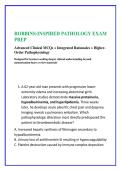
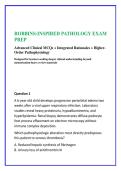
ROBBINS-INSPIRED PATHOLOGY EXAM
PREP
Advanced Clinical MCQs + Integrated Rationales + Higher-
Order Pathophysiology
Designed for learners seeking deeper clinical understanding beyond
memorization-heavy review materials
Question 1
A 24-year-old woman presents with progressive periorbital
edema and frothy urine developing 2 weeks after an upper
respiratory infection. Laboratory studies demonstrate heavy
proteinuria, hypoalbuminemia, and hyperlipidemia. Renal
biopsy shows diffuse effacement of podocyte foot processes on
electron microscopy without immune complex deposition.
Several weeks later, she develops sudden pleuritic chest pain
and dyspnea.
Which pathophysiologic alteration most directly predisposed
this patient to her new complication?
A. Hepatic overproduction of fibrinogen causing disseminated
fibrin deposition
B. Urinary loss of antithrombin III resulting in hypercoagulability
,C. Immune-mediated endothelial destruction activating the
extrinsic pathway
D. Platelet consumption secondary to widespread
microvascular thrombosis
Correct Answer: B. Urinary loss of antithrombin III resulting in
hypercoagulability
Key Diagnostic Clue
The combination of massive proteinuria, hypoalbuminemia,
and podocyte effacement indicates minimal change disease
causing nephrotic syndrome.
Mechanistic Interpretation
Nephrotic syndromes cause urinary loss of anticoagulant
proteins, especially antithrombin III, creating a
hypercoagulable state. This predisposes patients to venous
thrombosis and pulmonary embolism.
Why the Correct Answer Wins
Pulmonary embolism is a classic thrombotic complication of
nephrotic syndrome due to selective urinary protein loss.
Why the Other Choices Fail
• A: Fibrinogen increases occur, but diffuse fibrin deposition
describes DIC rather than isolated nephrotic
hypercoagulability.
• C: No evidence suggests vasculitis or endothelial
destruction.
, • D: Platelet consumption occurs in DIC, not uncomplicated
nephrotic syndrome.
Exam Trap
Students often associate edema with nephritic syndromes and
overlook the thrombotic complications unique to nephrotic
protein loss patterns.
Clinical Correlation
Renal vein thrombosis and pulmonary embolism are important
complications of severe nephrotic syndromes, especially
membranous nephropathy.
Question 2
A 67-year-old man with longstanding hypertension develops
acute chest pain radiating to his left arm. Four hours later,
serum troponin levels are elevated. Histologic examination of
the affected myocardium would most likely demonstrate which
cellular alteration?
A. Caseous necrosis with granulomatous inflammation
B. Liquefactive necrosis caused by enzymatic digestion
C. Coagulative necrosis with preservation of tissue architecture
D. Fat necrosis with calcium soap formation
Correct Answer: C. Coagulative necrosis with preservation of
tissue architecture
Key Diagnostic Clue
, Acute myocardial infarction classically produces ischemic injury
in a solid organ.
Mechanistic Interpretation
Ischemia denatures structural proteins and enzymes, delaying
proteolysis. Dead cells therefore temporarily retain their
outlines.
Why the Correct Answer Wins
Coagulative necrosis is the hallmark of ischemic infarction in
most solid tissues except the brain.
Why the Other Choices Fail
• A: Caseous necrosis is associated with tuberculosis and
granulomatous inflammation.
• B: Liquefactive necrosis predominates in CNS infarcts and
abscesses.
• D: Fat necrosis occurs in pancreatitis or traumatic adipose
injury.
Exam Pearl
The brain is the major exception to ischemic coagulative
necrosis because high lipid content and hydrolytic enzymes
favor liquefaction.
Memory Anchor
“Solid tissues coagulate; brain tissue liquefies.”
PREP
Advanced Clinical MCQs + Integrated Rationales + Higher-
Order Pathophysiology
Designed for learners seeking deeper clinical understanding beyond
memorization-heavy review materials
Question 1
A 24-year-old woman presents with progressive periorbital
edema and frothy urine developing 2 weeks after an upper
respiratory infection. Laboratory studies demonstrate heavy
proteinuria, hypoalbuminemia, and hyperlipidemia. Renal
biopsy shows diffuse effacement of podocyte foot processes on
electron microscopy without immune complex deposition.
Several weeks later, she develops sudden pleuritic chest pain
and dyspnea.
Which pathophysiologic alteration most directly predisposed
this patient to her new complication?
A. Hepatic overproduction of fibrinogen causing disseminated
fibrin deposition
B. Urinary loss of antithrombin III resulting in hypercoagulability
,C. Immune-mediated endothelial destruction activating the
extrinsic pathway
D. Platelet consumption secondary to widespread
microvascular thrombosis
Correct Answer: B. Urinary loss of antithrombin III resulting in
hypercoagulability
Key Diagnostic Clue
The combination of massive proteinuria, hypoalbuminemia,
and podocyte effacement indicates minimal change disease
causing nephrotic syndrome.
Mechanistic Interpretation
Nephrotic syndromes cause urinary loss of anticoagulant
proteins, especially antithrombin III, creating a
hypercoagulable state. This predisposes patients to venous
thrombosis and pulmonary embolism.
Why the Correct Answer Wins
Pulmonary embolism is a classic thrombotic complication of
nephrotic syndrome due to selective urinary protein loss.
Why the Other Choices Fail
• A: Fibrinogen increases occur, but diffuse fibrin deposition
describes DIC rather than isolated nephrotic
hypercoagulability.
• C: No evidence suggests vasculitis or endothelial
destruction.
, • D: Platelet consumption occurs in DIC, not uncomplicated
nephrotic syndrome.
Exam Trap
Students often associate edema with nephritic syndromes and
overlook the thrombotic complications unique to nephrotic
protein loss patterns.
Clinical Correlation
Renal vein thrombosis and pulmonary embolism are important
complications of severe nephrotic syndromes, especially
membranous nephropathy.
Question 2
A 67-year-old man with longstanding hypertension develops
acute chest pain radiating to his left arm. Four hours later,
serum troponin levels are elevated. Histologic examination of
the affected myocardium would most likely demonstrate which
cellular alteration?
A. Caseous necrosis with granulomatous inflammation
B. Liquefactive necrosis caused by enzymatic digestion
C. Coagulative necrosis with preservation of tissue architecture
D. Fat necrosis with calcium soap formation
Correct Answer: C. Coagulative necrosis with preservation of
tissue architecture
Key Diagnostic Clue
, Acute myocardial infarction classically produces ischemic injury
in a solid organ.
Mechanistic Interpretation
Ischemia denatures structural proteins and enzymes, delaying
proteolysis. Dead cells therefore temporarily retain their
outlines.
Why the Correct Answer Wins
Coagulative necrosis is the hallmark of ischemic infarction in
most solid tissues except the brain.
Why the Other Choices Fail
• A: Caseous necrosis is associated with tuberculosis and
granulomatous inflammation.
• B: Liquefactive necrosis predominates in CNS infarcts and
abscesses.
• D: Fat necrosis occurs in pancreatitis or traumatic adipose
injury.
Exam Pearl
The brain is the major exception to ischemic coagulative
necrosis because high lipid content and hydrolytic enzymes
favor liquefaction.
Memory Anchor
“Solid tissues coagulate; brain tissue liquefies.”