

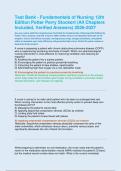
Test Bank - Fundamentals of Nursing 12th
Edition Potter Perry Stockert (All Chapters
Included, Verified Answers) 2026-2027
Ace your exams with this comprehensive Test Bank for Fundamentals of Nursing (12th Edition) by
Potter, Perry, Stockert, and Hall. Features 100% verified answers and detailed rationales for all
chapters. Covers vital clinical concepts, nursing process steps, dosage calculations, and patient
safety to maximize your study efficiency and guarantee high scores. Perfect for quick reviews or
deep-dive study sessions.
A nurse is assessing a patient with chronic obstructive pulmonary disease (COPD)
who is experiencing worsening shortness of breath. Which non-pharmacological
nursing intervention is most effective for improving ventilation and reducing air
trapping?
A) Assisting the patient into a supine position
B) Encouraging the patient to practice pursed-lip breathing
C) Instructing the patient to take shallow, rapid breaths
D) Administering high-flow oxygen via a non-rebreather mask
B) Encouraging the patient to practice pursed-lip breathing
Rationale: Pursed-lip breathing creates positive expiratory pressure in the airways,
which helps keep the bronchioles open longer during exhalation, promotes carbon
dioxide elimination, and reduces air trapping.
A nurse is caring for an older adult patient who has been on prolonged bed rest.
Which nursing intervention is the most effective priority action to prevent deep vein
thrombosis (DVT)?
A) Massaging the patient's calves daily
B) Applying sequential compression devices (SCDs) as ordered
C) Limiting daily fluid intake
D) Keeping the patient's knees flexed with pillows
B) Applying sequential compression devices (SCDs) as ordered
Rationale: Sequential compression devices physically compress the veins of the
lower extremities, which enhances venous return, prevents venous stasis, and
significantly decreases the risk of blood clot formation.
While preparing to administer an oral medication, the nurse notes that the patient's
name on the medication administration record (MAR) matches the patient's ID band,
but the medical record number does not match. What is the nurse's immediate
, priority action?
A) Administer the medication since the name is correct
B) Hold the medication and contact the pharmacy to verify the order
C) Ask the patient to verbally confirm their date of birth
D) Change the medical record number on the ID band to match the MAR
B) Hold the medication and contact the pharmacy to verify the order
Rationale: Safe medication administration requires two unique patient identifiers to
match exactly across all documentation, and holding the medication when a
discrepancy is found prevents a potential medical error.
If you'd like, let me know:
• Which specific nursing topics you want to test next (e.g., fluid and electrolytes,
wound care, medication administration)
• How many total questions you want in the next batch
• If you want to include clinical case scenarios
I can generate another precise quiz tailored to your study preferences.
1-60
Ready to create a quiz?
Use Canvas to test your knowledge with a custom quiz
Get started
A nurse completes an incident report after a patient falls. Where should the nurse file
the incident report?
A) Inside the patient's official medical record
B) Send it to the hospital risk management department
C) Attach it to the nurse's shift progress notes
D) Place it in the patient's bedside chart folder
B) Send it to the hospital risk management department
Rationale: Incident reports are internal quality improvement documents designed to
track trends and mitigate future liabilities, meaning they belong exclusively to risk
management and must never be placed or referenced in the patient's medical
record.
A nurse prepares to move a heavy patient up in bed. Which body mechanics
principle should the nurse implement?
A) Flex the knees and keep the feet wide apart
B) Bend at the waist and lock the knees straight
,C) Keep the center of gravity as high as possible
D) Twist the torso while lifting the patient's torso
A) Flex the knees and keep the feet wide apart
Rationale: Bending the knees shifts the workload to the strong muscles of the thighs
and buttocks, while a wide base of support maximizes balance and stability to
prevent musculoskeletal strains.
A patient is placed on a clear liquid diet following abdominal surgery. Which item can
the nurse safely include on the patient's food tray?
A) Vanilla ice cream
B) Strained tomato soup
C) Apple juice
D) Oatmeal gruel
C) Apple juice
Rationale: Clear liquids consist of fluids that are completely transparent at room
temperature and leave minimal residue in the gastrointestinal tract, making apple
juice an appropriate selection.
A nurse performs hand hygiene before inserting an indwelling urinary catheter. What
is the primary purpose of this action?
A) To sterilize the skin surface of the hands
B) To reduce the number of transient microorganisms
C) To eliminate all resident skin flora from fingers
D) To create a chemical barrier against bodily fluids
B) To reduce the number of transient microorganisms
Rationale: Hand hygiene removes transmission-prone transient pathogens picked up
from the environment, which interrupts the chain of infection and protects vulnerable
entry points on the patient.
An older adult patient with limited mobility is at risk for pressure injuries. Which area
should the nurse assess most frequently when the patient is in a supine position?
A) The patella and shins
B) The sacrum and heels
, C) The trochanter and ears
D) The sternum and clavicle
B) The sacrum and heels
Rationale: In a supine position, the bony prominences of the sacrum and heels bear
the direct weight of the body against the mattress, making them the most susceptible
sites for localized pressure necrosis.
A nurse administers an injection using the Z-track method. What is the clinical
reason for utilizing this specific technique?
A) To speed up the systemic absorption rate of medication
B) To seal the medication deep within the muscle tissue
C) To reduce the acute pain caused by the needle puncture
D) To ensure the medication enters a deep subcutaneous layer
B) To seal the medication deep within the muscle tissue
Rationale: Displacing the upper tissue layers before needle insertion creates a
zigzag track that prevents irritating or staining medications from leaking back into the
delicate subcutaneous layer.
A patient refuses a scheduled dose of antihypertensive medication. Which action
should the nurse take first?
A) Mix the medication into the patient's food covertly
B) Inform the patient about the potential risks of refusal
C) Notify the healthcare provider immediately of the refusal
D) Document that the patient is being non-compliant
B) Inform the patient about the potential risks of refusal
Rationale: Patients possess the ethical and legal right to autonomy and informed
refusal, requiring the nurse to first explore the patient's reasons and educate them on
the consequences before taking administrative or provider actions.
A nurse reviews the vital signs of an adult patient and notes a pulse rate of 112
beats per minute. How should the nurse document this finding?
A) Bradycardia
B) Tachypnea
Edition Potter Perry Stockert (All Chapters
Included, Verified Answers) 2026-2027
Ace your exams with this comprehensive Test Bank for Fundamentals of Nursing (12th Edition) by
Potter, Perry, Stockert, and Hall. Features 100% verified answers and detailed rationales for all
chapters. Covers vital clinical concepts, nursing process steps, dosage calculations, and patient
safety to maximize your study efficiency and guarantee high scores. Perfect for quick reviews or
deep-dive study sessions.
A nurse is assessing a patient with chronic obstructive pulmonary disease (COPD)
who is experiencing worsening shortness of breath. Which non-pharmacological
nursing intervention is most effective for improving ventilation and reducing air
trapping?
A) Assisting the patient into a supine position
B) Encouraging the patient to practice pursed-lip breathing
C) Instructing the patient to take shallow, rapid breaths
D) Administering high-flow oxygen via a non-rebreather mask
B) Encouraging the patient to practice pursed-lip breathing
Rationale: Pursed-lip breathing creates positive expiratory pressure in the airways,
which helps keep the bronchioles open longer during exhalation, promotes carbon
dioxide elimination, and reduces air trapping.
A nurse is caring for an older adult patient who has been on prolonged bed rest.
Which nursing intervention is the most effective priority action to prevent deep vein
thrombosis (DVT)?
A) Massaging the patient's calves daily
B) Applying sequential compression devices (SCDs) as ordered
C) Limiting daily fluid intake
D) Keeping the patient's knees flexed with pillows
B) Applying sequential compression devices (SCDs) as ordered
Rationale: Sequential compression devices physically compress the veins of the
lower extremities, which enhances venous return, prevents venous stasis, and
significantly decreases the risk of blood clot formation.
While preparing to administer an oral medication, the nurse notes that the patient's
name on the medication administration record (MAR) matches the patient's ID band,
but the medical record number does not match. What is the nurse's immediate
, priority action?
A) Administer the medication since the name is correct
B) Hold the medication and contact the pharmacy to verify the order
C) Ask the patient to verbally confirm their date of birth
D) Change the medical record number on the ID band to match the MAR
B) Hold the medication and contact the pharmacy to verify the order
Rationale: Safe medication administration requires two unique patient identifiers to
match exactly across all documentation, and holding the medication when a
discrepancy is found prevents a potential medical error.
If you'd like, let me know:
• Which specific nursing topics you want to test next (e.g., fluid and electrolytes,
wound care, medication administration)
• How many total questions you want in the next batch
• If you want to include clinical case scenarios
I can generate another precise quiz tailored to your study preferences.
1-60
Ready to create a quiz?
Use Canvas to test your knowledge with a custom quiz
Get started
A nurse completes an incident report after a patient falls. Where should the nurse file
the incident report?
A) Inside the patient's official medical record
B) Send it to the hospital risk management department
C) Attach it to the nurse's shift progress notes
D) Place it in the patient's bedside chart folder
B) Send it to the hospital risk management department
Rationale: Incident reports are internal quality improvement documents designed to
track trends and mitigate future liabilities, meaning they belong exclusively to risk
management and must never be placed or referenced in the patient's medical
record.
A nurse prepares to move a heavy patient up in bed. Which body mechanics
principle should the nurse implement?
A) Flex the knees and keep the feet wide apart
B) Bend at the waist and lock the knees straight
,C) Keep the center of gravity as high as possible
D) Twist the torso while lifting the patient's torso
A) Flex the knees and keep the feet wide apart
Rationale: Bending the knees shifts the workload to the strong muscles of the thighs
and buttocks, while a wide base of support maximizes balance and stability to
prevent musculoskeletal strains.
A patient is placed on a clear liquid diet following abdominal surgery. Which item can
the nurse safely include on the patient's food tray?
A) Vanilla ice cream
B) Strained tomato soup
C) Apple juice
D) Oatmeal gruel
C) Apple juice
Rationale: Clear liquids consist of fluids that are completely transparent at room
temperature and leave minimal residue in the gastrointestinal tract, making apple
juice an appropriate selection.
A nurse performs hand hygiene before inserting an indwelling urinary catheter. What
is the primary purpose of this action?
A) To sterilize the skin surface of the hands
B) To reduce the number of transient microorganisms
C) To eliminate all resident skin flora from fingers
D) To create a chemical barrier against bodily fluids
B) To reduce the number of transient microorganisms
Rationale: Hand hygiene removes transmission-prone transient pathogens picked up
from the environment, which interrupts the chain of infection and protects vulnerable
entry points on the patient.
An older adult patient with limited mobility is at risk for pressure injuries. Which area
should the nurse assess most frequently when the patient is in a supine position?
A) The patella and shins
B) The sacrum and heels
, C) The trochanter and ears
D) The sternum and clavicle
B) The sacrum and heels
Rationale: In a supine position, the bony prominences of the sacrum and heels bear
the direct weight of the body against the mattress, making them the most susceptible
sites for localized pressure necrosis.
A nurse administers an injection using the Z-track method. What is the clinical
reason for utilizing this specific technique?
A) To speed up the systemic absorption rate of medication
B) To seal the medication deep within the muscle tissue
C) To reduce the acute pain caused by the needle puncture
D) To ensure the medication enters a deep subcutaneous layer
B) To seal the medication deep within the muscle tissue
Rationale: Displacing the upper tissue layers before needle insertion creates a
zigzag track that prevents irritating or staining medications from leaking back into the
delicate subcutaneous layer.
A patient refuses a scheduled dose of antihypertensive medication. Which action
should the nurse take first?
A) Mix the medication into the patient's food covertly
B) Inform the patient about the potential risks of refusal
C) Notify the healthcare provider immediately of the refusal
D) Document that the patient is being non-compliant
B) Inform the patient about the potential risks of refusal
Rationale: Patients possess the ethical and legal right to autonomy and informed
refusal, requiring the nurse to first explore the patient's reasons and educate them on
the consequences before taking administrative or provider actions.
A nurse reviews the vital signs of an adult patient and notes a pulse rate of 112
beats per minute. How should the nurse document this finding?
A) Bradycardia
B) Tachypnea


