

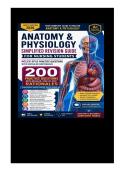
,ANATOMY & PHYSIOLOGY SIMPLIFIED REVISION GUIDE FOR NURSING
STUDENTS
200 NCLEX-STYLE PRACTICE QUESTIONS WITH DETAILED STEP-BY-STEP
RATIONALES | A+ EXAM SUCCESS EDITION (2026 UPDATED)
ANATOMY & PHYSIOLOGY SIMPLIFIED REVISION GUIDE FOR NURSING STUDENTS
NCLEX-Style Practice Questions with Detailed Rationales
1. CELL STRUCTURE & FUNCTION
Question 1
Which organelle is known as the “powerhouse of the cell”?
A. Ribosome
B. Nucleus
C. Mitochondria
D. Golgi apparatus
Correct Answer:
C. Mitochondria
Detailed Rationale:
Mitochondria are responsible for producing energy in the form of ATP (adenosine triphosphate)
through cellular respiration. Since all body cells require energy to function, mitochondria are
essential for survival.
• Ribosomes synthesize proteins.
• Nucleus controls cell activities and contains DNA.
• Golgi apparatus packages and transports proteins.
Nursing Tip:
Cells with high energy demand such as cardiac and muscle cells contain many mitochondria.
,Question 2
What is the primary function of the cell membrane?
A. Protein synthesis
B. Energy production
C. Control movement of substances in and out of the cell
D. Waste removal only
Correct Answer:
C. Control movement of substances in and out of the cell
Detailed Rationale:
The cell membrane acts as a selectively permeable barrier. It regulates what enters and exits the
cell, helping maintain homeostasis.
• Nutrients enter the cell.
• Waste products leave the cell.
• Harmful substances are blocked.
The membrane also helps with cell communication.
Question 3
Which structure contains the genetic material of the cell?
A. Cytoplasm
B. Nucleus
C. Lysosome
D. Endoplasmic reticulum
Correct Answer:
B. Nucleus
Detailed Rationale:
The nucleus is the control center of the cell and contains DNA, which carries genetic information
responsible for growth, reproduction, and cellular activities.
, • Lysosomes digest waste materials.
• Cytoplasm supports organelles.
• Endoplasmic reticulum assists in protein and lipid transport.
2. TISSUES & BODY MEMBRANES
Question 4
Which tissue type is responsible for movement?
A. Epithelial tissue
B. Connective tissue
C. Nervous tissue
D. Muscle tissue
Correct Answer:
D. Muscle tissue
Detailed Rationale:
Muscle tissue contracts to produce movement. There are three types:
1. Skeletal muscle – voluntary movement
2. Cardiac muscle – heart contractions
3. Smooth muscle – movement in organs
• Epithelial tissue covers surfaces.
• Connective tissue supports structures.
• Nervous tissue transmits impulses.
Question 5
Which epithelial tissue is specialized for diffusion and filtration?
A. Simple squamous epithelium
B. Stratified squamous epithelium
C. Cuboidal epithelium
D. Transitional epithelium
STUDENTS
200 NCLEX-STYLE PRACTICE QUESTIONS WITH DETAILED STEP-BY-STEP
RATIONALES | A+ EXAM SUCCESS EDITION (2026 UPDATED)
ANATOMY & PHYSIOLOGY SIMPLIFIED REVISION GUIDE FOR NURSING STUDENTS
NCLEX-Style Practice Questions with Detailed Rationales
1. CELL STRUCTURE & FUNCTION
Question 1
Which organelle is known as the “powerhouse of the cell”?
A. Ribosome
B. Nucleus
C. Mitochondria
D. Golgi apparatus
Correct Answer:
C. Mitochondria
Detailed Rationale:
Mitochondria are responsible for producing energy in the form of ATP (adenosine triphosphate)
through cellular respiration. Since all body cells require energy to function, mitochondria are
essential for survival.
• Ribosomes synthesize proteins.
• Nucleus controls cell activities and contains DNA.
• Golgi apparatus packages and transports proteins.
Nursing Tip:
Cells with high energy demand such as cardiac and muscle cells contain many mitochondria.
,Question 2
What is the primary function of the cell membrane?
A. Protein synthesis
B. Energy production
C. Control movement of substances in and out of the cell
D. Waste removal only
Correct Answer:
C. Control movement of substances in and out of the cell
Detailed Rationale:
The cell membrane acts as a selectively permeable barrier. It regulates what enters and exits the
cell, helping maintain homeostasis.
• Nutrients enter the cell.
• Waste products leave the cell.
• Harmful substances are blocked.
The membrane also helps with cell communication.
Question 3
Which structure contains the genetic material of the cell?
A. Cytoplasm
B. Nucleus
C. Lysosome
D. Endoplasmic reticulum
Correct Answer:
B. Nucleus
Detailed Rationale:
The nucleus is the control center of the cell and contains DNA, which carries genetic information
responsible for growth, reproduction, and cellular activities.
, • Lysosomes digest waste materials.
• Cytoplasm supports organelles.
• Endoplasmic reticulum assists in protein and lipid transport.
2. TISSUES & BODY MEMBRANES
Question 4
Which tissue type is responsible for movement?
A. Epithelial tissue
B. Connective tissue
C. Nervous tissue
D. Muscle tissue
Correct Answer:
D. Muscle tissue
Detailed Rationale:
Muscle tissue contracts to produce movement. There are three types:
1. Skeletal muscle – voluntary movement
2. Cardiac muscle – heart contractions
3. Smooth muscle – movement in organs
• Epithelial tissue covers surfaces.
• Connective tissue supports structures.
• Nervous tissue transmits impulses.
Question 5
Which epithelial tissue is specialized for diffusion and filtration?
A. Simple squamous epithelium
B. Stratified squamous epithelium
C. Cuboidal epithelium
D. Transitional epithelium


