

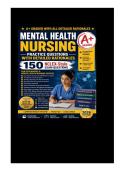
,MENTAL HEALTH NURSING PRACTICE QUESTIONS WITH DETAILED RATIONALES: 150 NCLEX-
STYLE EXAM QUESTIONS FOR PSYCHIATRIC & MENTAL HEALTH NURSING SUCCESS |
COMPREHENSIVE REVIEW FOR NURSING STUDENTS, RN & PN EXAMS | A+ EXAM MASTERY
2026 EDITION
Mental Health Nursing Practice Questions with Detailed Rationales
1. A nurse is caring for a client diagnosed with major depressive disorder. Which statement by
the client requires immediate intervention?
A. “I feel hopeless about my future.”
B. “I don’t enjoy activities anymore.”
C. “My family would be better off without me.”
D. “I have trouble sleeping at night.”
Correct Answer:
C. “My family would be better off without me.”
Rationale:
This statement suggests suicidal ideation and feelings of worthlessness, which require
immediate assessment and intervention to ensure the client’s safety. Depression commonly
causes hopelessness and sleep disturbances, but suicidal thoughts take priority because they
pose an immediate risk to life.
• Option A: Indicates hopelessness but not direct self-harm intent.
• Option B: Anhedonia is common in depression.
• Option D: Insomnia is a common depressive symptom.
2. A client with schizophrenia is experiencing auditory hallucinations. What is the nurse’s best
response?
A. “The voices are not real.”
B. “What are the voices saying to you?”
C. “Ignore the voices and focus on me.”
D. “You should not listen to those voices.”
Correct Answer:
,B. “What are the voices saying to you?”
Rationale:
The nurse should assess the hallucinations to determine if they are command hallucinations or
pose danger to the client or others. Therapeutic communication acknowledges the client’s
experience without reinforcing the hallucination.
• Option A: Dismissing the hallucination may increase distrust.
• Option C: May not address safety concerns.
• Option D: Is nontherapeutic and judgmental.
3. A nurse is caring for a manic client who has not slept for 48 hours. Which nursing
intervention is the priority?
A. Encourage group activities
B. Provide high-calorie finger foods
C. Teach relaxation techniques
D. Encourage journaling
Correct Answer:
B. Provide high-calorie finger foods
Rationale:
Clients experiencing mania are hyperactive and often unable to sit long enough to eat meals.
Providing portable, high-calorie foods prevents malnutrition and dehydration, which are
immediate physiological concerns.
• Option A: Group activities may overstimulate the client.
• Option C: Relaxation techniques may not be effective during acute mania.
• Option D: Requires concentration the client may not have.
4. Which defense mechanism is demonstrated when a client who failed an exam state, “The
test was unfair anyway”?
A. Projection
B. Rationalization
, C. Regression
D. Displacement
Correct Answer:
B. Rationalization
Rationale:
Rationalization involves creating logical excuses to justify unacceptable feelings or behaviors.
The client avoids personal responsibility by blaming the exam.
• Projection: Attributing one’s feelings to others.
• Regression: Returning to earlier developmental behaviors.
• Displacement: Redirecting emotions to another target.
5. A client diagnosed with generalized anxiety disorder reports feeling constantly worried.
Which physical symptom would the nurse expect?
A. Bradycardia
B. Hypotension
C. Muscle tension
D. Excessive sleepiness
Correct Answer:
C. Muscle tension
Rationale:
Anxiety activates the sympathetic nervous system, producing symptoms such as muscle tension,
restlessness, increased heart rate, and sweating.
• Option A: Anxiety usually causes tachycardia.
• Option B: Blood pressure often increases.
• Option D: Anxiety more commonly causes insomnia.
6. A nurse is assessing a client experiencing a panic attack. Which action should the nurse take
first?
STYLE EXAM QUESTIONS FOR PSYCHIATRIC & MENTAL HEALTH NURSING SUCCESS |
COMPREHENSIVE REVIEW FOR NURSING STUDENTS, RN & PN EXAMS | A+ EXAM MASTERY
2026 EDITION
Mental Health Nursing Practice Questions with Detailed Rationales
1. A nurse is caring for a client diagnosed with major depressive disorder. Which statement by
the client requires immediate intervention?
A. “I feel hopeless about my future.”
B. “I don’t enjoy activities anymore.”
C. “My family would be better off without me.”
D. “I have trouble sleeping at night.”
Correct Answer:
C. “My family would be better off without me.”
Rationale:
This statement suggests suicidal ideation and feelings of worthlessness, which require
immediate assessment and intervention to ensure the client’s safety. Depression commonly
causes hopelessness and sleep disturbances, but suicidal thoughts take priority because they
pose an immediate risk to life.
• Option A: Indicates hopelessness but not direct self-harm intent.
• Option B: Anhedonia is common in depression.
• Option D: Insomnia is a common depressive symptom.
2. A client with schizophrenia is experiencing auditory hallucinations. What is the nurse’s best
response?
A. “The voices are not real.”
B. “What are the voices saying to you?”
C. “Ignore the voices and focus on me.”
D. “You should not listen to those voices.”
Correct Answer:
,B. “What are the voices saying to you?”
Rationale:
The nurse should assess the hallucinations to determine if they are command hallucinations or
pose danger to the client or others. Therapeutic communication acknowledges the client’s
experience without reinforcing the hallucination.
• Option A: Dismissing the hallucination may increase distrust.
• Option C: May not address safety concerns.
• Option D: Is nontherapeutic and judgmental.
3. A nurse is caring for a manic client who has not slept for 48 hours. Which nursing
intervention is the priority?
A. Encourage group activities
B. Provide high-calorie finger foods
C. Teach relaxation techniques
D. Encourage journaling
Correct Answer:
B. Provide high-calorie finger foods
Rationale:
Clients experiencing mania are hyperactive and often unable to sit long enough to eat meals.
Providing portable, high-calorie foods prevents malnutrition and dehydration, which are
immediate physiological concerns.
• Option A: Group activities may overstimulate the client.
• Option C: Relaxation techniques may not be effective during acute mania.
• Option D: Requires concentration the client may not have.
4. Which defense mechanism is demonstrated when a client who failed an exam state, “The
test was unfair anyway”?
A. Projection
B. Rationalization
, C. Regression
D. Displacement
Correct Answer:
B. Rationalization
Rationale:
Rationalization involves creating logical excuses to justify unacceptable feelings or behaviors.
The client avoids personal responsibility by blaming the exam.
• Projection: Attributing one’s feelings to others.
• Regression: Returning to earlier developmental behaviors.
• Displacement: Redirecting emotions to another target.
5. A client diagnosed with generalized anxiety disorder reports feeling constantly worried.
Which physical symptom would the nurse expect?
A. Bradycardia
B. Hypotension
C. Muscle tension
D. Excessive sleepiness
Correct Answer:
C. Muscle tension
Rationale:
Anxiety activates the sympathetic nervous system, producing symptoms such as muscle tension,
restlessness, increased heart rate, and sweating.
• Option A: Anxiety usually causes tachycardia.
• Option B: Blood pressure often increases.
• Option D: Anxiety more commonly causes insomnia.
6. A nurse is assessing a client experiencing a panic attack. Which action should the nurse take
first?


