

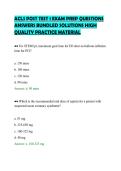
ACLS POST TEST 1 EXAM PREP QUESTIONS
ANSWERS BUNDLED SOLUTIONS HIGH
QUALITY PRACTICE MATERIAL
●● For STEMI pt, maximum goal time for ED door-to-balloon-inflation
time for PCI?
a. 150 mins
b. 180 mins
c. 120 mins
d. 90 mins
Answer: d. 90 mins
●● Which is the recommended oral dose of aspirin for a patient with
suspected acute coronary syndrome?
a. 81 mg
b. 325-650 mg
c. 160-325 mg
d. 40 mg
Answer: c. 160-325 mg
,●● chest compressions during for adult rate
a. 40-60/min
b. 60-80/min
c. 80-100/min
d. 100-120/min
Answer: d. 100-120/min
●● What is the effect of excessive ventilation?
a. decresed cardiac output
b. decreased intrathoracic pressure
c. increased perfusion pressure
d. increased venous return
Answer: a. decreased cardiac output
●● temperature to achieve targeted temperature management after
cardiac arrest
a. 30-34C
b. 32-36C
c. 36-40C
, d. 38-42C
Answer: b. 32-36C
●● 3 mins into cardiac arrest resuscitation attempt, one member of your
team inserts an endotracheal tube while another performs chest
compressions. Capnography shows a persistent waveform & a PETCO2
of 8mmHg. What is the significance of the finding?
a. chest compression may not be effective
b. The endotrachael tube is in the esophagus
c. the team is ventilating the patient too often
d. the patient meets the criteria for termination of efforts
Answer: a. chest compression may not be effective
●● Your patient is in cardiac arrest and has been intubated. To assess
CPR quality, you should?
a. obtain a chest x-ray
b. check the patient's pulse
c. monitor the patient's PETCO2
d. obtain a 12-lead ECG
Answer: c. monitor the patient's PETCO2
ANSWERS BUNDLED SOLUTIONS HIGH
QUALITY PRACTICE MATERIAL
●● For STEMI pt, maximum goal time for ED door-to-balloon-inflation
time for PCI?
a. 150 mins
b. 180 mins
c. 120 mins
d. 90 mins
Answer: d. 90 mins
●● Which is the recommended oral dose of aspirin for a patient with
suspected acute coronary syndrome?
a. 81 mg
b. 325-650 mg
c. 160-325 mg
d. 40 mg
Answer: c. 160-325 mg
,●● chest compressions during for adult rate
a. 40-60/min
b. 60-80/min
c. 80-100/min
d. 100-120/min
Answer: d. 100-120/min
●● What is the effect of excessive ventilation?
a. decresed cardiac output
b. decreased intrathoracic pressure
c. increased perfusion pressure
d. increased venous return
Answer: a. decreased cardiac output
●● temperature to achieve targeted temperature management after
cardiac arrest
a. 30-34C
b. 32-36C
c. 36-40C
, d. 38-42C
Answer: b. 32-36C
●● 3 mins into cardiac arrest resuscitation attempt, one member of your
team inserts an endotracheal tube while another performs chest
compressions. Capnography shows a persistent waveform & a PETCO2
of 8mmHg. What is the significance of the finding?
a. chest compression may not be effective
b. The endotrachael tube is in the esophagus
c. the team is ventilating the patient too often
d. the patient meets the criteria for termination of efforts
Answer: a. chest compression may not be effective
●● Your patient is in cardiac arrest and has been intubated. To assess
CPR quality, you should?
a. obtain a chest x-ray
b. check the patient's pulse
c. monitor the patient's PETCO2
d. obtain a 12-lead ECG
Answer: c. monitor the patient's PETCO2


