

Lab 07 - Optics
Materials/Supplies
Access to computer and high-speed internet, Java installed on the computer, a browser
with Flash built-in (likely Chrome is best)
Time Spent
Approximately 3 hours, does not need to be done at one sitting
Learning Objectives
Define how a light wave interacts with a physical medium and construct laws which
govern this interaction.
Virtual Lab
To begin this week’s lab, proceed to the following:
Bending Light Simulation
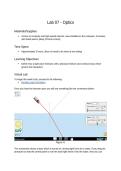
Once you have the browser open you will see something like the screenshot below:
Figure #1
The screenshot shows a laser which is turned on, shining light from air to water. If you drag the
protractor so that the central point is over the laser light when it hits the water, then you can
, measure the angles between the laser beam and the normal (dashed line) on both sides of the
water.
1. Please go ahead and measure the angle between the incoming light and the dashed line
going up. Also, please measure the angle between the light in the water, and the dashed
line going down. Write the answers below and comment on whether the angles
SHOULD be the same, different, in what way.
Answer:
The angle between the incoming light and the dashed line going up is 45°. The angle between
the light in the water and the dashed line going down is 32°. The angles are not the same.
The angle is larger in air and smaller in water because light bends toward the normal when it
enters a material with a higher index of refraction.
You may have already read in the textbook that Snell’s Law states that light entering into a
different substance, at some angle, will “refract” by some angle which is given by Snell’s Law,
n1*sin(𝜃1) = n2*sin(𝜃2) (eq. 1)
2. Check that Snell’s Law is correct for the default situation in the simulator. Develop a
method to check this, write it out below, and then proceed to test the theory. Write the
results of your test below as well.
Answer:
1.00sin(45∘)=1.33sin(32∘)
1.00(0.707)=1.33(0.530)
0.707≈0.705
To check Snell’s Law, I used the angles from question 1. Then I used the indices of refraction
for air (1.00) and water (1.33) and calculated both sides of equation 1. After comparing the
two values, they were approximately equal (0.707 ≈ 0.705). This shows that Snell’s Law is
correct for the situation in the simulator.
Hopefully you found that Snell’s Law does apply to the situation depicted in the simulator. Now
let’s use Snell’s Law in a more practical way, to figure out what an unknown substance is made
of!!
3. On the right side of the screen, you are able to change the lower material to a different
substance, Mystery A. Please do so and then develop a method to test the index of
refraction of the substance Mystery A and write down your procedure below. You must
take at least 5 sets of data with the protractor in your method!
Answer:
I would measure the angle between the incoming light and the dashed line, and the angle
between the refracted light and the dashed line for Mystery A. Then I would use Snell’s Law to
calculate the index of refraction. I would repeat this process for 5 different angles of incoming
Materials/Supplies
Access to computer and high-speed internet, Java installed on the computer, a browser
with Flash built-in (likely Chrome is best)
Time Spent
Approximately 3 hours, does not need to be done at one sitting
Learning Objectives
Define how a light wave interacts with a physical medium and construct laws which
govern this interaction.
Virtual Lab
To begin this week’s lab, proceed to the following:
Bending Light Simulation
Once you have the browser open you will see something like the screenshot below:
Figure #1
The screenshot shows a laser which is turned on, shining light from air to water. If you drag the
protractor so that the central point is over the laser light when it hits the water, then you can
, measure the angles between the laser beam and the normal (dashed line) on both sides of the
water.
1. Please go ahead and measure the angle between the incoming light and the dashed line
going up. Also, please measure the angle between the light in the water, and the dashed
line going down. Write the answers below and comment on whether the angles
SHOULD be the same, different, in what way.
Answer:
The angle between the incoming light and the dashed line going up is 45°. The angle between
the light in the water and the dashed line going down is 32°. The angles are not the same.
The angle is larger in air and smaller in water because light bends toward the normal when it
enters a material with a higher index of refraction.
You may have already read in the textbook that Snell’s Law states that light entering into a
different substance, at some angle, will “refract” by some angle which is given by Snell’s Law,
n1*sin(𝜃1) = n2*sin(𝜃2) (eq. 1)
2. Check that Snell’s Law is correct for the default situation in the simulator. Develop a
method to check this, write it out below, and then proceed to test the theory. Write the
results of your test below as well.
Answer:
1.00sin(45∘)=1.33sin(32∘)
1.00(0.707)=1.33(0.530)
0.707≈0.705
To check Snell’s Law, I used the angles from question 1. Then I used the indices of refraction
for air (1.00) and water (1.33) and calculated both sides of equation 1. After comparing the
two values, they were approximately equal (0.707 ≈ 0.705). This shows that Snell’s Law is
correct for the situation in the simulator.
Hopefully you found that Snell’s Law does apply to the situation depicted in the simulator. Now
let’s use Snell’s Law in a more practical way, to figure out what an unknown substance is made
of!!
3. On the right side of the screen, you are able to change the lower material to a different
substance, Mystery A. Please do so and then develop a method to test the index of
refraction of the substance Mystery A and write down your procedure below. You must
take at least 5 sets of data with the protractor in your method!
Answer:
I would measure the angle between the incoming light and the dashed line, and the angle
between the refracted light and the dashed line for Mystery A. Then I would use Snell’s Law to
calculate the index of refraction. I would repeat this process for 5 different angles of incoming


