

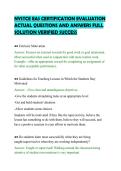
NYSTCE EAS CERTIFICATION EVALUATION
ACTUAL QUESTIONS AND ANSWERS FULL
SOLUTION VERIFIED SUCCESS
●● Extrinsic Motivation
Answer: Focuses on external rewards for good work or goal attainment.
Most successful when used in conjunction with more routine work.
Example - offer an appropriate reward for completing an assignment of
for other acceptable performance.
●● Guidelines for Teaching Lessons in Which the Students Stay
Motivated
Answer: - Give clear and unambiguous objectives
-Give the students stimulating tasks at an appropriate level
-Get and hold students' attention
-Allow students some choices
Students will be motivated if they like the topic/activity, believe the
lesson has something to do with them, believe they will succeed, and
have a positive reaction to your efforts to motivate them.
●● Do students learn most successfully when they are being
taught/supervised or when they are working independently?
Answer: Taught or supervised! Walking around the classroom being
attentive of student conversations is very important.
,●● Zone of Proximal Development (ZPD)
Answer: Developed by Lev Vygotsky. Consists of tasks the student
cannot do without help but can do with help. Teachers should present
activities in a student's ZPD to encourage a realistic learning opportunity
●● Scaffolding
Answer: A student receives help to learn something in his or her ZPD.
The help is withdrawn in a measured way until it the help becomes
unnecessary.
At a certain point, the children will be able to do the work without your
help!
●● Gardener's Multiple Intelligences
Answer: Theory by Howard gardner that presents 9 intelligences to
better reflect the wide range of ability demonstrated by students.
●● Spatial Thinkers
Answer: (Visual Learners) Learn best by visualizing problems and
solutions.
These students learn best when they write reports or create powerpoint
presenstations, for example.
,●● Linguistic Thinkers
Answer: (listening to spoken info) Learn best through words and
language
These students work best when they are given oral reports, oral
expression during class, and when you allow them to repeat ideas
learned in class.
●● Logical-mathematical thinkers
Answer: (Numerical Computations) Learn best through abstract and
scientific thinking, and through solving numerical problems
●● Bodily-kinesthetic thinkers
Answer: (Hands-on Learners) Learn best through physical activity
Provide these students with field trips and/or work in groups.
●● Musical thinkers
Answer: (Great Listeners) Learn best by listening and tend to excel at
singing/musical instruments
●● Interpersonal thinkers
, Answer: (works well when other students are involved) Learn best by
working with others and tend to be sensitive to the needs of others
●● Intrapersonal thinkers
Answer: (independent learners) Learn best by working alone and tend to
be intuitive and introverted
●● Naturalistic thinkers
Answer: (learn by relating to what is happening in society) Learn best by
relating subject matter to nature and the world around them
●● Existential thinkers
Answer: (think beyond the information given) May comprehend
concepts beyond the actual information given
●● Maslow's Deficiency Needs
Answer: Before the child can even focus on the lesson, what are the
needs of that child?
1. Biological/physiological - hunger, thirst, etc.
2. Safety
3. Belongingness/love
ACTUAL QUESTIONS AND ANSWERS FULL
SOLUTION VERIFIED SUCCESS
●● Extrinsic Motivation
Answer: Focuses on external rewards for good work or goal attainment.
Most successful when used in conjunction with more routine work.
Example - offer an appropriate reward for completing an assignment of
for other acceptable performance.
●● Guidelines for Teaching Lessons in Which the Students Stay
Motivated
Answer: - Give clear and unambiguous objectives
-Give the students stimulating tasks at an appropriate level
-Get and hold students' attention
-Allow students some choices
Students will be motivated if they like the topic/activity, believe the
lesson has something to do with them, believe they will succeed, and
have a positive reaction to your efforts to motivate them.
●● Do students learn most successfully when they are being
taught/supervised or when they are working independently?
Answer: Taught or supervised! Walking around the classroom being
attentive of student conversations is very important.
,●● Zone of Proximal Development (ZPD)
Answer: Developed by Lev Vygotsky. Consists of tasks the student
cannot do without help but can do with help. Teachers should present
activities in a student's ZPD to encourage a realistic learning opportunity
●● Scaffolding
Answer: A student receives help to learn something in his or her ZPD.
The help is withdrawn in a measured way until it the help becomes
unnecessary.
At a certain point, the children will be able to do the work without your
help!
●● Gardener's Multiple Intelligences
Answer: Theory by Howard gardner that presents 9 intelligences to
better reflect the wide range of ability demonstrated by students.
●● Spatial Thinkers
Answer: (Visual Learners) Learn best by visualizing problems and
solutions.
These students learn best when they write reports or create powerpoint
presenstations, for example.
,●● Linguistic Thinkers
Answer: (listening to spoken info) Learn best through words and
language
These students work best when they are given oral reports, oral
expression during class, and when you allow them to repeat ideas
learned in class.
●● Logical-mathematical thinkers
Answer: (Numerical Computations) Learn best through abstract and
scientific thinking, and through solving numerical problems
●● Bodily-kinesthetic thinkers
Answer: (Hands-on Learners) Learn best through physical activity
Provide these students with field trips and/or work in groups.
●● Musical thinkers
Answer: (Great Listeners) Learn best by listening and tend to excel at
singing/musical instruments
●● Interpersonal thinkers
, Answer: (works well when other students are involved) Learn best by
working with others and tend to be sensitive to the needs of others
●● Intrapersonal thinkers
Answer: (independent learners) Learn best by working alone and tend to
be intuitive and introverted
●● Naturalistic thinkers
Answer: (learn by relating to what is happening in society) Learn best by
relating subject matter to nature and the world around them
●● Existential thinkers
Answer: (think beyond the information given) May comprehend
concepts beyond the actual information given
●● Maslow's Deficiency Needs
Answer: Before the child can even focus on the lesson, what are the
needs of that child?
1. Biological/physiological - hunger, thirst, etc.
2. Safety
3. Belongingness/love


