

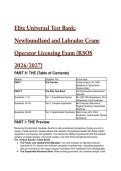
Elite Universal Test Bank:
Newfoundland and Labrador Crane
Operator Licensing Exam (RSOS
2026/2027)
PART 0: THE (Table of Contents)
Section Cognitive Tier Focus Area
PART I The Preview Critical Axioms, NL OHS
Baselines & Operational
Tension Data
PART II The Elite Test Bank Full 60-Question Assessment
Gauntlet
Questions 1–15 Tier 1: Foundational Syntax NL OHS Title Regulations, PLH
Clearances, Core Formulas
Questions 16–35 Tier 2: Complex Application Net Capacity Deductions,
Rigging Tensions, Suspended
Platforms
Questions 36–60 Tier 3: Grandmaster Synthesis Multi-Crane Lifts, Wind
Dynamics, Catastrophic Failure
Avoidance
PART I: THE Preview
Mastering this test bank translates directly to elite operational competence, forging you into a
master of load dynamics, Newfoundland and Labrador Occupational Health and Safety (OHS)
regulations, and rigorous risk mitigation. You replace the liability of guesswork with the absolute
certainty of applied physics, load chart mastery, and CSA Z150 operational dominance.
The "Critical Axioms" Cheat Sheet:
● The Power Line Hazard (PLH) Mandate: You must maintain an absolute minimum
clearance of 5.5 metres from unknown energized overhead lines. Operating equipment
that can encroach on this space requires mandatory PLH certification from WorkplaceNL.
● The Suspended Personnel Rule: When hoisting personnel, the combined weight of the
, platform, rigging, and rated load MUST NOT exceed 25% of the crane's rated capacity at
the working radius.
● Rigging Safety Factors: The safety factor for rigging hardware suspending personnel is
10. General cargo uses a factor of 5, while thrust-out beams require a factor of 4.
● The Multi-Crane Threshold: A formal, written multiple-crane lift procedure is legally
mandated if the load on any single crane exceeds 75% of its rated capacity, or if three or
more cranes are lifting simultaneously.
● The Structural Asterisk: On a load chart, capacities marked with an asterisk (*) are
governed by structural strength, not stability. Exceeding them results in sudden
mechanical failure, not a warning tip.
PART II: THE ELITE TEST BANK
Q1: A mobile crane operator in St. John's is setting up near energized power lines with an
unknown voltage. The operator has not yet contacted Newfoundland Power for a clearance
permit. According to Newfoundland and Labrador OHS Regulations, what is the IMMEDIATE
required action regarding clearance? A) Maintain a 3-metre clearance until the voltage is
verified by a spotter. B) Proceed with the lift if a dedicated spotter is used to watch the boom tip.
C) Maintain a minimum clearance of 5.5 metres from the lines at all times. D) De-rate the
crane's capacity by 25% to account for magnetic interference.
● The Answer: C (Maintain a minimum clearance of 5.5 metres from the lines at all times.)
● Distractor Analysis:
○ A is incorrect: The 3-metre clearance is only legally permissible for specific known
voltages (750 V to 75 kV) after utility consultation and voltage verification.
○ B is incorrect: A spotter does not negate or legally override the minimum statutory
clearance limit.
○ D is incorrect: De-rating capacity has no correlation to electrical arc hazards or PLH
regulations.
The Mentor's Analysis: Power Line Hazards (PLH) are the leading cause of crane fatalities.
Without explicit written permission and voltage verification from the utility, the 5.5-metre hard
deck is non-negotiable. By utilizing Absolute Clearance Distances, you bypass the common trap
of relying on visual depth perception, which is notoriously flawed against the sky.
Professional/Academic Intuition: Assume every wire is lethal and requires 5.5 metres of
clearance unless the utility specifically dictates otherwise in writing.
Q2: Under WorkplaceNL standards, before a worker is legally permitted to operate a mobile
crane, boom truck, or similar equipment capable of encroaching on an energized overhead line,
they MUST possess which of the following? A) A Class 03 driver's license with a maximum of 4
demerit points. B) A current, approved Power Line Hazards (PLH) certification from an approved
training provider. C) A 10-year teardown inspection certificate for the crane. D) A signed waiver
from the site supervisor assuming electrical liability.
● The Answer: B (A current, approved Power Line Hazards (PLH) certification from an
approved training provider.)
● Distractor Analysis:
○ A is incorrect: While required for driving the crane on public roads , the Class 03
permit does not govern overhead electrical encroachment laws.
○ C is incorrect: This is a mechanical inspection standard, entirely unrelated to
operator electrical safety training.
, ○ D is incorrect: Liability cannot be waived; safety legislation supersedes site
management directives.
The Mentor's Analysis: Newfoundland and Labrador OHS Section 483 dictates that holding a
basic crane ticket is insufficient if the boom can physically reach a wire. When operating
Capable Equipment, the immediate priority is specialized hazard awareness. By utilizing
Mandatory PLH Certification, you bypass the common trap of assuming mechanical
competence equals electrical safety competence. Professional/Academic Intuition: No PLH
card, no seat time near power lines. The certification is your legal shield.
Q3: You are preparing to hoist personnel in a suspended work platform. The platform and
rigging weigh 1,000 lbs, and the two workers with their gear weigh 500 lbs (Total Load = 1,500
lbs). Based on NL OHS Regulation 192, what is the ABSOLUTE MINIMUM Gross Chart
Capacity the crane must have at this specific radius to execute the lift legally? A) 3,000 lbs B)
4,500 lbs C) 6,000 lbs D) 15,000 lbs
● The Answer: C (6,000 lbs)
● Distractor Analysis:
○ A is incorrect: This represents a 2:1 ratio, which is dangerously below the legal
standard for human life.
○ B is incorrect: This represents a 3:1 ratio, often confused with general rigging
margins.
○ D is incorrect: This is a 10:1 ratio, which applies to the rigging hardware safety
factor , not the crane's chart capacity.
The Mentor's Analysis: Human cargo requires extraordinary mathematical buffers. When
calculating Personnel Suspensions, the immediate priority is proving the crane has four times
the capacity of the total suspended weight. By utilizing the 25% Capacity Rule , you bypass the
common trap of treating humans like standard freight. Professional/Academic Intuition:
Multiply the total personnel load by 4. If the crane's chart can't lift that number, humans
stay on the ground.
Q4: A crane operator is utilizing a dedicated two-way radio system to take directions from a
rigger during a blind lift. According to NL OHS regulations (Section 127), which communication
practice is strictly PROHIBITED? A) The use of a multi-channel radio frequency to direct the
crane's movement. B) The operator verbally repeating the signal back to the rigger before
executing. C) Utilizing the "emergency stop" command from a worker who is not the designated
rigger. D) Testing the radio batteries and signal clarity prior to the load lifting off the ground.
● The Answer: A (The use of a multi-channel radio frequency to direct the crane's
movement.)
● Distractor Analysis:
○ B is incorrect: Repeating commands is a best practice for operational clarity.
○ C is incorrect: ANY person on a job site is legally authorized to give an emergency
stop signal, and the operator must obey it.
○ D is incorrect: Pre-lift radio checks are mandatory safety procedures.
The Mentor's Analysis: Radio bleed-over causes catastrophic unintentional load movements.
When managing Blind Lift Communications, the immediate priority is absolute signal isolation.
By utilizing a Dedicated Radio Channel , you bypass the common trap of executing a command
that was actually meant for another crane on the site. Professional/Academic Intuition: One
channel, one crane. Shared frequencies breed fatal misunderstandings.
Q5: You are reviewing a mobile crane's logbook as required by NL OHS Regulations. Which
statement represents the MOST ACCURATE legal standard for logbook maintenance and
retention? A) The logbook must be digitized and stored exclusively at the employer's off-site
Newfoundland and Labrador Crane
Operator Licensing Exam (RSOS
2026/2027)
PART 0: THE (Table of Contents)
Section Cognitive Tier Focus Area
PART I The Preview Critical Axioms, NL OHS
Baselines & Operational
Tension Data
PART II The Elite Test Bank Full 60-Question Assessment
Gauntlet
Questions 1–15 Tier 1: Foundational Syntax NL OHS Title Regulations, PLH
Clearances, Core Formulas
Questions 16–35 Tier 2: Complex Application Net Capacity Deductions,
Rigging Tensions, Suspended
Platforms
Questions 36–60 Tier 3: Grandmaster Synthesis Multi-Crane Lifts, Wind
Dynamics, Catastrophic Failure
Avoidance
PART I: THE Preview
Mastering this test bank translates directly to elite operational competence, forging you into a
master of load dynamics, Newfoundland and Labrador Occupational Health and Safety (OHS)
regulations, and rigorous risk mitigation. You replace the liability of guesswork with the absolute
certainty of applied physics, load chart mastery, and CSA Z150 operational dominance.
The "Critical Axioms" Cheat Sheet:
● The Power Line Hazard (PLH) Mandate: You must maintain an absolute minimum
clearance of 5.5 metres from unknown energized overhead lines. Operating equipment
that can encroach on this space requires mandatory PLH certification from WorkplaceNL.
● The Suspended Personnel Rule: When hoisting personnel, the combined weight of the
, platform, rigging, and rated load MUST NOT exceed 25% of the crane's rated capacity at
the working radius.
● Rigging Safety Factors: The safety factor for rigging hardware suspending personnel is
10. General cargo uses a factor of 5, while thrust-out beams require a factor of 4.
● The Multi-Crane Threshold: A formal, written multiple-crane lift procedure is legally
mandated if the load on any single crane exceeds 75% of its rated capacity, or if three or
more cranes are lifting simultaneously.
● The Structural Asterisk: On a load chart, capacities marked with an asterisk (*) are
governed by structural strength, not stability. Exceeding them results in sudden
mechanical failure, not a warning tip.
PART II: THE ELITE TEST BANK
Q1: A mobile crane operator in St. John's is setting up near energized power lines with an
unknown voltage. The operator has not yet contacted Newfoundland Power for a clearance
permit. According to Newfoundland and Labrador OHS Regulations, what is the IMMEDIATE
required action regarding clearance? A) Maintain a 3-metre clearance until the voltage is
verified by a spotter. B) Proceed with the lift if a dedicated spotter is used to watch the boom tip.
C) Maintain a minimum clearance of 5.5 metres from the lines at all times. D) De-rate the
crane's capacity by 25% to account for magnetic interference.
● The Answer: C (Maintain a minimum clearance of 5.5 metres from the lines at all times.)
● Distractor Analysis:
○ A is incorrect: The 3-metre clearance is only legally permissible for specific known
voltages (750 V to 75 kV) after utility consultation and voltage verification.
○ B is incorrect: A spotter does not negate or legally override the minimum statutory
clearance limit.
○ D is incorrect: De-rating capacity has no correlation to electrical arc hazards or PLH
regulations.
The Mentor's Analysis: Power Line Hazards (PLH) are the leading cause of crane fatalities.
Without explicit written permission and voltage verification from the utility, the 5.5-metre hard
deck is non-negotiable. By utilizing Absolute Clearance Distances, you bypass the common trap
of relying on visual depth perception, which is notoriously flawed against the sky.
Professional/Academic Intuition: Assume every wire is lethal and requires 5.5 metres of
clearance unless the utility specifically dictates otherwise in writing.
Q2: Under WorkplaceNL standards, before a worker is legally permitted to operate a mobile
crane, boom truck, or similar equipment capable of encroaching on an energized overhead line,
they MUST possess which of the following? A) A Class 03 driver's license with a maximum of 4
demerit points. B) A current, approved Power Line Hazards (PLH) certification from an approved
training provider. C) A 10-year teardown inspection certificate for the crane. D) A signed waiver
from the site supervisor assuming electrical liability.
● The Answer: B (A current, approved Power Line Hazards (PLH) certification from an
approved training provider.)
● Distractor Analysis:
○ A is incorrect: While required for driving the crane on public roads , the Class 03
permit does not govern overhead electrical encroachment laws.
○ C is incorrect: This is a mechanical inspection standard, entirely unrelated to
operator electrical safety training.
, ○ D is incorrect: Liability cannot be waived; safety legislation supersedes site
management directives.
The Mentor's Analysis: Newfoundland and Labrador OHS Section 483 dictates that holding a
basic crane ticket is insufficient if the boom can physically reach a wire. When operating
Capable Equipment, the immediate priority is specialized hazard awareness. By utilizing
Mandatory PLH Certification, you bypass the common trap of assuming mechanical
competence equals electrical safety competence. Professional/Academic Intuition: No PLH
card, no seat time near power lines. The certification is your legal shield.
Q3: You are preparing to hoist personnel in a suspended work platform. The platform and
rigging weigh 1,000 lbs, and the two workers with their gear weigh 500 lbs (Total Load = 1,500
lbs). Based on NL OHS Regulation 192, what is the ABSOLUTE MINIMUM Gross Chart
Capacity the crane must have at this specific radius to execute the lift legally? A) 3,000 lbs B)
4,500 lbs C) 6,000 lbs D) 15,000 lbs
● The Answer: C (6,000 lbs)
● Distractor Analysis:
○ A is incorrect: This represents a 2:1 ratio, which is dangerously below the legal
standard for human life.
○ B is incorrect: This represents a 3:1 ratio, often confused with general rigging
margins.
○ D is incorrect: This is a 10:1 ratio, which applies to the rigging hardware safety
factor , not the crane's chart capacity.
The Mentor's Analysis: Human cargo requires extraordinary mathematical buffers. When
calculating Personnel Suspensions, the immediate priority is proving the crane has four times
the capacity of the total suspended weight. By utilizing the 25% Capacity Rule , you bypass the
common trap of treating humans like standard freight. Professional/Academic Intuition:
Multiply the total personnel load by 4. If the crane's chart can't lift that number, humans
stay on the ground.
Q4: A crane operator is utilizing a dedicated two-way radio system to take directions from a
rigger during a blind lift. According to NL OHS regulations (Section 127), which communication
practice is strictly PROHIBITED? A) The use of a multi-channel radio frequency to direct the
crane's movement. B) The operator verbally repeating the signal back to the rigger before
executing. C) Utilizing the "emergency stop" command from a worker who is not the designated
rigger. D) Testing the radio batteries and signal clarity prior to the load lifting off the ground.
● The Answer: A (The use of a multi-channel radio frequency to direct the crane's
movement.)
● Distractor Analysis:
○ B is incorrect: Repeating commands is a best practice for operational clarity.
○ C is incorrect: ANY person on a job site is legally authorized to give an emergency
stop signal, and the operator must obey it.
○ D is incorrect: Pre-lift radio checks are mandatory safety procedures.
The Mentor's Analysis: Radio bleed-over causes catastrophic unintentional load movements.
When managing Blind Lift Communications, the immediate priority is absolute signal isolation.
By utilizing a Dedicated Radio Channel , you bypass the common trap of executing a command
that was actually meant for another crane on the site. Professional/Academic Intuition: One
channel, one crane. Shared frequencies breed fatal misunderstandings.
Q5: You are reviewing a mobile crane's logbook as required by NL OHS Regulations. Which
statement represents the MOST ACCURATE legal standard for logbook maintenance and
retention? A) The logbook must be digitized and stored exclusively at the employer's off-site


