

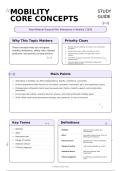
MOBILITY STUDY
GUIDE
CORE CONCEPTS
Adult Medical-Surgical RN | Alterations in Mobility | 2026
Why This Topic Matters Priority Clues
Mobility affects breathing, circulation, skin, elimination,
These concepts help you recognize and ADLs
mobility limitations, safety risks, altered Always assess pain, safety, and ability to move
perfusion, and priority nursing actions. Neurovascular changes are urgent after injury or
surgery
Immobility increases risk for DVT, UTI, pneumonia, and
pressure injury
Clinical judgment means finding the problem that
threatens function first
Main Points
Alterations in mobility can affect independence, dignity, confidence, and safety
Priority assessment often focuses on circulation, sensation, movement, pain, and respiratory status
Postoperative orthopedic clients need neurovascular checks, mobility support, and complication
prevention
Encourage safe activity, assistive devices, privacy, and small achievable mobility goals
Think: What could cause permanent damage, poor perfusion, or loss of function?
Key Terms Definitions
Mobility Mobility ability to move safely and
purposefully.
ADLs
ADLs activities of daily living, such as
Neurovascular bathing and dressing.
Range of motion Neurovascular assessment of nerve and blood
flow function.
Assistive device
Range of motion movement available at a joint.
Clinical judgment
Assistive device tool that supports safe
movement.
Clinical judgment prioritizing care based on client
cues.
1 | Mobility Study Guide
, FRACTURES + STUDY
NEUROVASCULAR GUIDE
CHECKS
Adult Medical-Surgical RN | Alterations in Mobility | 2026
Why This Topic Matters Priority Clues
Assess distal to the injury: pain, pulse, color,
Fracture questions test whether you can temperature, sensation, movement
recognize impaired circulation, nerve Capillary refill should be less than 3 seconds
injury, cast problems, and infection risks Report coolness, pallor, numbness, tingling, weak pulse,
or severe swelling
early. External fixator pin sites are infection risks
Blood flow problem = consider Doppler studies
Main Points
After a fracture, cast, splint, or fixator, compare the affected and unaffected extremities
Normal findings include warm skin, normal color, intact sensation, movement, and controlled pain
Abnormal findings include increasing pain, pale or blue skin, coolness, delayed cap refill, numbness, or
inability to move
For external fixation, assess pin sites for redness, drainage, swelling, warmth, odor, and loose pins
Use OPQRST to assess pain and identify changes that may signal complications
Key Terms Definitions
Fracture Fracture break in bone continuity.
Cast
Cast rigid device used to immobilize
Capillary refill an injury.
Distal pulse Capillary refill time for color to return after
blanching.
External fixation
Distal pulse pulse below the injury site.
OPQRST
External fixation stabilization using pins outside
the body.
OPQRST pain assessment framework.
2 | Mobility Study Guide
GUIDE
CORE CONCEPTS
Adult Medical-Surgical RN | Alterations in Mobility | 2026
Why This Topic Matters Priority Clues
Mobility affects breathing, circulation, skin, elimination,
These concepts help you recognize and ADLs
mobility limitations, safety risks, altered Always assess pain, safety, and ability to move
perfusion, and priority nursing actions. Neurovascular changes are urgent after injury or
surgery
Immobility increases risk for DVT, UTI, pneumonia, and
pressure injury
Clinical judgment means finding the problem that
threatens function first
Main Points
Alterations in mobility can affect independence, dignity, confidence, and safety
Priority assessment often focuses on circulation, sensation, movement, pain, and respiratory status
Postoperative orthopedic clients need neurovascular checks, mobility support, and complication
prevention
Encourage safe activity, assistive devices, privacy, and small achievable mobility goals
Think: What could cause permanent damage, poor perfusion, or loss of function?
Key Terms Definitions
Mobility Mobility ability to move safely and
purposefully.
ADLs
ADLs activities of daily living, such as
Neurovascular bathing and dressing.
Range of motion Neurovascular assessment of nerve and blood
flow function.
Assistive device
Range of motion movement available at a joint.
Clinical judgment
Assistive device tool that supports safe
movement.
Clinical judgment prioritizing care based on client
cues.
1 | Mobility Study Guide
, FRACTURES + STUDY
NEUROVASCULAR GUIDE
CHECKS
Adult Medical-Surgical RN | Alterations in Mobility | 2026
Why This Topic Matters Priority Clues
Assess distal to the injury: pain, pulse, color,
Fracture questions test whether you can temperature, sensation, movement
recognize impaired circulation, nerve Capillary refill should be less than 3 seconds
injury, cast problems, and infection risks Report coolness, pallor, numbness, tingling, weak pulse,
or severe swelling
early. External fixator pin sites are infection risks
Blood flow problem = consider Doppler studies
Main Points
After a fracture, cast, splint, or fixator, compare the affected and unaffected extremities
Normal findings include warm skin, normal color, intact sensation, movement, and controlled pain
Abnormal findings include increasing pain, pale or blue skin, coolness, delayed cap refill, numbness, or
inability to move
For external fixation, assess pin sites for redness, drainage, swelling, warmth, odor, and loose pins
Use OPQRST to assess pain and identify changes that may signal complications
Key Terms Definitions
Fracture Fracture break in bone continuity.
Cast
Cast rigid device used to immobilize
Capillary refill an injury.
Distal pulse Capillary refill time for color to return after
blanching.
External fixation
Distal pulse pulse below the injury site.
OPQRST
External fixation stabilization using pins outside
the body.
OPQRST pain assessment framework.
2 | Mobility Study Guide


